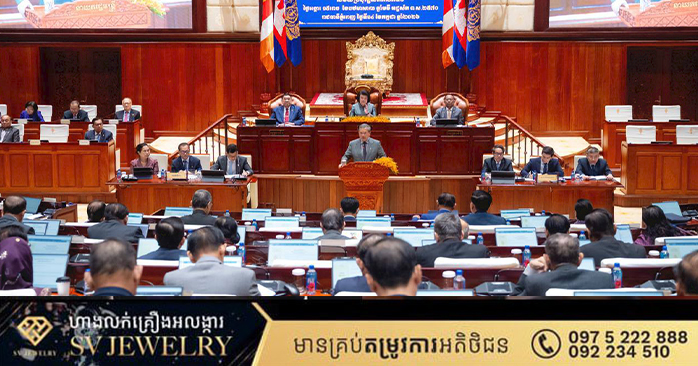
Cambodian National Assembly Approves New Minister and Four Key Economic Bills
Economy
2026年7月14日
5
CEN Cambodia
Relations
🇰🇭Cambodia🌐United Nations / ASEAN

Cambodian National Assembly Approves New Minister and Four Key Economic Bills

AI サマリー

The Cambodian National Assembly has approved the appointment of Prak Samoeun as a Minister Attached to the Prime Minister with Special Mission and passed four draft laws aimed at boosting economic and trade activities in aviation, automotive, and construction sectors, enhancing Cambodia's regional and global competitiveness.

On July 14, 2026, the Cambodian National Assembly convened its 6th plenary session of the 7th legislature. Presided over by Samdech Mahanokor, President of the National Assembly, Kuon Sudary, the session addressed five agenda items. A significant outcome was the successful vote of confidence for one additional member to the government and the approval of four draft laws deemed vital for propelling Cambodia's economy and trade on both regional and global stages. In the governmental appointments, Mr. Prak Samoeun was confirmed as a Minister Attached to the Prime Minister with Special Mission, receiving 108 votes in favor from the present National Assembly members. Furthermore, the National Assembly discussed and ratified four critical draft laws: 1. Draft Law on Ratification of the Convention on International Interests in Mobile Equipment and the Protocol thereto on Matters Specific to Aviation Equipment: This law, comprising two articles, is designed to elevate the civil aviation sector, offering substantial legal and economic advantages. Economically, it is anticipated to lower the cost of aircraft leasing for Cambodian airlines and support their fleet expansion. The draft law garnered 110 votes for approval. 2. Draft Law on Ratification of the ASEAN Framework Agreement on Mutual Recognition Arrangements: This two-article law will serve Cambodia as a member state by establishing a foundation for managing ASEAN committees and working groups. Its objective is to facilitate mutual recognition arrangements for products or services traded within the ASEAN market, thereby promoting the unimpeded circulation of Cambodia's essential products and encouraging improvements in its production systems for better integration into the ASEAN market. It was approved by 110 votes. 3. Draft Law on Ratification of the ASEAN Mutual Recognition Arrangement for Building and Construction Materials: This two-article law is set to yield economic benefits for Cambodia by reinforcing and streamlining trade and the free movement of building and construction material products across the ASEAN market. The National Assembly approved this draft law with 110 votes. 4. Draft Law on Ratification of the ASEAN Mutual Recognition Arrangement for Type Approval for Automotive Products: This two-article law will provide Cambodia with a framework to strengthen and facilitate trade and the free flow of Cambodian automotive products within the ASEAN market. It was approved by 110 votes. These legislative actions are poised to significantly boost Cambodia's economic and trade endeavors, enhancing its competitive standing in regional and international arenas, particularly within the aviation, automotive, and construction industries.

多角的分析

経済的影響

今回の法案可決は、カンボジアがASEAN経済共同体(AEC)内での統合を深め、域内貿易を拡大しようとする戦略の一環と見られる。特に、国際条約の批准は、航空機リースや建設資材、自動車部品などの輸入コスト削減に繋がり、国内産業の競争力向上に寄与する可能性がある。ASEAN相互承認協定は、カンボジア製品の輸出障壁を低減させ、域内市場へのアクセスを容易にするため、輸出主導型の成長を目指すカンボジア経済にとって重要な意味を持つ。これにより、外国からの直接投資(FDI)がこれらの分野で増加することも期待される。

投資家心理

投資家にとって、これらの法案はカンボジアのビジネス環境における予測可能性と安定性を高めるシグナルとなる。特に、国際的な枠組みへの参加は、法的なリスクを低減させ、長期的投資を誘引する要因となり得る。航空分野への投資は、観光客増加や物流コスト削減といったマクロ経済的恩恵と連動するため、関心が高まる可能性がある。建設資材や自動車分野における相互承認は、サプライチェーンの効率化と市場拡大に繋がり、関連企業の収益性向上に寄与すると考えられる。ただし、実際の投資判断には、国内インフラ整備や人材育成の進捗状況も注視されるだろう。

社会的影響

これらの法案は、直接的には産業界に恩恵をもたらすが、間接的にカンボジア国民の生活にも影響を与えると考えられる。例えば、航空分野の発展は、より安価な航空券の提供や、観光客増加による雇用機会の創出に繋がる可能性がある。建設分野の活性化は、住宅建設やインフラ整備を促進し、雇用機会を創出すると同時に、建築資材の品質向上や価格安定に寄与するかもしれない。自動車分野の相互承認は、国内自動車産業の発展を促し、将来的にはより多様な車種の入手や、メンテナンスサービスの向上に繋がる可能性も秘めている。しかし、これらの恩恵が国民全体に均等に行き渡るか、あるいは一部の層に限定されるかは、今後の政策実施にかかっている。

市民の声

今回国会で承認された法案は、カンボジア市民の日常生活に直接的な変化をもたらすものではないかもしれないが、長期的な経済発展を通じて恩恵が及ぶことが期待されている。例えば、航空分野の法整備は、将来的に旅行費用が下がり、より多くのカンボジア人が国内外を旅行できるようになる可能性を示唆している。また、建設分野や自動車分野の発展は、雇用機会の増加や、より質の高い製品・サービスへのアクセス向上に繋がるかもしれない。しかし、これらの恩恵がプノンペンなどの都市部だけでなく、地方の市民にも及ぶかどうかが課題となる。市民としては、経済成長の果実が公平に分配されることを望んでいる。

背景・歴史的文脈

カンボジアは、ASEAN(東南アジア諸国連合)の一員として、地域経済統合の深化を目指している。特に、2015年に発効したASEAN経済共同体(AEC)は、域内でのモノ、サービス、投資、資本、熟練労働者の自由な移動を促進する枠組みであり、カンボジアもその恩恵を最大限に受けるべく、関連法制の整備を進めている。今回の法案は、AECの目標達成に貢献するものであり、特に航空、自動車、建設といったカンボジアが将来的に成長が見込まれる産業分野に焦点を当てている。これらは、インフラ開発や観光産業の発展とも密接に関連しており、カンボジアの経済成長戦略の重要な柱となっている。また、国際的な条約への参加は、カンボジアの国際社会における信頼性を高め、外国からの投資を呼び込むための重要なステップである。

原文ソース

CEN Cambodia

原文を読む