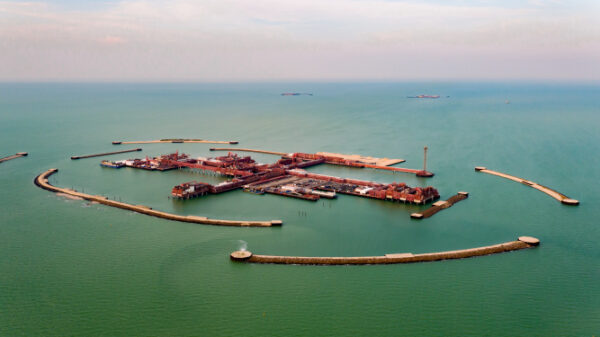
Kazakhstan Freezes Assets of Kashagan Oil Field Operator Over Unpaid Environmental Fine
Diplomacy
2026年7月27日
5
The Diplomat Indonesia

General articles are free for 24 hours after publish.

Kazakhstan Freezes Assets of Kashagan Oil Field Operator Over Unpaid Environmental Fine

Share
AI Summary

Kazakhstan's Ministry of Justice has frozen the assets of the North Caspian Operating Company (NCOC), the developer of the Kashagan oil field, for failing to pay a substantial environmental fine. The NCOC is an international consortium of oil companies, and the government is seeking renegotiation of contract terms and a larger share of profits.

Kazakhstan's Ministry of Justice has imposed a freeze on property and transport assets owned by the North Caspian Operating Company (NCOC), which is developing the Kashagan oil and gas field, for failure to pay a massive environmental fine. This decision follows a protracted back-and-forth between the government and NCOC, a consortium of international oil companies operating one of the country's largest oil fields. The July 21 decision was disclosed three days later, and it remains unclear exactly what kind of property or transport assets were affected. On the same day, Kazakhstan's Ministry of Justice informed NCOC's managing director Giancarlo Ruiu that he would be held responsible for "administrative and criminal liability for non-compliance." In 2023, a local court imposed a 2.3 trillion tenge ($4.9 billion) fine on the consortium for improper sulfur storage. This fine, alongside a dispute over a number of provisions in the contract between the government and NCOC, has become a point of contention within much larger arbitration proceedings. The Kazakh government claims that the conditions of the Kashagan contract are unfair and is now asking for a recalculation of costs and a higher share of profits. Sources familiar with the arbitration proceedings indicate this claim is worth around $165 billion. On July 20, Kazakhstan's state-owned oil company Kazmunaigas, which owns 16.88 percent of NCOC, offered to pay its share of the environmental fine, insiders told Bloomberg. Meanwhile, the international partners in the consortium—Shell, Eni, TotalEnergies, and ExxonMobil, each holding a 16.81 percent stake, along with China's CNPC (8.33 percent) and Japan's Inpex (7.65 percent)—refused. Given the complex and lengthy legal dispute, a UNCITRAL tribunal rejected Kazakhstan’s request to lift restraining measures on the enforcement of the environmental fine, which are in place as long as the arbitration between the parties remains pending. Kazakhstan’s Ministry of Justice replied that the United Nations tribunal cannot limit its sovereign rights to enforce the fine. "An interim order in a commercial arbitration proceeding under UNCITRAL rules does not have automatic effect in Kazakhstan and does not limit the state’s exercise of its sovereign powers to protect the environment and public interests," an official note said. Under Kazakhstan’s new Constitution, hastily approved via referendum on March 15 and in force since July 1, domestic laws have precedence over international obligations. The foreign companies, meanwhile, said that they "consider the sulfur fine to be without any basis and are contesting it by all available means." In 2022, Kazakhstan levied a fine alleging that NCOC had breached its sulfur storage permits. Sulfur is a toxic byproduct of oil extraction and can be used as a component for fertilizers. NCOC sells most of its sulfur to Chinese importers, but a temporary ban on exports led to excessive amounts being stored in addition to the existing stockpile in the summer of 2022. In the past, environmental fines have been used by the government of Kazakhstan to push for better conditions or a revision of existing agreements. Analysts argued that these fines are, in fact, political tools. In 2011, Kazakhstan’s government threatened an environmental fine against Karachaganak, a major gas and condensate field. The consortium sold off a 10 percent stake to Kazmunaigas and the fine disappeared. Seven years later, the foreign consortium operating Karachaganak agreed to pay Kazakhstan a $1.1 billion compensation to end all existing disputes. And yet, in January 2026, the government once again knocked at Karachaganak’s door and asked for an additional $4 billion. The Kashagan deal was struck in 1997 and further amended in 2008. The contract, much like the one signed for Karachaganak, is a so-called production sharing agreement (PSA), which legal experts deem favorable toward private investors. According to the International Consortium of Investigative Journalists, Kazakhstan’s 2023 arbitral claim stated that NCOC "currently receives 98 percent of all post-Priority Payment revenue from oil production." Kazakhstan’s President Kassym-Jomart Tokayev repeatedly urged the government to renegotiate better terms for the PSA and joint venture contracts that concern the largest oil fields. According to analysts, there are ongoing talks of contract overhauls for the three largest oil fields, including Tengiz and Karachaganak. Together, these fields produce the vast majority of Kazakhstan’s oil and represent major tax and hard currency contributors to the country’s budget. Information Source: The Diplomat Indonesia

0

Original source

The Diplomat Indonesia

原文を読む