Vietnam Proposes Streamlining Lao Cai-Hanoi-Hai Phong Railway Project
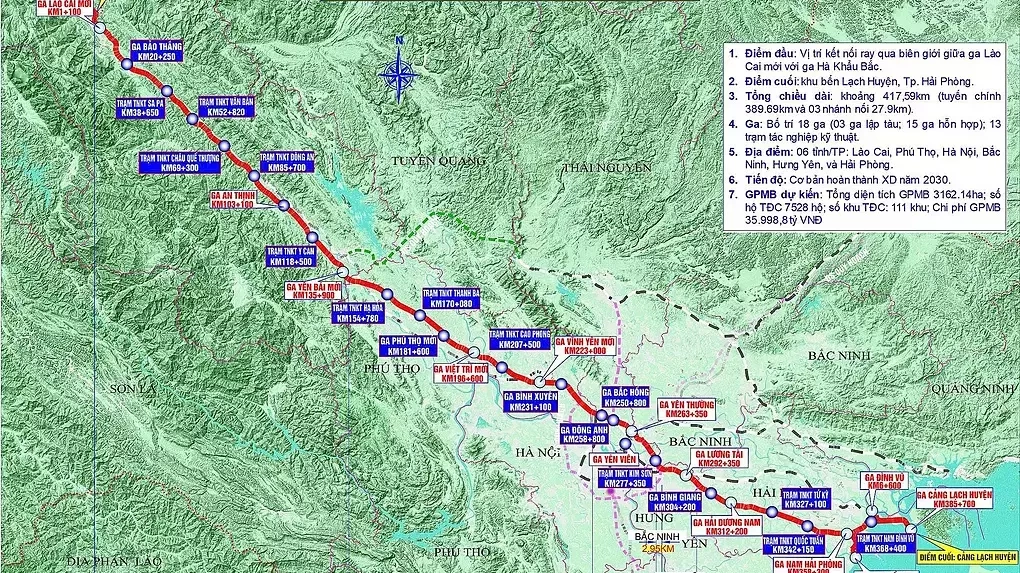
Vietnam's Ministry of Construction has proposed to the government to adjust the investment policy for the Lao Cai-Hanoi-Hai Phong railway project. Key changes include shortening the main line by approximately 27 km, altering the functions of some stations, and designating Nam Hai Phong station as the main line's terminus.
Vietnam's Ministry of Construction has proposed to the government to consider adjusting the investment policy for the Lao Cai-Hanoi-Hai Phong railway project. These adjustments stem from updated development conditions and changes in initial calculation bases during the feasibility study. The proposed modifications, while not altering the fundamental goal of constructing a new railway, will impact the investment scale, route alignment, connection methods, land use, and total investment cost. A significant change involves the main line's terminus. According to the proposal by China Railway No. 4 Survey and Design Institute, cargo from the pre-port stations of Dinh Vu, Lach Huyen, and Nam Do Son will be consolidated at Nam Hai Phong station before forming trains for the main line to Hanoi and Lao Cai. Consequently, Nam Hai Phong station is identified as the main line's endpoint, replacing Lach Huyen station as per the previous plan. The main line's length will be reduced to approximately 362 km, a decrease of about 27 km from the initially approved plan. Conversely, the total length of branch lines will increase to ensure better connectivity. The Ministry of Construction also suggests adding an 8.4 km railway section between Yen Vien and Gia Lam, along with upgrading Gia Lam station, to directly connect with the Lao Cai-Hanoi-Hai Phong railway. Following a proposal from the Hanoi People's Committee, Gia Lam station will serve as the northern passenger terminal hub, while Yen Vien station will function as a technical station. The early investment in the Yen Vien-Gia Lam section is projected to shorten travel times for passengers from Hanoi's city center and generate economic benefits of approximately VND 10.5 billion annually. This segment will also facilitate connections with the existing Hanoi-Hai Phong railway and metro lines, thereby easing road traffic pressure and enhancing the railway network's operational efficiency. Furthermore, the Ministry of Construction proposes adding several branch lines to connect with the existing national railway network. These include a 0.5 km link to Lao Cai station, a 2.7 km connection to the Hanoi-Thai Nguyen line, and a 4.1 km link to the 1000mm gauge Yen Vien-Lao Cai line. These connections are expected to improve the overall network's efficiency and reduce freight handling and transshipment costs. A notable proposal is the immediate investment in a double-track railway from Bac Hong station to Nam Hai Phong station, instead of the original plan of a single track with provisions for future expansion. Investing in a double track now is deemed more economically advantageous and capable of meeting long-term transport demand. This approach is estimated to save over VND 12.58 trillion by avoiding the construction of two separate bridges and eliminating the need for two technical stations, Kim Son and Quoc Tuan, thereby reducing land use by approximately 115 hectares. If approved, the project will feature a new standard gauge (1435 mm) railway accommodating both passengers and freight. The main line will be single-track, except for the Bac Hong to Nam Hai Phong section and the Yen Vien-Gia Lam section, which will be double-track. Design speeds will reach 160 km/h on the main line from the new Lao Cai station to Nam Hai Phong station, 120 km/h for the section through Hanoi, and 80 km/h on other segments. The Lao Cai-Hanoi-Hai Phong railway project was approved by the National Assembly in 2025, with an initial length of approximately 417 km (main line 389 km, branch lines 27.9 km). The total investment was set at VND 203.231 trillion (approximately $8.37 billion USD), with construction slated to begin in 2025 and completion targeted for 2030. The project's starting point was at the rail connection point near the border in Lao Cai province, and its endpoint at Lach Huyen station in Hai Phong. Information Source: VnExpress
多角的分析
今回の鉄道計画の調整は、初期投資の抑制と効率化を目指す動きと見られます。特に、本線の短縮と複線化区間の早期投資は、建設コストの削減と将来的な運行効率の向上を両立させるための合理的な判断と言えます。南ハイフォン駅を終点とする変更は、港湾地区からの貨物集約を効率化し、物流コストの削減に寄与する可能性があります。ベトナム経済の成長に伴う輸送需要の増加に対応するため、インフラ投資は不可欠ですが、同時に財政負担の軽減も重要な課題であり、今回の調整はそのバランスを取る試みと言えます。
投資家にとって、鉄道計画の規模縮小や最適化は、プロジェクトのリスク評価に影響を与えます。当初計画からの変更は、プロジェクトの実行可能性や収益性に関する不確実性を一時的に高める可能性があります。しかし、建設省の提案が示すように、効率化やコスト削減が進めば、プロジェクト全体の魅力は向上するでしょう。特に、複線化区間の早期投資は、将来的な輸送能力の増強と収益性の向上を示唆しており、長期的な視点ではポジティブな要素となり得ます。投資家は、最終的な承認内容と詳細な財務計画を注視する必要があります。
鉄道計画の変更は、沿線住民の生活や土地利用に影響を与える可能性があります。本線の短縮や駅機能の変更は、一部地域での利便性の変化をもたらすかもしれません。一方で、イエンヴィエン-ザーラム間の鉄道建設やザーラム駅の改修は、ハノイ市中心部へのアクセス向上に繋がり、多くの市民の移動をより容易にするでしょう。また、道路交通の負荷軽減は、大気汚染の改善など、都市環境の質向上に貢献することが期待されます。地域社会は、計画の進捗と、それによる生活環境の変化を注視していくことになります。
今回の鉄道計画の調整は、国民生活に直接的な影響を与える可能性を秘めています。特にハノイ周辺では、ザーラム駅の機能強化やイエンヴィエン-ザーラム間の新設により、公共交通機関としての鉄道の利便性が向上し、通勤・通学の負担軽減が期待されます。また、貨物輸送の効率化は、間接的に物価の安定にも寄与する可能性があります。しかし、一部の地域では、計画変更により鉄道へのアクセスが悪化する可能性も考えられ、住民の声がどのように反映されるかが重要となります。
背景・歴史的文脈
ベトナムは、経済成長を加速させるために、長年にわたりインフラ整備、特に交通網の拡充を国家戦略の柱としてきました。ラオカイ-ハノイ-ハイフォン鉄道計画は、中国との国境地帯から北部主要港湾への貨物輸送を効率化し、経済回廊を強化する目的で立案されました。当初の計画は、2025年に承認されたもので、総延長約417km、総事業費約83.7億ドルと大規模なものでした。しかし、建設途中で現地の開発状況や経済状況の変化、技術的な検討が進む中で、より現実的かつ効率的な計画へと見直されることは、ベトナムのインフラ開発プロジェクトにおいてしばしば見られるプロセスです。特に、近年のベトナムは、中国との経済関係を維持しつつも、自国の国益を最大化するために、技術導入や投資案件において柔軟な姿勢を示しています。
原文ソース
VnExpress