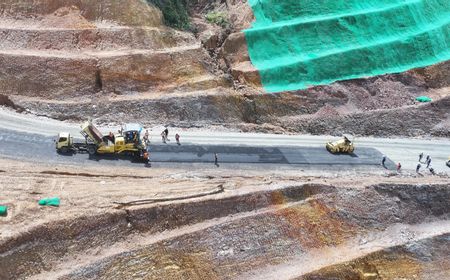
Trans Papua Road Construction Aims to Lower Staple Goods Prices in Papua Highlands
Infrastructure
2026年8月3日
7
VOI English

General articles are free for 24 hours after publish.

Trans Papua Road Construction Aims to Lower Staple Goods Prices in Papua Highlands

Share
AI Summary

Indonesia's Ministry of Public Works is accelerating the construction of the Trans Papua Road (Jayapura-Wamena segment, Mamberamo-Elelim section) to reduce logistics costs and stabilize staple goods prices in the Papua Highlands. The road is expected to be a key artery to end regional isolation and facilitate goods distribution and community mobility.

The Ministry of Public Works is accelerating the construction of the Trans Papua Road to reduce logistics costs and stabilize the prices of basic necessities in the Papua Highlands. Specifically, the Mamberamo-Elelim segment, connecting Jayapura and Wamena with a total length of 50.14 kilometers, is expected to be a key artery to end regional isolation and facilitate goods distribution and community mobility. The Minister of Public Works stated that the development of road and bridge networks is an essential foundation for strengthening connectivity between economic growth centers across Indonesia. This road network development aims to open access for investment, support industrial areas, boost the tourism sector, and strengthen connectivity. The construction of the Mamberamo-Elelim segment is expected to have a direct impact on people's lives, not just facilitating transportation flows. Improved road access is projected to lower cargo transportation costs, potentially making staple goods, which have been relatively high due to transportation difficulties, more affordable. Furthermore, it is expected to promote children's access to school, patients' access to health facilities, the provision of government services, and the creation of new economic opportunities for residents in the Papua Mountains. Construction of this segment began in July 2024 and is targeted for completion in November 2026. As of mid-July 2026, the progress has reached 51.59 percent. The work includes the opening and formation of road bodies, construction of pavement structures, drainage systems, bridges, ancillary buildings, earthworks, slope protection, installation of road equipment, and the construction of a Motor Vehicle Weighing Unit. This segment's construction faces significant challenges as it traverses mountainous areas with steep cliffs, dense forests, high rainfall year-round, and areas prone to landslides. The mobilization of heavy equipment and construction materials also requires special handling due to limited access to the project site. To overcome these challenges, the Ministry of Public Works has implemented various modern technologies in the planning and construction process. Route planning utilizes satellite-based RTK-GNSS technology combined with LiDAR survey technology for more accurate topographic data. Detailed geotechnical surveys are also conducted, and construction methods are adapted to field and weather conditions. In landslide-prone areas, slope drainage systems, cliff stabilization, installation of retaining structures, revegetation, and periodic monitoring of slope conditions are implemented to maintain the safety and sustainability of the road's function. The Trans Papua Road Project also generates economic benefits during the construction period through the involvement of local communities. To date, 116 local workers, or approximately 28 percent of the total project workforce, have been involved in the construction of the Mamberamo-Elelim section, as part of efforts to empower the economy of the Papuan community. Through the construction of the Trans Papua Road, the Ministry of Public Works hopes to strengthen connectivity between Papua Province and Papua Highlands Province, improve logistics efficiency, reduce transportation costs, and enhance access to education, health services, and economic activities. The benefits of infrastructure development are expected to be directly felt by the community through improved welfare and more affordable staple goods. Source: VOI English

0

Original source

VOI English

原文を読む