Junta Suffers Heavy Losses in Month-Long Southern Chin State Fighting
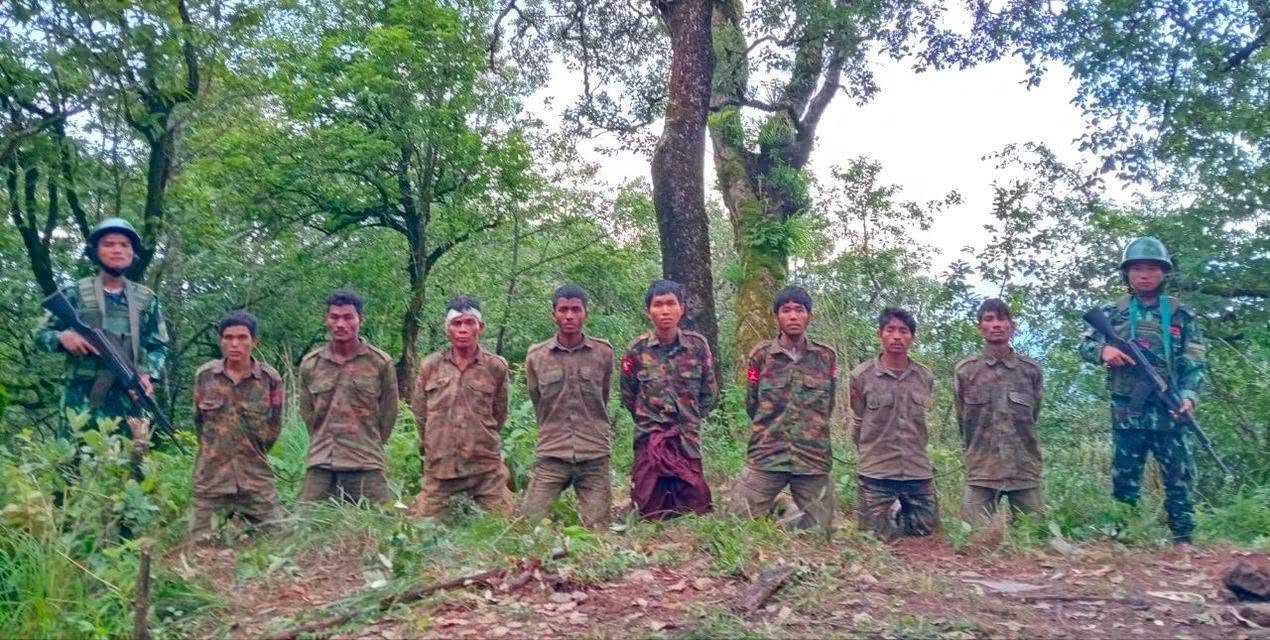
The Myanmar military junta has suffered heavy casualties and seen several of its assault columns fall into disarray during more than a month of fierce fighting in southern Chin State, where the Chin People’s Army (CPA) and allied resistance groups have mounted a sustained counteroffensive, according to the Chin People's Union (CPU). The clashes began on May 16, after junta forces launched offensives into Mindat and Kanpetlet townships. The CPA, the armed wing of the CPU, responded with coordinated counterattacks alongside allied resistance groups, reportedly inflicting hundreds of casualties on regime troops. The CPU stated that several junta columns collapsed under intense pressure, forcing a chaotic retreat. Throughout the campaign, the CPA has fought alongside allied groups from the neighboring Yaw region of Magway Region, including the Yaw Defence Force (YDF) and the Yaw Army (YA). The Yaw area covers Saw, Kyaukhtu, and Tilin townships along the border between Chin State and Magway Region. In a statement released on July 2, the CPA announced that resistance forces had recovered numerous bodies of regime soldiers, captured several prisoners of war (PoWs), and seized significant quantities of weapons and ammunition. While the official statement did not explicitly mention it, frontline sources indicate that the Arakan Army (AA) has also been actively participating in these combat operations in southern Chin State. In response to its setbacks on the ground, the junta has intensified its attacks, targeting not only resistance positions but also villages and civilian infrastructure with round-the-clock airstrikes, artillery shelling, and drone bombardments. "Junta aircraft have been conducting strikes every single day since the fighting began," a Mindat resident reported. "Around 4:30 a.m. on June 30, two fighter jets from the Tada-U Air Base in Mandalay dropped eight bombs across four locations east of Mindat. Shortly after, a Y-12 transport aircraft arrived and dropped over 40 additional bombs. Ground clashes are still ongoing daily." Locals added that within a 24-hour period spanning June 30 and July 1, junta fighter jets and Y-12 aircraft dropped more than 100 bombs on Mindat Town alone. These relentless strikes on civilian areas have killed dozens of innocent people, including women and children, while destroying numerous homes and religious buildings. On June 29, a junta airstrike on a village near Mindat instantly killed three young girls under the age of 10 from the same extended family. "The more the junta loses on the ground, the more it relies on airstrikes. The regime is deliberately bombing civilian villages that have no connection to the fighting," said another Mindat resident who recently fled his home. "What did those innocent children ever do to deserve this? People are now too afraid to stay in their villages. They have fled into the forests to build makeshift shelters, but even those temporary camps are being systematically targeted." According to the Chin Human Rights Organization (CHRO), the junta conducted at least 440 airstrikes in Mindat Township between April 11 and June 22, documenting up to 91 separate bombing raids on a single day. The military's large-scale offensive in southern Chin State appears aimed at recapturing Mindat and Kanpetlet—two strategically vital towns along the primary route connecting Chin State, Magway Region, and Arakan State. The junta is currently deploying an estimated 250 troops toward Kanpetlet and over 800 around Mindat, with fierce fighting expected to persist. This southern push comes even as the military, having recently regained control of the northern Chin State towns of Falam and Tonzang, prepares another drive toward Rihkhawdar, a key border trade town on the Indian frontier. Currently, resistance forces control Mindat, Kanpetlet, Matupi, Cikha, Rihkhawdar, Lai Len Pi (Lialaipi), Kyawtwee (Kyindwe), M'Kuiimnu, Hnaring, Rezua, and Surkhua in Chin State, while the Arakan Army (AA) maintains control over Paletwa and Samee. Meanwhile, the junta retains control of the state capital, Hakha, as well as Falam, Thantlang, Tedim, Khaikam, Webula, and Tonzang.
This article requires PRO
This article is outside the free access window or is a special report. PRO unlocks it and the full archive.
Related articles
- Myanmar military deploys troops to Ywangan village, restricts male residents
The Myanmar military has deployed nearly 100 troops to Nwar Ban Gyi village in southern Shan State's Ywangan Township, restricting male residents from leaving the area and compiling detailed household rosters, according
- 87 individuals involved in online fraud and gambling arrested in Hopone
The Myanmar Police Force announced that 87 individuals involved in online fraud and gambling were arrested along with business equipment near Narlong Village, Hopone Township, Shan State South. On the morning of October
- Over 10 Billion Kyats Worth of Narcotics Seized in Leway
Over 10 billion kyats worth of methamphetamine tablets and heroin powder were seized from a 12-wheel vehicle in Leway Township, Naypyidaw, the Myanmar Police Force announced. A joint team including members of the Anti-Na
- Surrenders and internal friction reported among resistance ranks in Sagaing Region
At least 30 members of the People’s Defence Force (PDF), as well as another 30 members of unnamed resistance forces, surrendered to the military in Sagaing Region’s Shwebo, Monywa and Chaung-U townships over the past two