General articles are free for 24 hours after publish.
Hun Sen Comments on Thai Article Regarding Maritime Border Dispute
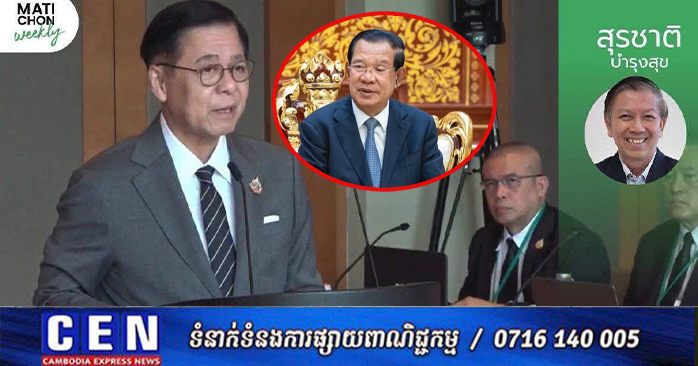
Cambodia's acting head of state, Hun Sen, has taken note of an article in a Thai weekly newspaper concerning the maritime border dispute. He shared the article, hoping it would enhance understanding between the two nations' citizens, refraining from personal commentary and leaving judgment to the readers. The article critiques Thailand's diplomatic approach in light of its domestic politics.
Acting Cambodian Head of State Samdech Techo Hun Sen announced on social media on September 19, 2026, that he was interested in an article by Professor Surachart Bamrunsuk titled "Satisfied, But Not Yet Won!" published in the Thai weekly Matichon Weekly. He stated that he had unofficially translated the article to share with the citizens of both Cambodia and Thailand for further understanding, and would refrain from making any further comments, leaving the interpretation to the public. The article highlights that the maritime border dispute between Thailand and Cambodia remains a topic of significant interest in Thailand, particularly in certain media outlets. The recent focus is on the first meeting of the "UNCLOS Thailand-Cambodia" Compulsory Conciliation Commission on the maritime dispute between Thailand and Cambodia, held in Singapore from September 14 to 16. This forum is considered crucial for ASEAN, and the commission's views are expected to hold significant weight in resolving the maritime conflict between Thailand and Cambodia. However, the article notes that the Thai side is reassuring itself that these views will not impose legal obligations on Thailand. The article questions Thailand's aggressive stance at the outset of the meeting, suggesting it should have been an opportunity to showcase leadership and direction to the international community and media, creating a "good image." It also points out the stark difference between domestic and international forum perceptions, asserting that international bodies are less interested in the details of confrontations, as claimed by the Thai representative, and more focused on how disputing parties can end their conflicts. Furthermore, it suggests that international forums prioritize the potential for parties to find common ground over moralistic issues like "sincerity." The article sarcastically remarks that if Thailand's Foreign Minister's use of "insults" in international forums were truly effective, international negotiation studies would be obsolete, replaced by "eloquent speakers." It suggests that Thai politicians might be clinging to nationalism to gain political support, a tactic potentially useful in 2025, but argues that 2026 should be a year for problem-solving and extricating Thailand from the "Cambodia war trap." The conflict, it contends, offers no strategic benefits to Thailand and severely impacts its domestic economy. While nationalism might have served as a tool for generating support for the government in the 2025 elections, the article posits that 2026 should be dedicated to resolving issues and escaping the "Cambodia war trap." Thai politicians and media, trapped by nationalism, should question whether the Thai Foreign Minister's pronouncements in Singapore yield diplomatic benefits or merely serve as internal political communication. Ultimately, the article concludes that Thailand's approach of "insulting Cambodia" significantly degrades its diplomatic image compared to Cambodia, serving no national interest. The contrast between Thailand's aggressive posture and Cambodia's moderate, principled stance reinforces the image of Thailand as the "aggressor" and Cambodia as the "victim." Source: CEN Cambodia
Original source
CEN Cambodia