General articles are free for 24 hours after publish.
Indonesian President Pitches Country as Russia's 'Gateway' to Southeast Asia
Indonesian President Prabowo Subianto proposed his country as Russia's 'gateway' to Southeast Asia at the Eastern Economic Forum in Vladivostok, urging closer trade and investment ties. The nations have deepened relations, including Indonesia joining BRICS and signing an FTA with the Eurasian Economic Union.
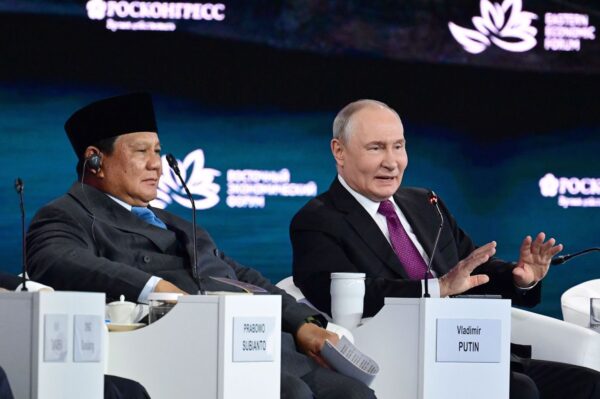
Read The Diplomat, Know The Asia-Pacific Speaking at the Eastern Economic Forum in Vladivostok, Prabowo Subianto described his country as “a natural entry point to ASEAN” for investors. Indonesian President Prabowo Subianto and Russian President Vladimir Putin take part in a plenary session at the Eastern Economic Forum in Vladivostok, Russia, Sept. 3, 2026. Indonesian President Prabowo Subianto yesterday described his country as Russia’s gateway to Southeast Asia, as he pushed for closer trade and investment ties between the two nations. Speaking at the Eastern Economic Forum (EEF) in Vladivostok alongside Russian President Vladimir Putin, Prabowo urged Russian businesses to invest in Indonesia, stating that the Pacific should become a “highway between our two economies.” “For Eurasian businesses, Indonesia is a natural entry point to ASEAN,” Prabowo said, according to a report by the Straits Times. He described the two nations as having ” very profound and important historical ties that have lasted for more than five decades” and said that Moscow was “an important partner” for Jakarta. Prabowo apologized to Putin for having skipped the ASEAN-Russia Commemorative Summit in Kazan in June, which was attended by leaders from 10 of ASEAN’s 11 member states, and joked that he was paying off my ‘debt’ now by coming to Vladivostok.” Prabowo also extended an invitation for Putin to visit Indonesia at some point in the future. In his own address at the EEF, which was established in 2015 with the aim of drawing investment into the underdeveloped Russian Far East, Putin emphasized the importance of Russia’s relationship with Asia in general and Indonesia in particular. He said that the Asia-Pacific “is a powerful centre of growth and sets the pace for the development of the entire global economy.” “Russia is an active participant in investment and trade cooperation in the Asia-Pacific region,” he added. “We interact as equals with our partners and with the region’s leading integration groupings.” Putin also told Prabowo that he regarded Indonesia as “one of Russia’s trusted friends in ASEAN.” Prabowo was the EFF’s main guest of honor, a year after he was accorded the same privilege at the St Petersburg International Economic Forum. Prabowo’s trip to Vladivostok is the second trip he has made to Russia this year, following a visit in April, and the fifth time that he has met with Putin since taking office in late 2024. All of this testifies to the recent growth in the relationship between Jakarta and Moscow, albeit from a relatively low base. Bilateral trade came to just $4.8 billion in 2025, up 21.7 percent from a year earlier, according to Indonesian statistics cited by the Straits Times. However, both sides seem to believe that there is a lot of unfulfilled potential in the relationship, and have taken substantial steps to augment their trade, investment, and security ties. Since Prabowo took office, Indonesia has joined BRICS and signed a free trade agreement with the Russia-dominated Eurasian Economic Union, a grouping that also includes Armenia, Belarus, Kazakhstan, and Kyrgyzstan. The two nations also upgraded their relationship to a strategic partnership in December 2025. Russia’s bid for closer defense, economic, and nuclear relations with Indonesia is a clear attempt to strengthen its influence in the Global South and reduce the effectiveness of Western efforts to isolate the country since its invasion of Ukraine in early 2022. For Indonesia, a closer relationship with Russia is an important component of Prabowo’s policy of assertive non-alignment, which seeks improved relations with nations of all geopolitical persuasions. In a post on X, Indonesian Foreign Minister Sugiono said that Indonesia’s participation in the EEF “reflects our commitment to deepening mutually beneficial and concrete cooperation including in trade, investment, energy, and other strategic sectors.” He added, “Guided by our independent and active foreign policy, Indonesia will continue to engage with all partners and build bridges across regions to deliver tangible benefits for our people, Indonesian Foreign Minister Sugiono said in a post on X. Subscribe today and join thousands of diplomats, analysts, policy professionals and business readers who rely on The Diplomat for expert Asia-Pacific coverage. Get unlimited access to in-depth analysis you won't find anywhere else, from South China Sea tensions to ASEAN diplomacy to India-Pakistan relations. More than 5,000 articles a year. Already have an account? Log in. Sebastian Strangio is Southeast Asia editor at The Diplomat. Get briefed on the story of the week, and developing stories to watch across the Asia-Pacific.
Original source
The Diplomat Indonesia