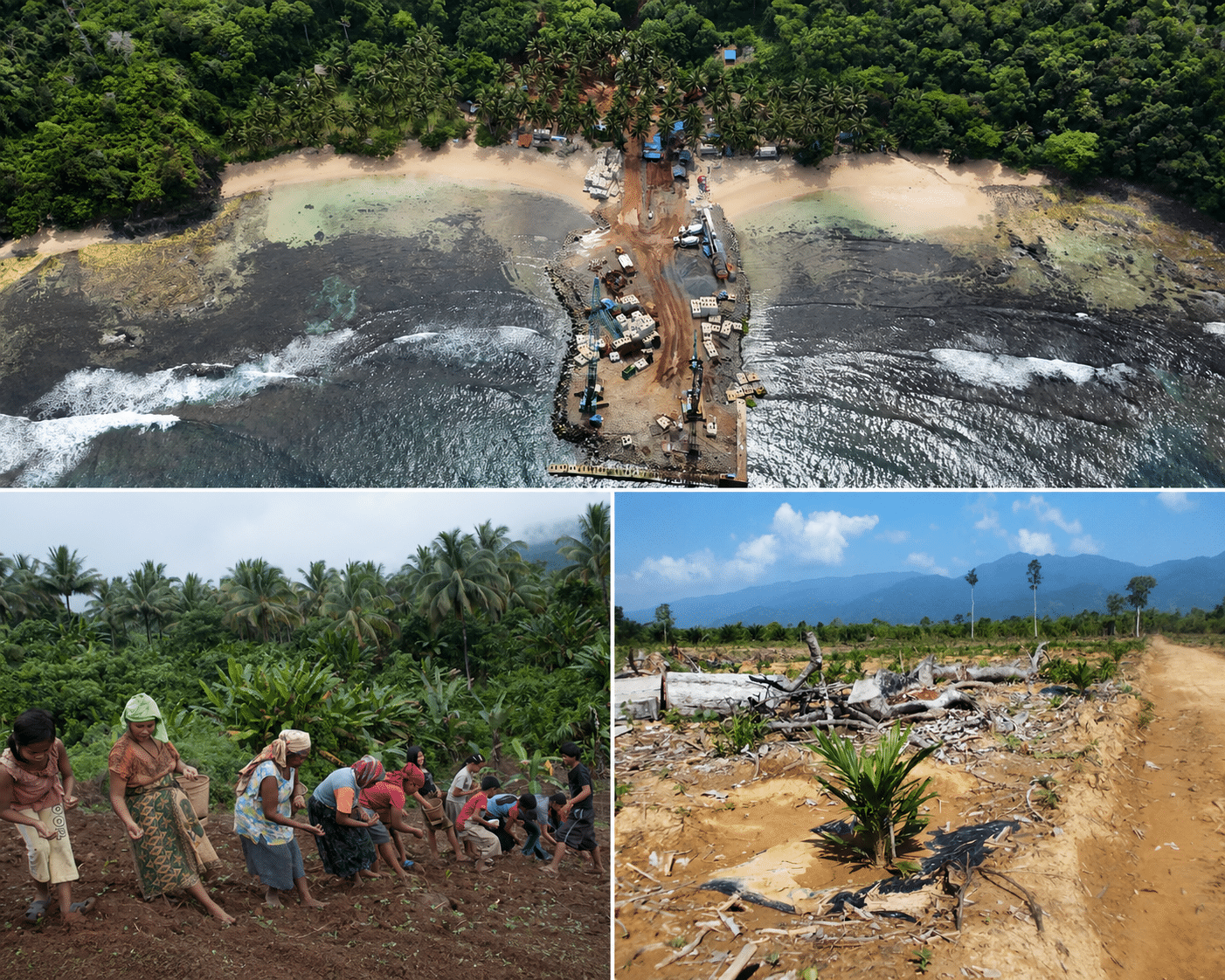
Palawan Forest Loss Attributed to Kaingin; Environmental Group Disputes Simple Framing
Southern Palawan lost 57,715 hectares of forest between 2001 and 2023, with slash-and-burn agriculture (kaingin) cited as the primary cause by the Palawan Council for Sustainable Development (PCSD). However, an environmental group cautions against oversimplifying the issue.
Southern Palawan lost 57,715 hectares of forest from 2001 to 2023, with kaingin, or slash-and-burn agriculture, accounting for most of the loss, the Palawan Council for Sustainable Development (PCSD) said, even as an environmental group cautioned against treating the practice as a catch-all explanation for deforestation. Citing a study conducted by the Palawan Council for Sustainable Development Staff, Holy Trinity University and Western Philippines University, PCSD said kaingin accounted for 44,698 hectares, or 77.4 percent, of the forest loss recorded within the Environmentally Critical Areas Network (ECAN) core and buffer zones. But the Save Palawan Movement (SPM) said recent public communications and studies, including those released by PCSDS, risk oversimplifying a complex ecological and governance issue by framing kaingin as the principal driver of forest loss. SPM said such interpretations, while grounded in data, could lead to misleading conclusions if not properly contextualized. PCSD identified other drivers of forest loss, including perennial crops, which accounted for 4,652 hectares, or 8.1 percent; mining areas covered by mineral production sharing agreements, 1,388 hectares, or 2.4 percent; annual crops, 1,121 hectares, or 1.9 percent; inland water, 738 hectares, or 1.3 percent; bare land, 583 hectares, or 1 percent; built-up areas, 446 hectares, or 0.8 percent; and other causes, 4,089 hectares, or 7.1 percent. “These figures are more than just numbers on a map,” PCSD said in a statement. “They represent a complex shift in our land-use patterns. As agricultural practices intensify and the needs of our communities evolve, we are seeing a direct impact on our natural landscapes.” PCSD, the government body tasked with promoting sustainable development and environmental protection in Palawan, said the problem could not be solved by “pointing fingers,” but by addressing its root causes. It cited the need to create sustainable livelihood alternatives, support communities in shifting to resilient farming methods, and build inclusive land-use policies that work with people rather than against them. The council said the findings were validated using the 2001-2023 Global Forest Change data from the University of Maryland’s Global Land Analysis and Discovery program, in partnership with NASA and Google; Mineral Production Sharing Agreement data from the Department of Environment and Natural Resources-Mines and Geosciences Bureau; the National Mapping and Resource Information Authority’s 2020 Land Cover Map; and the PCSDS 2024 Kaingin Extent Map. SPM said it recognizes that forest loss is a critical and urgent concern and that unsustainable land-clearing practices, regardless of form, must be addressed. However, the group said attributing most forest loss primarily to kaingin, without distinguishing among land-use types and the actors involved, risks obscuring broader structural drivers and weakening accountability. According to SPM, kaingin, as traditionally practiced by Indigenous Peoples, is a form of swidden agriculture governed by customary law and ecological knowledge systems. The group cited Republic Act No. 8371, or the Indigenous Peoples’ Rights Act, saying Section 3(b) recognizes swidden farms as part of ancestral lands, while Sections 7(b) and 51 affirm the rights of Indigenous communities to manage and use their lands according to traditional practices. These provisions establish that kaingin, within its proper cultural and ecological context, is a legally protected and historically rooted land-use system and is not inherently destructive, SPM said. The group said it is critical to distinguish between rotational swidden agriculture and other forms of forest clearing that are often broadly labeled as kaingin. Traditional swidden agriculture is typically small-scale and cyclical, allowing natural regeneration and the formation of landscape mosaics that include cultivated fields and regenerating forests, SPM said. Other forms of forest clearing, it added, may involve permanent land conversion, commercial expansion, speculative occupation or externally driven extraction. “Conflating these fundamentally different practices under a single category risks misrepresenting the data and unfairly shifting responsibility onto Indigenous Cultural Communities and upland communities,” the group said. SPM also cited a 2016 review led by Wolfram Dressler, a University of Melbourne associate professor who studies Indigenous livelihoods, environmental policy and swidden agriculture in the Philippines. The review, which covered 93 studies across Southeast Asia, found that long-fallow swidden systems can sustain both livelihoods and ecosystem functions, and that policies forcing transitions away from swidden have often been misguided. The same body of research identified land-use policies, market forces and population dynamics as major drivers of landscape change, showing that forest loss cannot be explained by a single factor, SPM said. Given this, SPM said the classification of 77.4 percent of forest loss as kaingin warrants closer examination. “Without transparency on how land-clearing activities are defined, detected and attributed, there is a risk that diverse and structurally different drivers are being aggregated under a single label.” “A science-based approach requires not only data, but also clarity in interpretation,” it added. SPM said the issue has become more urgent following public concern over mining-linked tree cutting that initially involved more than 218,000 trees and has since reportedly exceeded 300,000. If forest loss is occurring at such scales, the group said, a comprehensive and disaggregated accounting of all drivers is necessary to ensure informed public discourse and institutional accountability. Protecting Palawan’s forests requires a balanced approach that includes rigorous science, respect for Indigenous knowledge systems, secure land tenure and accountability across all sectors, SPM said. “The protection of Palawan’s forests demands not only enforcement, but fairness, historical understanding, and a commitment to sustainable practices that benefit both people and the environment.”
多角的分析
パラワン島の森林減少は、単に農業活動の結果として片付けられるべきではない。焼畑農業(カインギン)が主因とされているが、その背景には、持続可能な代替生計手段の不足や、地域経済における市場の圧力、さらには鉱業開発のような大規模な土地利用変更が複合的に作用していると考えられる。特に、鉱業関連の土地利用が森林減少の2.4%を占めるという事実は、環境規制の執行力や、経済開発と環境保護の間のトレードオフが依然として大きな課題であることを示唆している。これらの要因が、地域住民の経済的困窮と結びつき、結果として森林への依存度を高めている可能性が高い。
パラワン島の森林減少問題は、投資家にとって環境・社会・ガバナンス(ESG)リスクの観点から注視すべき事案である。特に、環境保護団体が指摘するような、焼畑農業の単純化されたラベリングは、問題の根本原因である土地利用政策や市場の力、さらには鉱業開発といった構造的な要因への投資家の注意をそらす可能性がある。鉱業セクターへの投資は、環境影響評価や地域社会との関係性、そして将来的な規制強化のリスクを慎重に評価する必要がある。また、持続可能な農業やエコツーリズムなど、環境負荷の低い分野への投資機会も同時に検討されるべきだろう。
パラワン島における森林減少問題は、先住民コミュニティの権利と伝統的な土地利用慣行に直接的な影響を与えている。環境保護団体SPMが指摘するように、伝統的な焼畑農業(カインギン)が、より大規模で破壊的な土地利用形態と混同されることは、先住民文化への誤解を招き、彼らの土地利用権を侵害する危険性を孕んでいる。例えば、ブルックポイントの先住民パラワン族の農民が upland rice を栽培する光景(写真参照)は、彼らの伝統的な生活様式を示唆しているが、これが「カインギン」として一括りにされ、環境破壊の主犯と見なされることは、彼らの生活基盤や文化遺産を脅かす可能性がある。また、アボルランの鉱業開発による人工的な堤防(写真参照)は、開発が地域社会の環境や景観に与える物理的な影響を示しており、これは先住民だけでなく、地域住民全体の生活環境の悪化につながりうる。
パラワン島の森林減少問題は、地域住民、特に先住民コミュニティの生活に直接的な影響を与えている。PCSDが焼畑農業(カインギン)を森林減少の主因と発表したことは、伝統的な農法を営む住民にとって、不当なレッテル貼りに繋がりかねない。例えば、ブルックポイントで upland rice を栽培する先住民パラワン族にとって、彼らの慣習法に基づく農法が、単なる「焼畑」として片付けられ、環境破壊の責任を負わされることは、生活の糧を奪われかねない事態である。また、アボルランにおける鉱業開発による人工的な堤防の存在は、開発が地域住民の生活環境に与える物理的な影響を示しており、これが将来的な土地利用や資源へのアクセスにどのような影響を与えるのか、住民は不安を感じているだろう。
背景・歴史的文脈
パラワン島は、フィリピン国内でも有数の生物多様性を誇る地域であり、ユネスコ生物圏保護区にも指定されている。しかし、経済開発の圧力、特に鉱業や大規模農園開発、そして伝統的な焼畑農業(カインギン)が、長年にわたり森林減少の要因として指摘されてきた。過去には、これらの開発プロジェクトが環境基準を満たしていないとして、環境保護団体からの批判も相次いでいる。今回のPCSDの発表は、森林減少の主要因をカインギンと特定したが、環境保護団体は、この定義が曖昧であり、より構造的な問題を見えにくくしていると警鐘を鳴らしている。これは、フィリピンにおける開発と環境保護の間の緊張関係が、パラワン島においても依然として続いていることを示唆している。
原文ソース
Inquirer NewsInfo