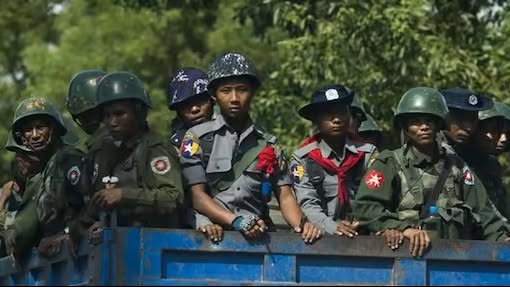
Provisional Government Army preparing to restructure police force into military model due to declining military academy admissions
Security
2026年7月6日
1
Ayeyarwaddy Times

Provisional Government Army preparing to restructure police force into military model due to declining military academy admissions

AI サマリー

The examination and editing committee of the Provisional Government Army's military academy is currently preparing to restructure the police force into a military model, including changes to uniforms and appearance, as w

The examination and editing committee of the Provisional Government Army's military academy is currently preparing to restructure the police force into a military model, including changes to uniforms and appearance, as well as organizational changes and mobilization activities, due to an extreme decrease in those wishing to join the military. This was learned from sources. While the military has its military academy, the police force has only had the Police Science, or Police Officer Training School, which was at the level of the Provisional Government Army's OTS (Officer Training School) and was organized at a lower tier. According to recent preparations, the Police Science in Zibingyi is being prepared to be upgraded to a "Police Academy" in the coming year 2028, and the current Police Officer Training School will be relocated and opened within the Taungoo Military Command, according to police sources. Regarding the ongoing organizational restructuring, a source told the Irrawaddy Times, "At the current Police Academy, promotions will be made similar to the military." Graduates of the Police Academy will be promoted under the Time Scale system with defined periods, similar to military academy graduates, and will be directly assigned to police regiments. Graduates of the Provisional Government Army's Officer Training School are eligible for promotion under the Time Scale system from Second Lieutenant to Colonel, receiving two stars after one year of graduation and three stars after three years. However, police officers within the police force tend to take longer to get promoted than in the military. CDM Major Zin Yaw told the Irrawaddy Times, "When attending combat training alongside police officers, even though the ranks were the same, we had to call them 'senior police officers.' Their ages also differed. In terms of promotion, it was lower than the military. The military is organized at a lower tier." Currently, due to the extreme decrease in those wishing to join the military, preparations are underway to desperately implement changes in appearance, uniforms, and mobilization. It is understood that by relocating and upgrading training schools to Zibingyi and Taungoo Military Command as is happening now, cooperation between the police and the military can be made more stringent, and this is a step to compensate for the decrease in personnel by transforming the police force into a military model.

多角的分析

経済的影響

直接の経済ニュースではありませんが、治安と司法の信頼は地域経済の土台です。職場での暴力や未成年者保護への不安が強まると、夜間営業、観光、雇用、地域サービス業のリスク認識が高まります。

投資家心理

投資家目線では、個別事件よりも法執行の予見可能性が焦点です。加害者への対応が曖昧になれば、ローカルビジネスの統治リスクや従業員保護の弱さとして評価されやすくなります。

社会的影響

警察官養成学校で問われるのは、加害者個人だけでなく、雇用主、警察、近隣社会が被害のサインをどう扱ったかです。軍が声を上げたことで、事件は噂話ではなく、記録され検証される公共問題に変わります。

市民の声

市民にとっては、自分や家族が被害に遭った時に公正な手続きへアクセスできるのかが最大の関心です。地域団体が声を上げることで、事件の風化を防ぎ、被害者側の孤立を和らげる意味があります。

背景・歴史的文脈

このニュースは、ミャンマーの地域社会で法の支配と弱者保護がどこまで機能しているかを映す事案です。暴力事件そのものに加え、女性団体や市民社会が司法手続きを求めて声を上げている点が重要です。軍政下では警察・司法への信頼が揺らぎやすく、個別事件が地域の不安や統治への不信に直結します。

原文ソース

Ayeyarwaddy Times

原文を読む