ABC Scam Centre Report Sparks Debate on Reporting Ethics from Disputed Cambodia-Thailand Border
Security
2026年6月30日
5
Phnom Penh Post
Relations
🇰🇭Cambodia🇹🇭Thailand🇦🇺Australia

ABC Scam Centre Report Sparks Debate on Reporting Ethics from Disputed Cambodia-Thailand Border

AI サマリー

An Australian television investigation into a scam compound near the Cambodia-Thailand border has ignited a debate in Cambodia over journalistic ethics, specifically regarding the provision of geographical and political context in reports from disputed territories.

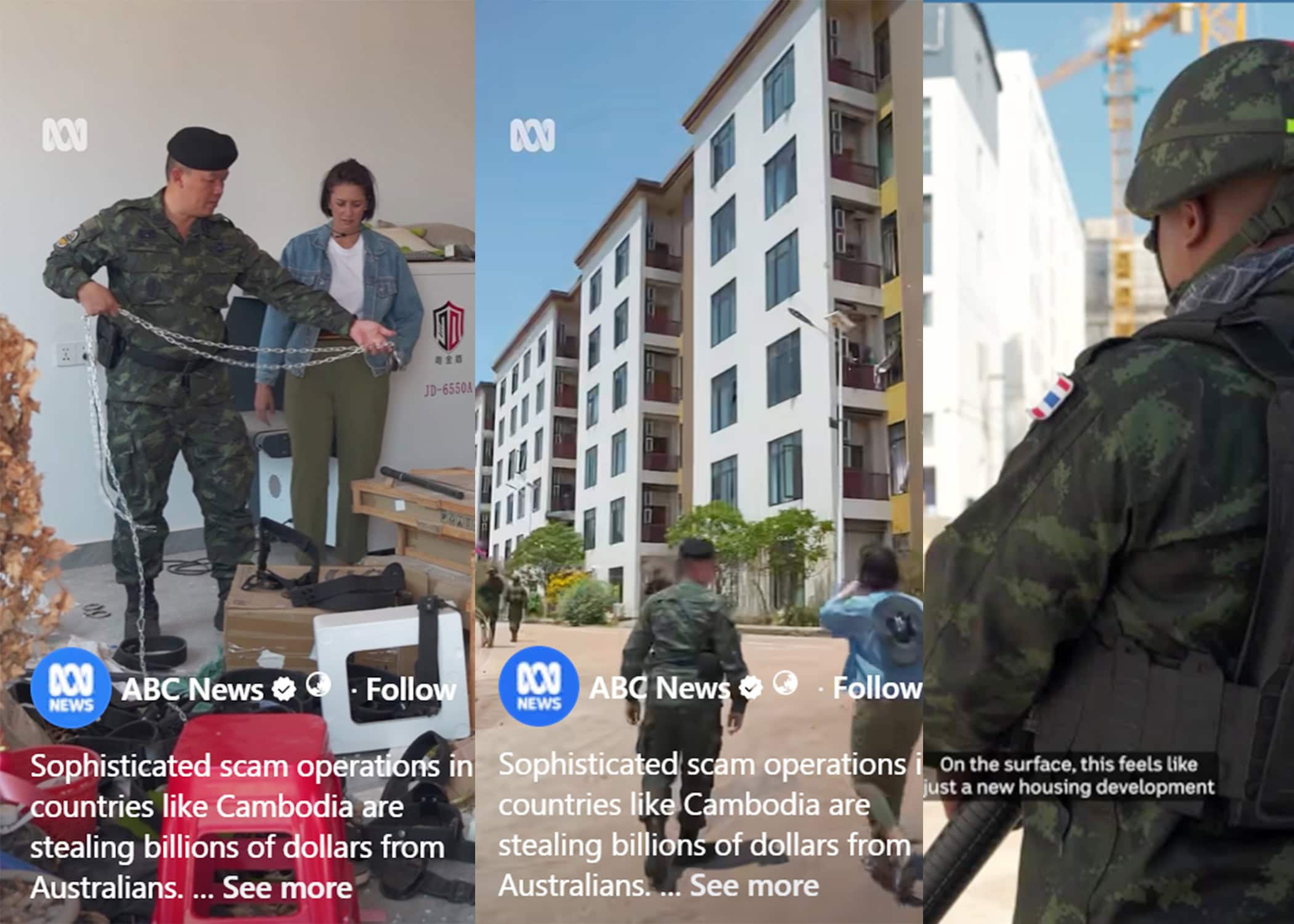
An Australian television investigation into an alleged online scam compound in O’Smach has sparked debate in Cambodia over whether international journalists should provide greater geographical and political context when reporting from disputed border areas, even when the primary focus is transnational crime. The discussion follows a report by ABC News that gained rare access to what it described as a scam compound on the Cambodia-Thailand border, where Australian journalist Karishma Vyas documented evidence allegedly left behind by criminal syndicates targeting victims overseas. The report showed buildings fitted with barred windows, surveillance cameras, stacks of victim lists, scripts allegedly used to impersonate Australian Federal Police officers, handcuffs, batons and blood-testing equipment. It also featured basement rooms described as detention and torture cells, allegedly for workers who failed to meet scamming quotas. Throughout the report, the ABC crew appeared to be escorted by Thai military personnel, one of whom explained documents he said contained instructions for scam operators on how to deceive victims. While the investigation has drawn attention for exposing the operations of transnational cybercrime syndicates, it has also prompted differing views among Cambodian media professionals and government officials over whether the report adequately reflected the sensitivity of the location where it was filmed. The debate comes against the backdrop of Cambodia’s longstanding position that the compound lies within its sovereign territory but has remained under Thai military occupation since border clashes in late 2025. In a diplomatic note issued on February 3, the Ministry of Foreign Affairs and International Cooperation lodged what it described as its strongest protest against Thailand after Thai military intelligence officials escorted foreign military attachés and law enforcement representatives to inspect two hotels in O’Smach district without Cambodia’s consent. According to the ministry, the hotels are located about 397 metres from the O’Smach International Border Checkpoint near Border Pillar No. 15 and lie within an area Cambodia says was occupied by Thai armed forces during military operations between December 7 and 27, 2025. Phnom Penh argued that organising visits to the area constituted an unlawful exercise of Thai sovereignty and an attempt to legitimise its occupation of Cambodian territory. Club of Cambodian Journalists (CCJ) president Puy Kea said the ABC report itself was not inaccurate in exposing online scam operations, an issue that has become a global concern. However, he argued that the report failed to explain that the location where the journalists were taken is a disputed area which Cambodia considers part of its sovereign territory. Puy Kea said omitting such context could leave international audiences unaware that the report was conducted in a politically sensitive area under the guidance of Thai military personnel. Cambodian Journalists Alliance Association (CamboJA) executive director Nop Vy, however, said the report remained focused on documenting scam operations rather than addressing competing territorial claims. “If I look at ABC’s report, its primary focus is the scam centre. It did not say whether the land belongs to Cambodia or Thailand,” he told The Post. “From a journalism perspective, it would only become problematic if the reporter explicitly stated that the land belonged to Thailand or identified it as Cambodian territory occupied by Thailand. But the report did not make such claims,” he added. He said journalists should avoid making assertions over territorial ownership unless such issues are central to the story and can be independently verified. “In this kind of case, journalists should not claim whose land it is. They should report verified facts. That is the correct journalistic approach,” he said. He added that the report’s principal objective was to reveal the activities of scam centres and the abuses associated with them rather than the sovereignty dispute. The Ministry of Information offered a more critical assessment, arguing that the report raised broader concerns about professional ethics and balanced reporting. Ministry spokesperson Tep Asnarith told The Post that the report appeared to have relied solely on arrangements made by the Thai military without seeking responses from Cambodian authorities or residents in the area. “If we assess it from the perspective of journalism ethics, this represents a loss of impartiality and balance in reporting,” he said. He argued that the fundamental principles of journalism require reporters to present balanced, transparent and impartial reporting by giving relevant stakeholders an opportunity to respond. According to Asnarith, relying exclusively on one side’s access and narrative without consulting Cambodian authorities or affected communities resulted in a report that did not fully reflect the reality surrounding the location. He also questioned whether ABC had undertaken sufficient verification before entering the disputed border area. “As a major international media organisation, ABC should have conducted thorough research and verified the facts before reporting from such a sensitive border area,” he said. Asnarith warned that by allowing its reporting to rely solely on arrangements made by one party, an international media outlet risked becoming “a tool for propaganda” rather than maintaining editorial independence. He further argued that entering Cambodian territory without authorisation in a disputed border area could contribute to heightened tensions between Cambodia and Thailand, adding that press freedom should always be exercised alongside respect for international law, national sovereignty and professional integrity. “Freedom of the press cannot be used to justify violations of international law, national law or journalism ethics,” he said, adding that such reporting could ultimately undermine the credibility of the media organisation itself. The ABC report is not the only recent international investigation into the compound. Earlier this year, CNA reported that Thai military personnel had recovered extensive evidence from the same O’Smach complex after it was seized during clashes between Cambodia and Thailand. According to CNA, investigators found rooms designed to resemble police stations from at least seven countries, including Singapore, Australia, China, India, Indonesia and Vietnam, along with documents containing target lists, contact details and scam scripts. Following the report, the Singapore Police Force confirmed that Thai authorities had discovered a room resembling a Singapore neighbourhood police centre and reminded the public that government officials would never ask individuals to transfer money or disclose banking credentials over the telephone. Source: Phnom Penh Post

多角的分析

経済的影響

カンボジア経済は、観光業や外国からの投資に大きく依存している。このような詐欺拠点の存在は、カンボジアの国際的なイメージを損ない、特に観光客や投資家の信頼を低下させる可能性がある。また、サイバー犯罪の温床となっていることは、カンボジアが国際社会から受ける経済制裁や、金融機関との取引におけるリスクを高める要因となりうる。

投資家心理

投資家にとって、カンボジアの法執行能力や治安維持能力に対する懸念は、投資判断に影響を与える。特に、紛争地域における外国軍の活動や、主権侵害の可能性が指摘される状況は、政治的リスクを高める。透明性の欠如や、情報へのアクセス制限は、投資家がリスクを正確に評価することを困難にし、新規投資を躊躇させる要因となる。

社会的影響

オスマック地区の住民にとって、詐欺拠点の存在は、治安の悪化や、国際的な注目による生活への影響をもたらす可能性がある。また、タイ軍による一方的な立ち入りや、カンボジア当局の関与が限定的であることは、住民の安全や権利に対する不安を増大させる。報道のあり方に関する議論は、カンボジア国内のメディアの自由と責任、そして国民への情報提供のあり方についても問いかけている。

市民の声

カンボジア国民は、自国の領土が外国軍に占領されているという状況と、その地域で国際的な犯罪が行われているという事実に複雑な思いを抱いているだろう。自国の主権が侵害されているにもかかわらず、有効な対策が取れていない現状は、政府への不信感につながる可能性がある。また、国際メディアの報道が、自国の立場を十分に反映していないと感じる場合、不公平感や不満を抱くことも考えられる。

背景・歴史的文脈

カンボジアとタイの国境線は、歴史的に不明確な部分が多く、両国間で領土紛争が繰り返されてきた。特に2025年12月の国境紛争後、オスマック国際検問所付近の特定の地域がタイ軍の管理下にあるとカンボジアは主張している。今回のABCの報道は、この紛争地域における犯罪活動を明らかにしたが、同時に、報道が紛争地域における両国の立場や、国際法上の主権問題をどのように扱うべきかという、ジャーナリズム倫理の根源的な問いを投げかけている。

原文ソース

Phnom Penh Post

原文を読む