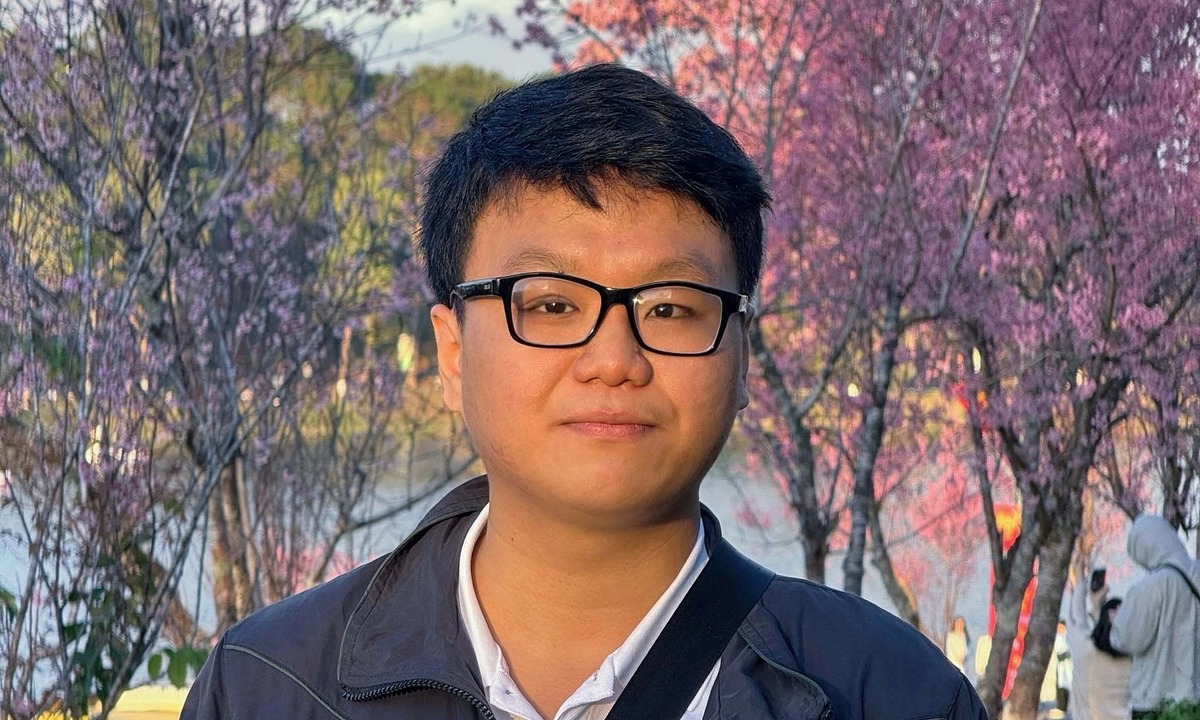
Vietnamese Teen Accepted to Stanford Driven by Desire to Solve Environmental Issues
Phung Quang Thang, a high school student from Ho Chi Minh City, has been accepted to Stanford University, a prestigious institution in Silicon Valley. His childhood fascination with keyboards evolved into a passion for developing technology to solve environmental issues, paving his way to the highly selective university.
Phung Quang Thang, a 12th-grader at Le Hong Phong High School for the Gifted in Ho Chi Minh City, has been accepted to Stanford University, one of the most selective institutions in Silicon Valley. The university admits fewer than 4% of applicants annually, with the class of 2024 seeing a 3.6% acceptance rate. Thang's journey to Stanford began with a childhood fascination with keyboards. He would dismantle them to understand their mechanics and then reassemble and decorate the parts, earning him the nickname "avid keyboard modifier" among his peers. This tinkering evolved into coding and a desire to use technology for societal good. Growing up in Khanh Hoa province, a region in central Vietnam frequently hit by storms and floods, Thang set out to develop technology that could mitigate such damages. For his main Stanford essay, he described designing a sensor-triggered flood barrier that inflates with water to hold back surges. His initial prototype failed due to mud and leaves jamming the sensors. However, he rebuilt it with different sensors, tested it under various conditions, and installed a working version at a local home. He paired this with software that pushes weather alerts to residents, warns of storms and floods, and maps evacuation routes. Thang believed his grades alone wouldn't set him apart, so he focused on his essays and research. His academic achievements are nonetheless strong: a GPA of 9.5 out of 10 over three years, a SAT score of 1550, an IELTS score of 8.0, and a perfect 5 on the AP Computer Science A exam. He also holds a gold medal from the Hong Kong International Computing Olympiad and a first prize at Ho Chi Minh City's Youth Informatics Contest. His research on using deep learning on satellite imagery to predict deforestation in Vietnam earned him first prize at this year's city science and engineering fair. Stanford was not his only offer; he was also accepted to the University of Texas at Austin, the University of Florida, the University of Rochester, the University of Melbourne, and the University of Sydney. The University of Rochester offered him the largest financial aid package, exceeding $200,000 over four years. Vu Thi Hong Hanh, his homeroom teacher, praised Thang's ability to balance research and coursework without compromise. "With this ability, I believe he will go far in his research journey," she said. Thang's only regret was cramming for the SAT and IELTS close to his deadline. "That period was quite stressful. If I could go back, I'd prepare earlier," he admitted. Thang will begin his studies at Stanford in September, where he plans to further refine his flood system and delve deeper into work that fuses computer science with environmental science. Source: VnExpress International
多角的分析
Thang's academic success and technological innovation highlight Vietnam's growing pool of highly skilled talent, particularly in STEM fields. This influx of qualified individuals is a crucial asset for Vietnam's economic development, especially as the country aims to transition towards higher value-added industries and a knowledge-based economy. The ability of Vietnamese students to secure places at top global universities also signals the increasing competitiveness of the Vietnamese education system on the international stage, potentially attracting more foreign investment and fostering collaborative research opportunities.
The success of students like Thang in gaining admission to elite global institutions like Stanford signifies a maturing human capital landscape in Vietnam. For investors, this indicates a growing availability of well-educated, innovative talent capable of driving technological advancements and contributing to the growth of high-tech sectors. Companies looking to establish R&D centers or expand operations in Vietnam may find a more robust talent pool, reducing recruitment challenges and fostering innovation, which is a positive signal for long-term investment.
Thang's story is inspiring for young Vietnamese, demonstrating that dedication and a focus on problem-solving can lead to global opportunities. His commitment to addressing environmental issues, particularly those affecting his home province, resonates with the growing awareness of climate change impacts in Vietnam. This narrative can encourage other students to pursue STEM fields not just for personal achievement but also for the betterment of their communities and the nation, fostering a sense of civic responsibility through technological innovation. The focus on practical application, like the flood barrier, also highlights a shift towards tangible solutions for real-world problems faced by ordinary citizens.
The acceptance of Phung Quang Thang to Stanford is a source of national pride and inspiration for Vietnamese citizens, particularly the youth. It showcases the potential of Vietnamese students to excel on the global stage, challenging the notion that top-tier education is beyond reach. His focus on developing solutions for environmental challenges, such as floods, directly addresses issues that affect many Vietnamese communities, offering hope for technological advancements that can improve daily life and safety. This story highlights the increasing access to quality education and the growing emphasis on innovation within Vietnam, which citizens hope will translate into broader societal benefits and a stronger national economy.
背景・歴史的文脈
ベトナムは1986年のドイモイ(刷新)政策以降、経済成長を最優先課題とし、教育分野への投資を拡大してきた。特にSTEM分野における人材育成に注力しており、国際的な学術コンテストでのベトナム人学生の活躍は近年目覚ましい。Phung Quang Thangさんのような事例は、ベトナム政府が推進する「質の高い教育を通じた国際競争力の向上」という政策目標の具体例と言える。また、ベトナムは気候変動の影響を受けやすい国であり、特に沿岸部やメコンデルタ地域では洪水や高潮が深刻な問題となっているため、Thangさんのような環境問題解決を目指す技術開発への関心は、社会的なニーズとも合致している。
原文ソース
VnExpress International