Calloused Hands and the 3-Language Exchange: Building Bridges Between the Philippines and Japan
Diplomacy
2026年7月23日
7
Rappler Business

General articles are free for 24 hours after publish.

Calloused Hands and the 3-Language Exchange: Building Bridges Between the Philippines and Japan

Share
AI Summary

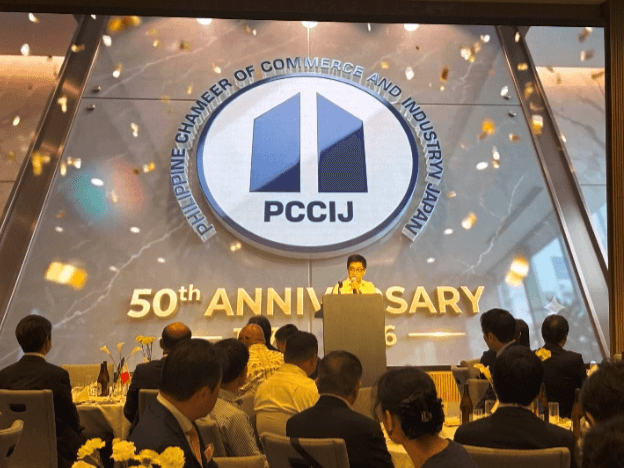
At the 50th anniversary of the Philippine Chamber of Commerce and Industry in Japan (PCCIJ), Chairman Allan Reyes exemplified the strong bond between the two nations by seamlessly switching between Japanese, English, and Tagalog. His speech highlighted the efforts and adaptability of individuals building lives across cultures.

TOKYO, Japan – Last June 25, I watched in awe as Philippine Chamber of Commerce and Industry in Japan (PCCIJ) chairman Allan Reyes step onto the podium and welcomed the room in Japanese before shifting effortlessly to English. The transition was so natural that it almost went unnoticed. It was one of the most remarkable moments of the evening for me. Language, after all, is rarely just language. I expected Allan to crack his trademark joke in Tagalog, but none came this time. The PCCIJ was celebrating its 50th anniversary, and the moment called for reflection rather than laughter. Allan’s fluency was not the product of a polished classroom. It was a language with callouses on its hands, earned over decades of living between two countries. Allan arrived in Japan as a high school student over three decades ago, supporting himself through all sorts of arubaito (part-time jobs) before eventually working for Japanese companies and later establishing his own successful business consultancy. As he looked across the ballroom, it was clear that he was speaking not only to business leaders but to people whose journeys echoed his own. The room understood what it meant to build a life from the unfamiliar. The Kiku ballroom in Hilton Tokyo reflected that shared experience. Japanese executives in dark suits sat beside Filipino entrepreneurs, Embassy officials, professionals, and past and present members of the PCCIJ Board, many dressed in elegant Filipiniana. Conversations flowed easily across tables, switching from Japanese to English and, every so often, to Filipino. The evening celebrated 50 years of an institution, but more importantly, it celebrated thousands of individual journeys that made such an institution necessary. Most people never think about chambers of commerce. They are rarely visible to the public, yet many of the investments, partnerships, and business relationships that shape the Philippine-Japan economic relationship begin in rooms exactly like this one. Organizations such as the PCCIJ create opportunities for companies to meet, exchange ideas, and navigate the practical challenges of doing business across borders. That work has become increasingly important as the relationship between our two countries continues to deepen. This year also marks the 70th anniversary of the normalization of diplomatic relations between the Philippines and Japan. Diplomacy opened the doors. Businesses walked through them. Over time, so did families, professionals, students, and entrepreneurs. The result is visible throughout Japan today. As recent statistics reveal, nearly 261,000 Filipinos were employed in Japan by the end of 2025, a figure that continues to grow as Japan confronts demographic decline and labor shortages. Whether in manufacturing, healthcare, hospitality, logistics, engineering, or technology, Filipinos have become an increasingly important part of Japan’s economy. Must Read [Between Islands] Filipino Professionals in Japan: Buds before the bloom Yet behind those numbers lies another story—one that rarely appears in employment statistics or investment reports. Over the past seven years practicing law in Tokyo, I have come to see that building a life in Japan is not simply about finding work or starting a business. It is also about navigating a legal system where stability often depends on careful compliance with rules that many people take for granted. A visa renewal submitted too late. A company that suddenly closes. An employer that unknowingly mishandles immigration requirements. A family that struggles to understand unfamiliar procedures after the death of a loved one. These are not dramatic headlines but ordinary problems that can place years of hard work at risk. For many Filipinos, belonging is never something assumed; rather something continuously maintained through documents, deadlines, and responsibilities that quietly shape everyday life. That reality gives evenings like the PCCIJ anniversary a different meaning. The entrepreneurs celebrating new investments, the professionals exchanging business cards, and the executives discussing future projects all share something beyond commercial ambition. Each has learned to navigate two systems, two cultures, and often two languages at once. Success here requires more than technical expertise. It requires patience, adaptability, and a willingness to keep learning long after arriving in Japan. When Allan concluded his remarks, the room came alive once more. Across the ballroom, conversations resumed in Japanese, English, and Filipino. A Japanese executive discussed an investment opportunity with a Filipino entrepreneur. Nearby, two professionals shifted naturally between English and Japanese before ending their conversation with a cheerful “Salamat po.” (Thank you.) Watching the room, I realized that the three languages were doing different kinds of work. Japanese built trust. English connected businesses across borders. Filipino reminded everyone where many of those journeys had begun. Before leaving the stage, Allan stepped down from the podium and was immediately surrounded by old friends and new faces. He greeted each person in whichever language the moment required. Perhaps that is the quiet achievement worth celebrating after 50 years. Not simply stronger trade or larger investments, but the growth of a community that has become at home in both the Philippines and Japan. In that room, three languages were being spoken, but they all expressed the same idea: that the strongest bridge between two countries has always been the people who choose to build a life across them. – Rappler.com Ricky Aringo Sabornay is a cross-border lawyer who moves between the Philippines and Japan, helping people navigate not just different legal systems, but different ways of thinking. He runs Sabornay Law, a member firm of Uryu & Itoga, where his work sits at the intersection of two legal systems and two cultures that don’t always speak the same language. Connect with him on LinkedIn. Below are other Between Islands columns you may have missed:

0

Original source

Rappler Business

原文を読む