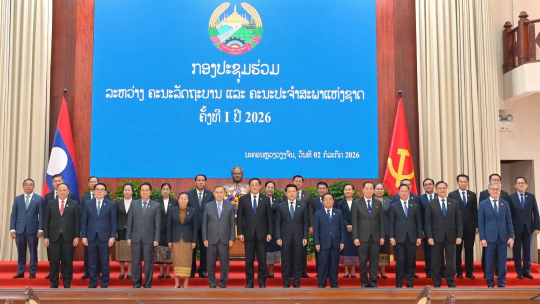
First Joint Government–National Assembly Meeting Held Ahead of Extraordinary Session
The Lao National Assembly is set to convene its 10th Legislature Extraordinary Session from July 6-10. Ahead of this, the government and the National Assembly held a joint meeting to discuss urgent legislative and national policy matters, reflecting decision-making processes within Laos's one-party system.
This article requires PRO
This article is outside the free access window or is a special report. PRO unlocks it and the full archive.
Related articles
- Laos Replaces Prime Minister in Major Leadership Reshuffle
Laos has announced a significant leadership reshuffle, including the replacement of its Prime Minister. This move may indicate shifts in the power structure within the country's one-party system and responses to economic challenges.
- Laos' New Prime Minister to Host Vietnamese Counterpart, Focus on Economy and Regional Cooperation
Laos' new Prime Minister will host his Vietnamese counterpart, with a focus on maintaining economic growth and strengthening the 'special solidarity' between the two nations. Laos faces economic challenges, making stronger ties with neighboring countries a pressing concern.
- Vietnamese PM to Visit Laos, Focusing on Bilateral Ties and Economic Challenges
Vietnamese Prime Minister Le Minh Hung will make an official visit to Laos from October 8-9, aiming to further strengthen the "great friendship, special solidarity, comprehensive cooperation, and strategic partnership." The visit comes as Laos focuses on economic growth and stability.
- Vietnamese PM to Visit Laos to Strengthen Bilateral Ties
Vietnamese Prime Minister Le Minh Hung will make an official visit to Laos from October 8-9, at the invitation of Lao Prime Minister Saleumxay Kommasith. The visit aims to further strengthen the 'great friendship, special solidarity, comprehensive cooperation, and strategic partnership' between the two nations.