General articles are free for 24 hours after publish.
Hanoi's Vinh Hung District Embarks on Major Urban Redevelopment Project
A major urban redevelopment project aiming to improve infrastructure and living conditions has commenced in Hanoi's Vinh Hung district. Spanning approximately 447 hectares with an investment exceeding 186 trillion VND, it is slated for completion by 2030. Residents hold high hopes for addressing long-standing issues.
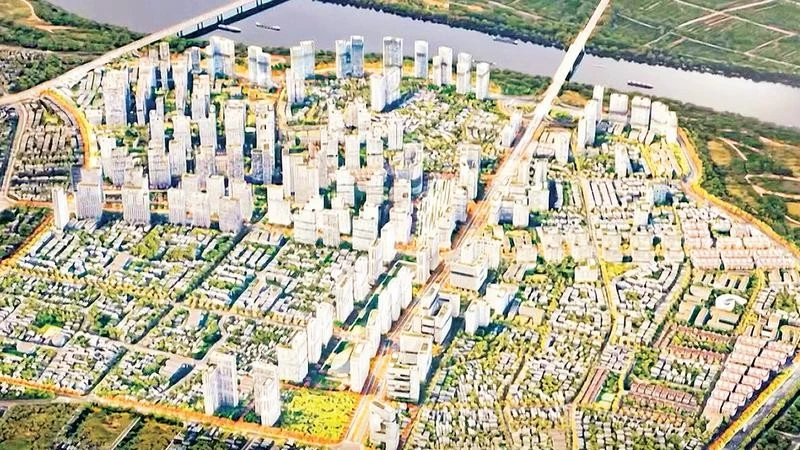
A major urban renovation and redevelopment project, aimed at improving infrastructure and residents' living conditions, is garnering significant attention in Hanoi's Vinh Hung district. Despite its proximity to Hoan Kiem Lake, Vinh Hung has faced limited opportunities for socio-economic development for years due to constrained infrastructure and delayed projects. Residents express strong hopes that this initiative will not only enhance infrastructure but crucially elevate their quality of life. Nguyen Ngoc Anh, a resident of Vinh Hung street, notes that numerous past projects, including road expansions and residential/eco-area developments, have been significantly delayed. This has led to prolonged issues of land idling, environmental pollution, urban blight, and misuse of land. Furthermore, weaknesses in land management, delays in issuing land use certificates and changing land purposes, along with frequent violations of construction and urban order, have been prevalent. Anh explains that in this densely populated area, fragmented and delayed infrastructure development has resulted in deterioration. Consequently, traffic congestion, environmental pollution, flooding, and a shortage of schools for children are common occurrences. Residents are eagerly anticipating that the current urban renovation and redevelopment project will be implemented synchronously and on schedule, resolving the long-standing urban bottlenecks in Vinh Hung. The project's investor indicates that it covers an area of approximately 447 hectares, currently home to nearly 80,000 residents. This zone holds strategic importance for Hanoi's urban spatial development, situated between Ring Roads 2 and 3, and adjacent to Ring Road 2.5 and the Red River Scenic Boulevard. The project is divided into two main areas. The urban redevelopment zone, exceeding 206 hectares, will feature new construction and modern urban spatial organization, including transportation and social infrastructure. Priority will be given to public spaces, parks, green areas, water surfaces, and transport infrastructure. These redeveloped zones will integrate with the urban railway system and multi-functional underground spaces, adopting a Transit-Oriented Development (TOD) model to reduce traffic pressure and enhance living quality, ensuring residents can easily access public spaces and social services like recreation, shopping, education, and healthcare within a 15-minute walk. The remaining area, over 240 hectares, will undergo synchronized renovation and upgrading. The total investment is nearly 186 trillion VND, with completion projected for Q4 2030. Notably, all affected households will be resettled within the district. According to the investor's representative, the Vinh Hung urban renovation and redevelopment project aims to create a green valley within a modern city. Upon completion, it is expected not only to meet housing needs but also to serve as a model for urban renovation and redevelopment in the capital's central areas, establishing modern living standards integrated with cultural and social amenities. Recently, at the project's groundbreaking ceremony, Chairman of the Hanoi People's Committee Vu Dai Thang emphasized that urban reconstruction must go beyond mere rebuilding to genuinely improve infrastructure and living conditions, rationally reorganize urban space, supplement lacking public and social infrastructure, and utilize land resources more effectively. The Vinh Hung project is crucial for the city to gradually form its approach and gain experience in urban renovation and redevelopment for the future. Information source: Nhan Dan
Original source
Nhan Dan