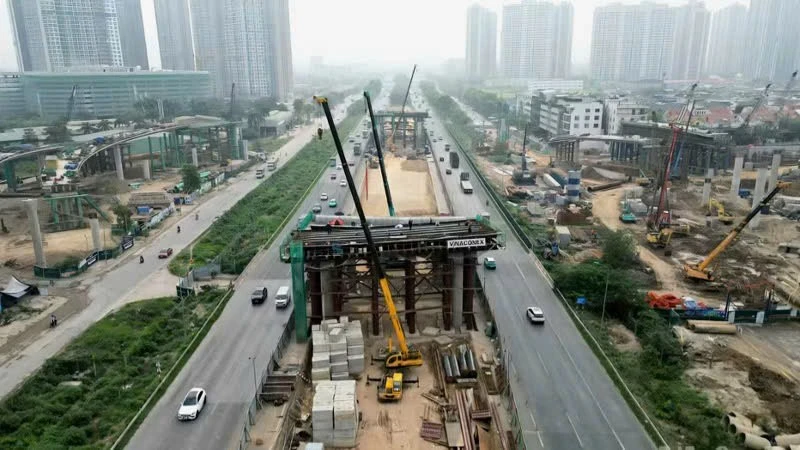
Hanoi Adjusts Traffic Management for Ring Road 3.5 and Thang Long Boulevard Intersection Construction
Hanoi's Department of Construction announced traffic adjustments for the second phase of the Ring Road 3.5 and Thang Long Boulevard interchange project, effective until the end of 2026. The measures include complete road closures and lane reductions in certain sections, with a maximum speed limit of 60 km/h.
Hanoi's Department of Construction has issued a notice on adjusting traffic organization to serve the construction of the interchange between Ring Road 3.5 and Thang Long Boulevard. The traffic diversion plan will be implemented from June 25, 2026, to December 31, 2026, aiming to ensure the project's progress and maintain traffic safety and reduce congestion on the route. According to the plan, the right-side service road of Thang Long Boulevard, from Km7+760 to Km8+680, will be completely closed for construction. Vehicles on the service road will be directed to use the existing highway to bypass the construction area. Additionally, a section of the highway adjacent to the central median will continue to be narrowed to facilitate bridge pier construction. For the right-side highway, the entire section from Km8+120 to Km8+860 will be closed, with traffic organized on a temporary road set up in the central median. Emergency lanes will also be narrowed in some locations to serve drainage systems and highway ramps. On the left-side highway, localized lane reductions will continue in several sections for the construction of bridge piers, drainage systems, and ramps. Within construction areas, the maximum speed for vehicles will be adjusted to no more than 60 km/h to ensure traffic safety. The traffic organization for the left-side service road of Thang Long Boulevard and Hoang Tung Street will largely remain the same as in Phase 1. However, at some locations where drainage systems, utility tunnels, and auxiliary items are being constructed, the road surface will be narrowed, ensuring a minimum remaining width of 4 meters for vehicles to pass through the construction zone. The Department of Construction requires the City Project Management Board for Civil Construction Investment to coordinate with relevant forces to implement remote and on-site traffic diversion, install adequate signage, warning lights, and arrange 24/7 traffic control personnel. They must also develop a plan for timely handling of traffic jams. The investor and contractors are obligated to strictly adhere to regulations on labor safety, environmental sanitation, and the safety of adjacent structures, and will be held responsible for any incidents during construction.
多角的分析
この交通規制は、ハノイ市のインフラ開発計画の一環であり、環状道路網の整備と主要幹線道路の接続性向上を目的としている。タン・ロン大通りと環状3.5号線の交差点は、ハノイ西部と北部を結ぶ重要な結節点となるため、この工事の完了は物流効率の向上や沿線地域への経済効果をもたらす可能性がある。しかし、工事期間中の交通渋滞は、一時的に物流コストの増加や地域経済活動への影響を与えることも考えられる。ベトナム経済はインフラ投資に大きく依存しており、このような大規模プロジェクトは経済成長を牽引する一方で、その実施に伴う一時的な混乱は慎重な管理が求められる。
このニュースは、直接的な投資機会を示すものではないが、ハノイ市のインフラ開発への継続的な投資意欲を示唆している。環状3.5号線とタン・ロン大通りの交差点改良は、将来的には沿線地域の不動産価値の上昇や、物流・商業施設の開発を促進する可能性がある。投資家にとっては、ハノイの都市開発計画全体を理解する上で、このようなインフラプロジェクトの進捗状況を注視することが重要となる。特に、長期的な視点では、交通網の改善が経済活動の活性化に繋がり、新たな投資機会を生み出す可能性を秘めている。
工事期間中の交通規制は、ハノイ市民、特にタン・ロン大通りや環状3.5号線沿線地域に住む人々や通勤・通学者にとって、日常生活への直接的な影響をもたらす。通勤時間の増加や迂回による移動の不便さは、生活の質に影響を与える可能性がある。また、工事車両の増加や騒音、粉塵などの環境問題も懸念される。建設現場周辺の住民は、これらの影響を直接受けるため、当局は交通誘導の徹底、情報提供、そして環境対策を怠らないことが求められる。公共の利益のためのインフラ整備と、市民生活への影響とのバランスが重要となる。
ハノイ市民、特にタン・ロン大通りや環状3.5号線を利用するドライバーや、沿線地域に住む人々は、この交通規制によって日常生活に影響を受ける。通勤時間が長くなったり、迂回を余儀なくされたりすることで、日々の生活にストレスが増える可能性がある。また、工事中の騒音や粉塵も懸念される。公共交通機関の利用促進や、代替ルートに関する十分な情報提供が、市民の不便を軽減するために不可欠となる。
背景・歴史的文脈
ハノイ市は、人口増加と経済成長に伴う交通渋滞の深刻化に対応するため、都市インフラの拡充を最優先課題の一つとしている。環状3.5号線は、ハノイ市を囲む環状道路網の一部であり、市中心部への交通負荷を軽減し、郊外地域との連携を強化する役割を担う。タン・ロン大通りは、ハノイ市と近郊のソン・タイ市を結ぶ主要幹線道路であり、この二つの道路の交差点での立体化は、交通の円滑化に不可欠なプロジェクトである。過去にもハノイでは、インフラ整備に伴う交通規制が頻繁に行われており、市民生活への影響を最小限に抑えつつ、長期的な都市発展を目指すという、ベトナムが直面する共通の課題を示している。
原文ソース
Nhan Dan