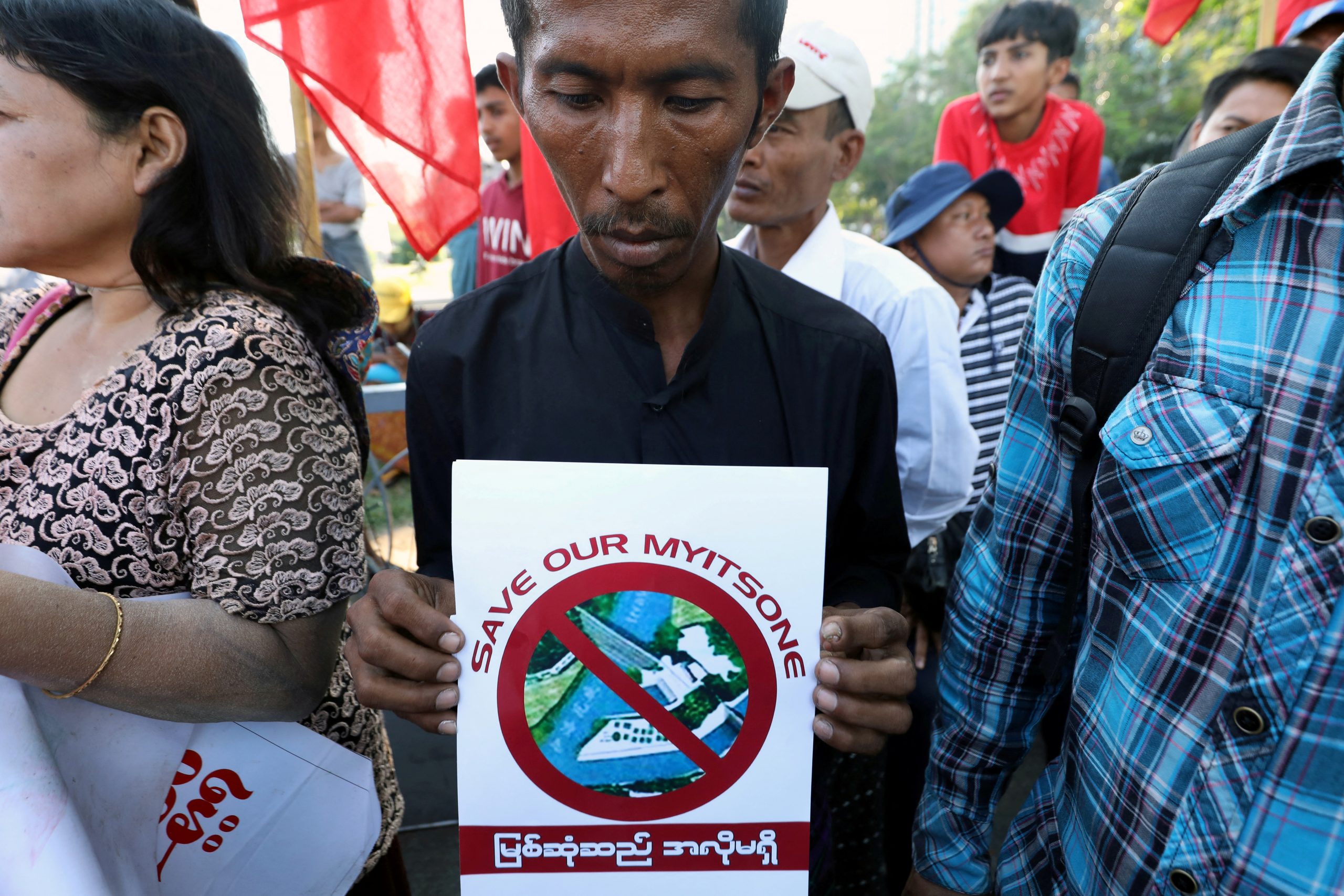
Myanmar set to restart contentious $3.6 billion dam project backed by China
Myanmar’s new pro-military administration led by Min Aung Hlaing, the military commander-in-chief who was appointed president by a pro-military parliament, aims to complete within roughly eight years a contentious $3.6 b
Myanmar’s new pro-military administration led by Min Aung Hlaing, the military commander-in-chief who was appointed president by a pro-military parliament, aims to complete within roughly eight years a contentious $3.6 billion USD dam project at Myitsone in northern Kachin State, said two sources with knowledge of comments by Khet Htein Nan, who leads the regime’s state administration. The comments come after Min Aung Hlaing returned from a visit last month to China, which has long sought to build the massive hydropower project in the northernmost province of Myanmar. “It will begin shortly,” Htet Paing Htoo, a member of the Kachin State parliament, told Reuters regarding construction work suspended in 2011 after rare public outrage over a hydropower project that would have been Myanmar’s largest. “An official announcement will be released. The president himself has already stated that it will be restarted.” The halt angered China, but resentment at its deep influence in Myanmar and environmental concerns about flooding an area roughly the size of Singapore prevailed over plans to export 90 per cent of the six gigawatts of generated power to the giant neighbour. That capacity would rank Myitsone among Southeast Asia’s largest hydropower projects, though still dwarfed by the likes of China’s Three Gorges Dam, with installed capacity of 22.5 GW. Project resumption figured in talks during Min Aung Hlaing’s China visit, his spokesperson told pro-regime media in the capital Naypyidaw on June 30, adding it could provide more than half the 10 GW of power required by a country woefully short of electricity. Min Aung Hlaing’s pro-military administration is weighing concerns over flooding and displacement voiced by local communities, said his spokesperson Khaing Khaing Soe. “We are analysing these matters in detail, evaluating the extent of the benefits versus the negative impacts, to strike a balance,” she told the press conference on June 30. Khet Htein Nan’s office and China’s foreign ministry did not immediately respond to a request for comment. The two sources sought anonymity as the discussions led by Khet Htein Nan were private. Revived project could cost more than three times original A revived Myitsone dam could cost $11.5 billion USD, or more than three times its 2009 price tag, based on the International Renewable Energy Agency’s most recent estimate of average construction costs of $1,914 USD a kilowatt for Asian hydropower projects outside China and India. Min Aung Hlaing’s pro-military administration, which took power in April after a widely criticized election won by a military-aligned political party, is working to resurrect the project, said three officials, including the Kachin State lawmaker. The move comes amid a civil war triggered by a 2021 coup in which the military, led by Min Aung Hlaing, deposed the elected government of Nobel Peace Prize winner Aung San Suu Kyi, who had also opposed the Myitsone dam. In Myitkyina, the state capital about 23 miles (37 km) distant from the dam site, state leader Khet Htein Nan has underlined the government’s desire to pursue the project, said the two sources with knowledge of talks. Unlike in the past, China is now ready to tackle environmental issues with new technology, the chief minister told a June 23 discussion on the dam, one of the sources said. “They will use technology to ensure it can withstand such risks,” the source quoted the minister as saying. “There is nothing to worry about.” A powerful 7.7 magnitude earthquake that killed thousands last March when it struck central Myanmar has fuelled concern over the risks of a massive dam in a seismically active region. The Myitsone dam would stand 152 m (500 ft) tall and stretch 152 m (500 ft) at the confluence of the Mali and Nmai rivers. A third source with direct knowledge of internal discussions cited the chief minister’s remarks at a June 22 meeting that the Myitsone Project should stand as a “historic achievement”. The source added, “The chief minister mentioned that China fully supports and encourages the resumption of the Myitsone project.” Reuters could not determine if Myanmar’s initial deal to send most of Myitsone’s electricity across the border to China had been reworked. Resistance continues Khet Htein Nan’s private comments coincide with the administration’s push to revitalize project support in an area now controlled by the military. After former deputy military chief Soe Win visited the Kachin State capital Myitkyina in April for talks with local authorities, at least 26 public meetings across the state backed the project, said two members of a regime committee. “What we want is to provide the public with accurate information and allow them to make their own decisions,” said one of the committee members, Naw Khon. But opposition continues, with 49 civil society groups recently calling for total cessation of the project. “It offers no benefits to the public and will only result in the severe destruction and loss of people’s lives, homes, and property,” the groups said in a joint statement on May 5. REUTERS The post Myanmar set to restart contentious $3.6 billion dam project backed by China appeared first on DVB.
多角的分析
親軍議会によって大統領に任命されたミン・アウン・フライン軍司令官が率いるミャンマーの新親軍政は、カチン州北部のミッソンで物議を醸している36億ドルのダム計画を約8年以内に完了することを目指していると、同政権国政を率いるケート・テイン・ナン氏の発言を知る2人の関係筋が語った。 このコメントは、ミン・アウン・フライン氏が先月、ミャンマー最北端の州で大規模な水力発電プロジェクトの建設を長年模索してきた中国への訪問から帰国した後に発表された。この動きは直接の経済指標ではなくても、行政運営、地域の信頼、公共サービスの質を通じて企業活動や生活コストに波及する可能性があります。
投資家にとっては、個別ニュースの背後にある制度の安定性、情報公開、地域社会の反応が判断材料になります。短期の見出しだけでなく、継続的な変化を見る必要があります。
親軍議会によって大統領に任命されたミン・アウン・フライン軍司令官が率いるミャンマーの新親軍政は、カチン州北部のミッソンで物議を醸している36億…という事実は、カチン州の住民にとって制度の発表ではなく、日々の判断材料になります。軍がどこまで説明し、洪水を抱える人に情報が届くかが社会的な焦点です。
市民にとっては、このニュースが安全、雇用、教育、行政サービスなど身近な領域にどうつながるかが焦点です。生活者目線で具体的な影響を追う価値があります。
背景・歴史的文脈
DVBが伝えたこのニュースは、ミャンマーの行政運営や地域社会の変化を読むための小さなシグナルです。個別の発表や事件でも、制度、生活、対外関係のどこに影響するかを分けて見ることで、ニュースの意味が見えやすくなります。
原文ソース
DVB