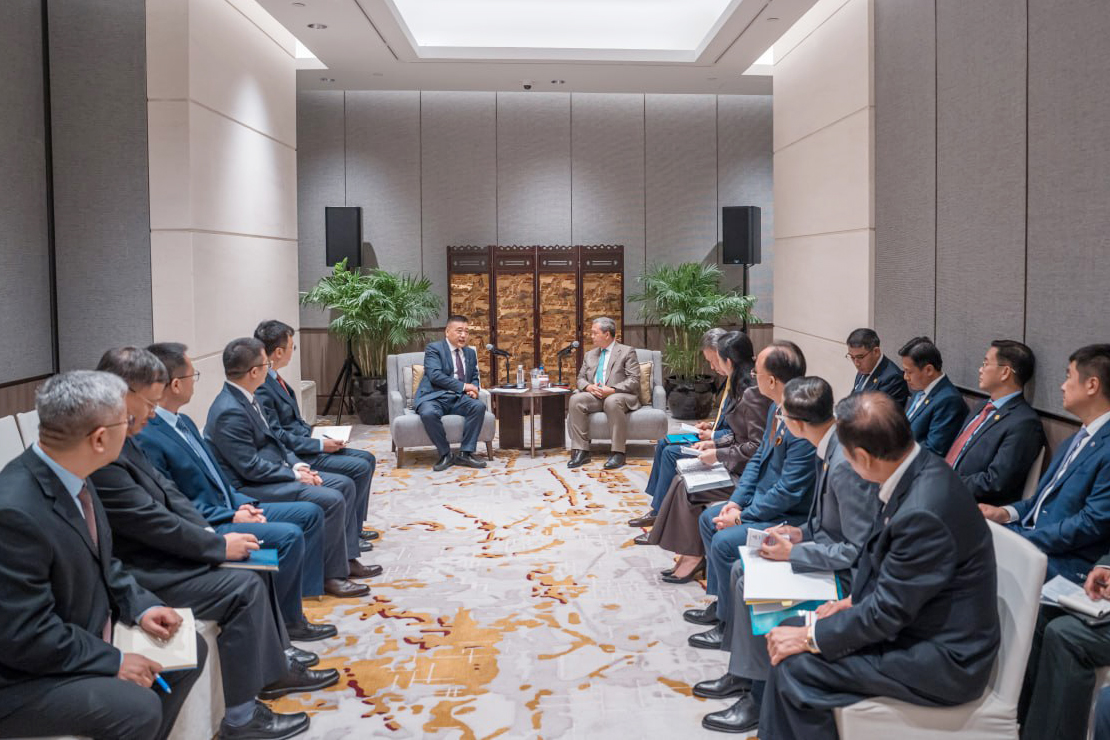
Major Chinese Firms Share Expanded Investment Plans with PM
During Prime Minister Hun Manet's visit to China, nine major Chinese companies expressed interest in expanding their investments in Cambodia, focusing on strengthening cooperation in energy, infrastructure, manufacturing, and agriculture.
Prime Minister Hun Manet's current visit to China has yielded potential dividends for Cambodia's energy, transport infrastructure, manufacturing, and agriculture sectors, with nine leading Chinese companies expressing interest in expanding their presence in the Kingdom. These intentions were shared during a series of meetings with Manet, who is in China to attend the 2026 World AI Conference and High-Level Meetings on Global AI Governance from July 15-17. Discussions focused on expanding economic cooperation and encouraging new investment in sectors aligned with Cambodia’s long-term development priorities. China Railway Construction Corporation (CRCC), operating in Cambodia since 2008, highlighted its past projects including the Battambang water supply system, the National Stadium sports village, the Ministry of National Defence headquarters, and the Cambodia-China Friendship Hospital in Tbong Khmum province. CRCC chairman Dai Hegen stated the company plans to expand investments in Cambodia’s transport infrastructure, digital infrastructure, renewable energy, and integrated investment, construction, and operation projects. China Energy International intends to diversify beyond its existing engineering, procurement, and construction (EPC) activities in the energy sector by investing in cement production, water treatment, and renewable energy projects. Prime Minister Manet welcomed this, noting that clean energy development is a key priority, with renewable energy already accounting for around 62 percent of Cambodia’s electricity generation and a target of 70 percent by 2030. Cambodia is also keen to introduce advanced technologies to improve power generation efficiency. China Machinery Engineering Corporation (CMEC), with investment in Cambodia since 2008, is working with local partners on a liquefied natural gas (LNG) power plant in Koh Kong province and seeks further investment in energy and agriculture. CMEC chairman Fang Yanshui is encouraging other Chinese firms to explore Cambodian opportunities. Shandong (Cambodia) Economic and Technological Development Zone plans to expand beyond its current agricultural operations, including cashew cultivation and industrial park development, with a focus on renewable energy projects. Consumer electronics giant Haier Group is partnering with a Cambodian company to establish a tablet assembly plant aimed at producing affordable devices for students and informal economy workers, thereby expanding digital access and supporting distance learning. Yuanda Group is exploring investment opportunities in education, agriculture, and digital technology, citing Cambodia’s rapid economic development and long-term growth potential. Fujian Jinlu Daily Chemical, a household consumer products manufacturer, is interested in establishing a plant in Cambodia to produce insecticides, laundry detergent, tissue paper, and kitchen supplies. AI company Beijing Star AI is working with Cambodian partners to explore investments in an ASEAN Regional Intelligent Computing Centre, a Film-Grade AI Agent Research and Development Centre, a Cross-border AI Short Drama Distribution Center, and an ASEAN Digital Commerce Operation Centre. CHINALCO (Aluminum Corporation of China) is assessing investment opportunities in Cambodia’s steel manufacturing and mineral resources sectors, leveraging its expertise in mining, infrastructure development, special economic zones, and railway construction.
多角的分析
中国企業によるカンボジアへの投資拡大は、同国の経済成長を加速させる潜在力を持つ。特にインフラ、エネルギー、製造業への投資は、雇用創出や技術移転につながる可能性がある。しかし、これらの投資がカンボジア経済の持続可能性や、国内産業への影響、そして中国への経済的依存度をどのように変化させるかが重要となる。再生可能エネルギー分野への投資は、カンボジアのエネルギー安全保障と環境目標達成に貢献する一方、大規模プロジェクトの実施には環境影響評価や地域社会への配慮が不可欠である。
今回表明された中国企業による投資拡大意欲は、カンボジアの投資環境に対する中国側からの信頼感の表れと見られる。特にインフラ、エネルギー、製造業といった分野は、カンボジアの成長ポテンシャルと中国の資本・技術力を結びつける好機となる。投資家としては、プロジェクトの透明性、契約条件、およびカンボジア政府の政策の一貫性が、今後の投資判断における重要な要素となるだろう。AI関連分野への投資は、新たな収益源の開拓とデジタル経済への移行を加速させる可能性を秘めている。
中国企業によるITインフラや教育関連(タブレット組立工場など)への投資は、カンボジア国民のデジタルアクセス向上や学習機会の拡大に寄与する可能性がある。しかし、大規模インフラ開発や資源開発においては、地域住民の生活や環境への影響が懸念される。特に、中国企業が主導するプロジェクトでは、労働者の権利保護や地域社会との調和が、社会的な課題として浮上する可能性がある。AI関連のセンター設立は、新たな雇用を生む一方で、高度なスキルを持つ人材育成の必要性も示唆している。
中国企業からの投資拡大は、カンボジア国民にとって、より多くの雇用機会と経済的恩恵をもたらす可能性がある。特にインフラ整備や製造業への投資は、地方経済の活性化にもつながりうる。しかし、これらの投資が、土地収用や環境問題を引き起こす場合、地域住民の生活に直接的な影響を与えることも考えられる。また、デジタル化の進展は、新たなスキル習得の機会を提供する一方で、デジタルデバイドの拡大という懸念も生じさせる。
背景・歴史的文脈
カンボジアは、経済発展のために外国からの投資を積極的に誘致してきた。特に中国は、インフラ開発における「一帯一路」構想の下、カンボジアへの投資を拡大してきた。過去には、中国からの投資がインフラ整備や不動産開発を促進した一方で、土地収用や環境問題、債務問題などが指摘されるケースもあった。今回の投資拡大表明は、こうした過去の文脈を踏まえつつ、カンボジアがAIやデジタル経済といった新たな分野への投資を模索する姿勢を示している。
原文ソース
Phnom Penh Post