General articles are free for 24 hours after publish.
India Successfully Tests Long-Range Surface-to-Air Missile 'Kusha' in Maiden Flight
India's Defence Research and Development Organisation (DRDO) successfully conducted the maiden test of the M1 interceptor missile under the long-range surface-to-air 'Kusha' program on July 23, 2026. This marks a significant step towards building India's multi-layered long-range air defense architecture.
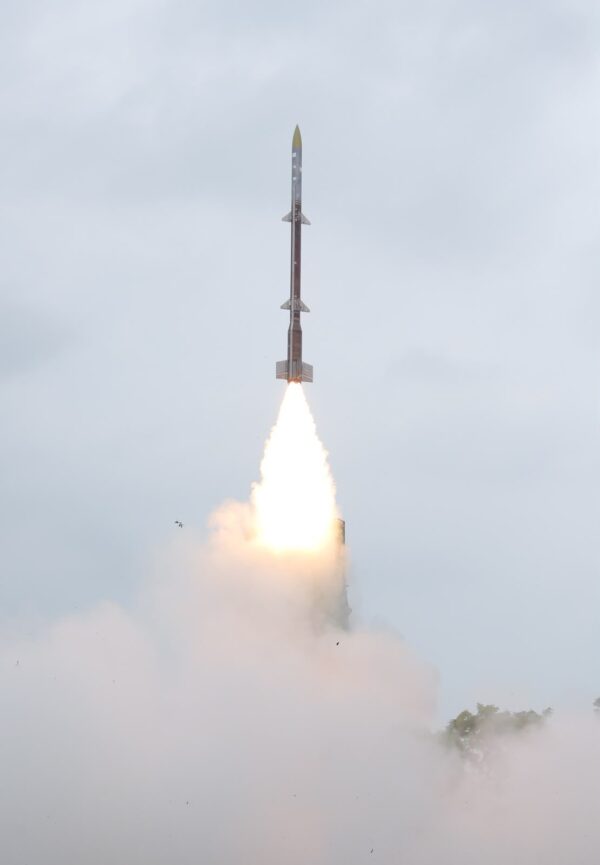
Read The Diplomat, Know The Asia-Pacific This is an important milestone in India’s evolving multi-layered long-range air defense architecture envisaged under Mission Sudarshan Chakra. The maiden flight test of the long-range surface-to-air Kusha missile from the APJ Abdul Kalam Island off the coast of Odisha, India, July 23,2026. On July 23, India’s Defense Research and Development Organization (DRDO) successfully carried out the maiden test of the M1 long-range surface-to-air missile (SAM), one of three interceptors being developed under the Kusha program, from the APJ Abdul Kalam Island off the Odisha coast. This is an important milestone in India’s evolving multi-layered long-range air defense architecture envisaged under Mission Sudarshan Chakra that is scheduled to be put in place by 2035. This test was conducted against an electronic target simulating a high-speed and high-altitude aerial threat, which was successfully intercepted. DRDO said that the Kusha missile system is capable of “neutralizing wide variety of aerial threats including fighter jets, missiles, UAVs and large enemy aircrafts within a wide range and altitude envelope.” Calling the test flight an “important milestone” in Indian defense research and development, India’s Defense Minister Rajnath Singh observed that only a handful of nations possess the capability of developing a long-range SAM system. Under Project Kusha, DRDO is developing three long-range interceptors – M1 to engage targets up to 150 km, M2 with a range of 250 km, and M3 to engage targets at distances of 350-400 km. The kill vehicle will remain the same, with a booster added to augment the range. Development is expected to be completed in the next couple of years, with induction targeted by 2030. Defense public sector undertaking Bharat Dynamics Limited and Solar Industries are the chosen Development-cum-Production Partners and are involved in the process. Bharat Electronics Limited is the development partner with DRDO for different types of radars and control systems. The system is backed by an architecture of command-and-control systems, a variety of radars, sensors, and various missile systems all plugged into the Integrated Air Command and Control System (IACCS) of the Indian Air Force. The Indian Army’s and Navy’s air defense networks are also linked to the IACCS to form a comprehensive air defense picture of the country’s airspace and to look deep into airspace far beyond the borders to track incoming threats. India’s long-range air defense is currently based on the Russian S-400 Triumf systems, which have an interception range of 400 km. Five S-400 regiments were contracted under a $5.43 billion deal with Russia in 2018. However, deliveries have been significantly delayed with the fourth regiment now delivered and the fifth to be delivered by year-end. After the four-day military conflict with Pakistan under Operation Sindoor in May 2025, the Defense Ministry approved the procurement of five additional S-400 regiments for which negotiations are underway. S-400 had proven its worth during Operation Sindoor and not only in shooting down incoming projectiles – it was also employed in an offensive role to shoot down a Pakistani early warning aircraft over 300 km away. Much has been written in the last few days about how Project Kusha will reduce import dependence on the S-400. Technically yes, but it’s a very long way off, as earlier contracted regiments are still being inducted and a new contract is in the pipeline, which means deliveries and inductions are several years away. So once Project Kusha starts getting deployed, for the near-to-medium future it will complement the S-400 and work in tandem to provide India a seamless air defense cover, particularly building redundancy. Nonetheless, it is a critical domain to build self-reliance. Long-range interceptors give additional time to respond, especially given the short distances on India’s Western border, allowing threats to be neutralized far away from population clusters or high-value assets. Apart from emerging threats, India faces a persistent threat from medium and long-range ballistic missiles of Pakistan and China, its nuclear-armed adversaries on the western and northern fronts, respectively. Hence, an anti-ballistic missile shield is critical. The S-400 is designed to engage a wide range of threats, including tactical and theatre ballistic missiles and medium-range ballistic missiles, while Project Kusha is expected to be able to tackle certain classes of ballistic and hypersonic threats. For the larger threat envelope, India has developed an indigenous Anti-Ballistic Missile defense; Phase-I, designed to engage ballistic missiles with a range of up to 2000 kms, has been validated and Phase-II for missiles of up to 5000 kms, is under development. After the 400 km S-400, the next system currently in the tier is the Barak-8 or Medium Range-SAM with a range of 70 km, jointly developed with Israel Aerospace Industry (IAI). That’s a significant gap in the missile ranges and the three interceptors under Project Kusha will bridge the gap once deployed, creating a truly multi-layered long-range net. The Naval variant of the Barak-8 is called LR-SAM and the land variant MR-SAM. At the shorter range are the Akash indigenous systems and the Israeli Spyder quick reaction systems. According to officials involved in the Kusha project, the entire project, including seekers, actuators, and computing systems, is indigenous. Over the years, DRDO has gained significant proficiency in developing a range of radars and is now working on Gallium Nitride (GaN)-based Active Electronically Scanned Array (AESA) radar systems which significantly improve efficiency and precision. In addition to the three interceptions, DRDO is currently in the process of developing other short-range AD systems – the Quick Reaction SAM and the man-portable very short-range air defense systems. Both have an important role in countering the growing threat of cruise missiles, loitering munitions, and unmanned systems that have changed the modern battlefield. Operation Sindoor proved the strength of India’s air defense network. But the next conflict is not going to be like the last one as the adversaries now know the strengths and more so the limitations. This warrants that the system be scaled up across the spectrum. Project Kusha marks an important milestone in an ambitious effort to tackle threats at the higher end of the air defense threat matrix. Subscribe today and join thousands of diplomats, analysts, policy professionals and business readers who rely on The Diplomat for expert Asia-Pacific coverage. Get unlimited access to in-depth analysis you won't find anywhere else, from South China Sea tensions to ASEAN diplomacy to India-Pakistan relations. More than 5,000 articles a year. Already have an account? Log in. Dinakar Peri is a Fellow with the Security Studies Program at Carnegie In
Original source
The Diplomat Indonesia