General articles are free for 24 hours after publish.
Villar Land's Trillion-Peso Profit: Gatekeeper Scrutiny Intensifies
New questions arise regarding the role of the auditing firm in the accounting reversal for Villar Land's massive profit, intensifying scrutiny on financial gatekeepers. Investors are demanding transparency on how such a dramatic shift occurred.
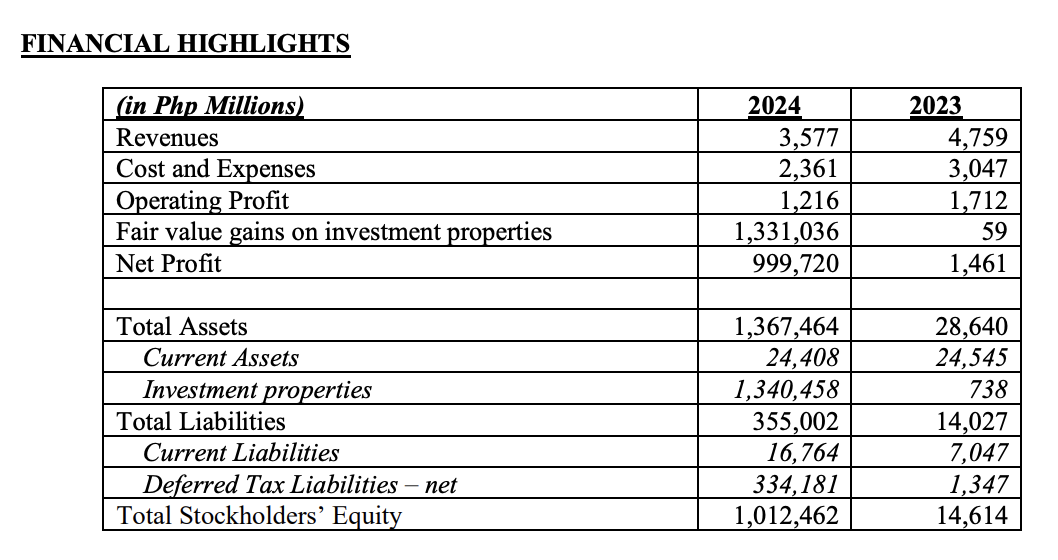
Villar Land’s trillion-peso mirage began as a valuation scandal. Documents reviewed by Vantage Point now raise a more unsettling question: what role did the financial gatekeepers play before the accounting was reversed and the audit report reissued? Villar Land’s trillion-peso mirage began as a question about an unbelievable property valuation. Now, documents obtained by Vantage Point raise an equally disturbing question: what happened between the issuance of its original audited financial statements and the later reversal of the accounting that helped create those spectacular numbers? When I first did a forensic on Villar Land Holdings Corp.’s nearly P1-trillion profit in May 2025, the problem seemed almost embarrassingly simple: the numbers did not make economic sense. Villar Land, then still known as Golden MV Holdings, had disclosed P999.72 billion in net profit for 2024 after booking P1.331 trillion in fair-value gains on investment properties. Yet revenues had actually fallen to P3.577 billion from P4.759 billion, while operating profit dropped to P1.216 billion from P1.712 billion. A deteriorating operating business had somehow become one of the most profitable companies in Philippine corporate history because land suddenly became extraordinarily valuable on paper. (READ: [Vantage Point] Villar Land justifies flawed valuation) We know much more today. The trillion-peso narrative eventually collapsed, the underlying appraisal came under regulatory scrutiny, and Villar Land’s financial statements were radically revised. But there is now another question that goes beyond Villar Land management and the appraiser: where were the financial gatekeepers, while this extraordinary accounting transformation was taking place? The chronology is crucial. On March 28, 2025, Golden MV informed regulators that its board had approved and authorized the release of its financial statements—containing those spectacular trillion-peso numbers—for the year ended December 31, 2024. Exactly one month later, on April 28, the renamed Villar Land Holdings disclosed that its board had approved and authorized the release of its Audited Financial Statements and the filing of its annual report. That April 28 date may be the most important new piece of the puzzle. Among the documents reviewed by Vantage Point is material reproducing portions of an audit report by Punongbayan & Araullo, or P&A Grant Thornton. The reproduced report refers to an audit opinion dated April 28, 2025, on originally issued separate financial statements in which the management of Villar Land had changed the accounting for investment properties from the cost model to the fair-value model. The same material says those statements were subsequently revised after discussions between management and the external auditor, with the former eventually deciding to retain the cost model and reverse the previous fair-value accounting. That sequence deserves careful reading. Financial statements adopting fair-value accounting apparently went through an audit process culminating in an April 28 opinion. Later, the accounting was changed back and the audit report reissued. By itself, this does not establish wrongdoing by the auditor, nor does it prove that P&A endorsed every peso of Villar Land’s P1.331-trillion consolidated fair-value gain. What I find concerning are the details that specifically relate to the standalone financial records of the parent company because the enormous consolidated gain also involved subsidiaries holding the Villar City properties. Without reviewing every individual audit report, it would be irresponsible to claim that one auditor approved the full P1.331 trillion. However, the auditor question cannot be simply waived because Villar Land itself placed its external auditor squarely into the controversy. Unavoidable question In a September 2025 regulatory disclosure, the company defended its earlier statements by explaining they were based entirely on the “unqualified representations” of its external auditor regarding the fair-value gains. Villar Land also attributed delays in filing its annual and quarterly reports partly to what it called the “protracted review process of its external auditor.” Those representations belong to Villar Land, not to me, but they create an unavoidable question. If Villar Land inaccurately characterized what its external auditor had represented, that deserves immediate clarification. If it reflected the auditor’s position accurately, investors deserve to know precisely what the auditor examined, how the audit was conducted, and why the financial statements subsequently changed so dramatically. This is not a minor bookkeeping dispute. Independent auditors occupy a privileged position in capital markets because investors cannot personally inspect corporate ledgers, challenge management assumptions, or verify property appraisals. An audit opinion does not guarantee that every corporate judgment will prove correct, and management remains responsible for preparing financial statements, choosing accounting policies, and making valuations. But the auditor’s signature exists precisely to provide reasonable assurance that those statements are free from material misstatement. When an accounting judgment transforms a company so dramatically, professional skepticism becomes particularly important. Villar Land’s investment properties reportedly ballooned to P1.340 trillion, total assets to P1.367 trillion, and stockholders’ equity to P1.012 trillion, even while revenues and operating profit were declining. This was not an obscure accounting adjustment buried deep in the notes. It fundamentally changed the financial identity of the company. The reversal therefore creates questions that deserve answers. What evidence supported the original adoption of fair-value accounting? What assumptions underpinned the valuation? How were those assumptions tested? Did subsequent information emerge that was unavailable when the April 28 opinion was issued, or did the Vantage Point May 2025 column cause management and the auditor to reconsider judgments previously considered acceptable? Most importantly, what explains the journey from an original audit opinion to revised financial statements and a reissued audit report? The documents I have presently do not answer those questions definitively, and because aspects of the Villar Land affair are now before legal and regulatory forums, conclusions about liability properly belong to those proceedings. But investors operate on a different timetable. Must Read [Vantage Point] The Villar empire: From untouchable to a governance test case They cannot wait years for final judgments before asking whether the institutions entrusted with protecting the credibility of financial reporting performed their roles as expected. The Villar Land affair
Original source
Rappler Business