CMAC Rejects Thai Claims of Bomb Detonation, Cites Evidence of Falsehoods
The Cambodian Mine Action Centre (CMAC) has vehemently rejected Thai claims that all aerial bombs dropped by the Thai military over Cambodian airspace last year detonated. CMAC presented evidence, including bomb manufacturing dates and origins, to refute these claims, labeling them as falsehoods intended to evade responsibility.
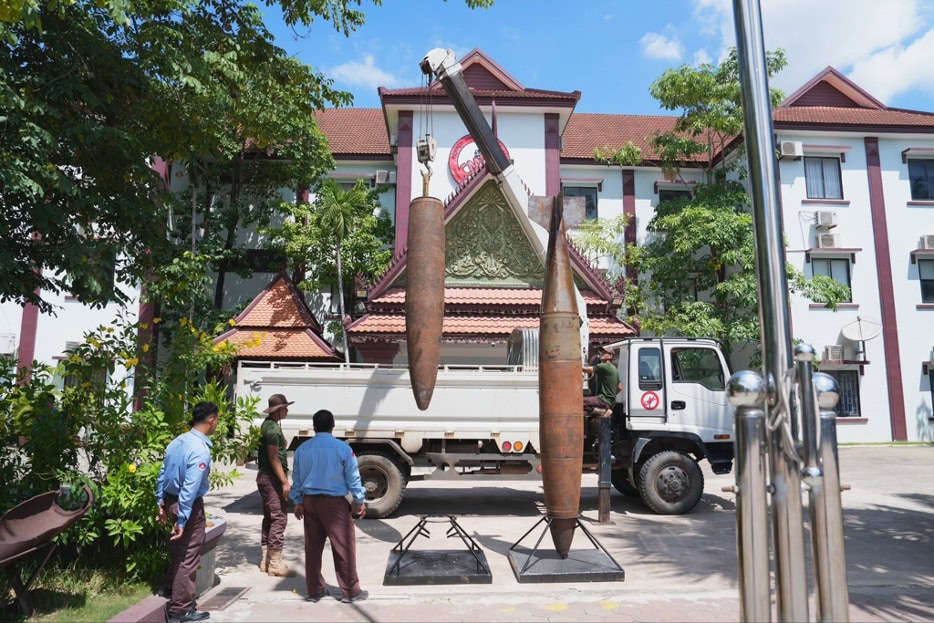
The head of the Cambodian Mine Action Centre (CMAC) has dismissed Thai claims that all ordnance dropped from aircraft during last year’s fighting exploded as patently false and untenable. CMAC director-general Heng Ratana noted a range of mixed messages from Thai officials and media, as well as the general public, regarding the claims. Some officials have issued blanket denials about the bombing, while some have proudly claimed responsibility, while saying that all of the bombs exploded. “Regarding the commentary stating that ‘all of their aircraft bombs exploded without exception’” I view this commentary as fresh evidence that the Thai military acknowledges that they used aircraft-dropped bombs to violate the territorial integrity of the Kingdom of Cambodia,” Ratana said, via social media. He explained that the latest claims are no different from previous ones regarding the explosion of a Thai cluster bomb remnant of war that killed a young Cambodian boy. He recalled that Thai officials previously declared that all the cluster bombs fired into Cambodian territory exploded, despite the discovery of many unexploded bomblets. “I believe that what the points they attempt to raise merely showcases pride and arrogance regarding military material superiority, while deflecting responsibility by lying to the Thai people and the international court of public opinion,” he said. While many Thai sources continue to claim that all of their munitions exploded, some chose a different path, suggesting that the unexploded bombs on display were dropped in Cambodia in the 1960s or 70s, a claim that Ratana described as a “distortion of the truth, a deflection of blame and a slander against concrete evidence”. He said every unexploded aerial bomb, as well other types of ordnance, possesses clear identification such as codes, dates, manufacturing companies and countries of origin, which meets the international standard for managing munitions. “The two MK-84 aerial bombs shown in the photos bear the identification code: 30003-923AS105, and lot number: IMI96G015-011, proving that they were manufactured by Israel Military Industries in 1996. Based on this evidence, I ask: How could a bomb manufactured in 1996 be used by the US air force in Cambodia during the years 1962–1975?” he asked. Ratana also noted that the US government has provided extensive data in Cambodia to the Cambodia government to support humanitarian unexploded ordnance (UXO) and bomb clearance operations, as well as to demonstrate a spirit of moral responsibility. CMAC has utilised the date extensively to support its operations. “Let me clarify once again that the location of the Thai bombs discovered by CMAC is absolutely not in line with the historical data provided by the US,” he said. “The MK-84 aerial bombs, cluster bombs and other unexploded ordnance cleared by CMAC all have clearly recorded locations and ordnance details,” he added.
多角的分析
タイ軍がカンボジア領空で投下した爆弾が不発であったという事実が確認されれば、それはタイの軍事技術の信頼性低下に繋がりかねない。不発弾処理はカンボジアにとって継続的な経済的負担となるが、タイ側の責任逃れは、将来的な補償問題や、両国間の経済協力における不信感の温床となり得る。また、不発弾によるインフラ被害や農業への影響は、カンボジアの経済発展を阻害する要因となりうる。
今回のCMACによる反論は、カンボジアにおける安全保障上のリスク要因として、不発弾問題が依然として存在することを示唆している。投資家にとって、これはインフラ開発や土地利用における潜在的なリスクとなりうる。また、タイとの外交関係の緊張は、地域経済の安定性に影響を与える可能性があり、投資判断において慎重な評価が必要となる。
タイ軍が投下した不発弾は、カンボジア市民、特に農村部や過去の紛争地域に住む人々にとって、依然として深刻な脅威となっている。子供たちが不発弾の犠牲になる痛ましい事件も過去に発生しており、今回のCMACの指摘は、タイ側の責任逃れがいかに多くの人々の安全を軽視しているかを示している。市民は、安全な生活環境の確保と、過去の紛争の遺産からの解放を求めている。
タイが投下した爆弾が全て爆発したという主張は、私たちカンボジア国民からすれば、あまりにも現実離れしている。不発弾は今も私たちの土地に埋まっており、いつ何時、誰が犠牲になるか分からない恐怖の中で暮らしている。CMACが証拠を突きつけているのに、タイがそれを認めないのは、私たちの命や安全を軽んじている証拠だ。私たちは、タイが責任を認め、不発弾処理に協力することを強く求めている。
背景・歴史的文脈
カンボジアとタイの間では、過去に国境紛争や領土問題などを巡る緊張関係が存在した。特に2008年から2011年にかけてのプレア・ビヒア寺院周辺での武力衝突では、双方から砲撃や空爆が行われたと報じられている。この紛争の遺産として、カンボジア国内には多数の不発弾が残存しており、CMACはこれらの処理を長年続けている。タイ側が今回、自軍の投下した爆弾が全て爆発したと主張するのは、過去の紛争における自軍の行為の責任を回避し、国際的な非難を避けるための意図があると見られる。
原文ソース
Phnom Penh Post