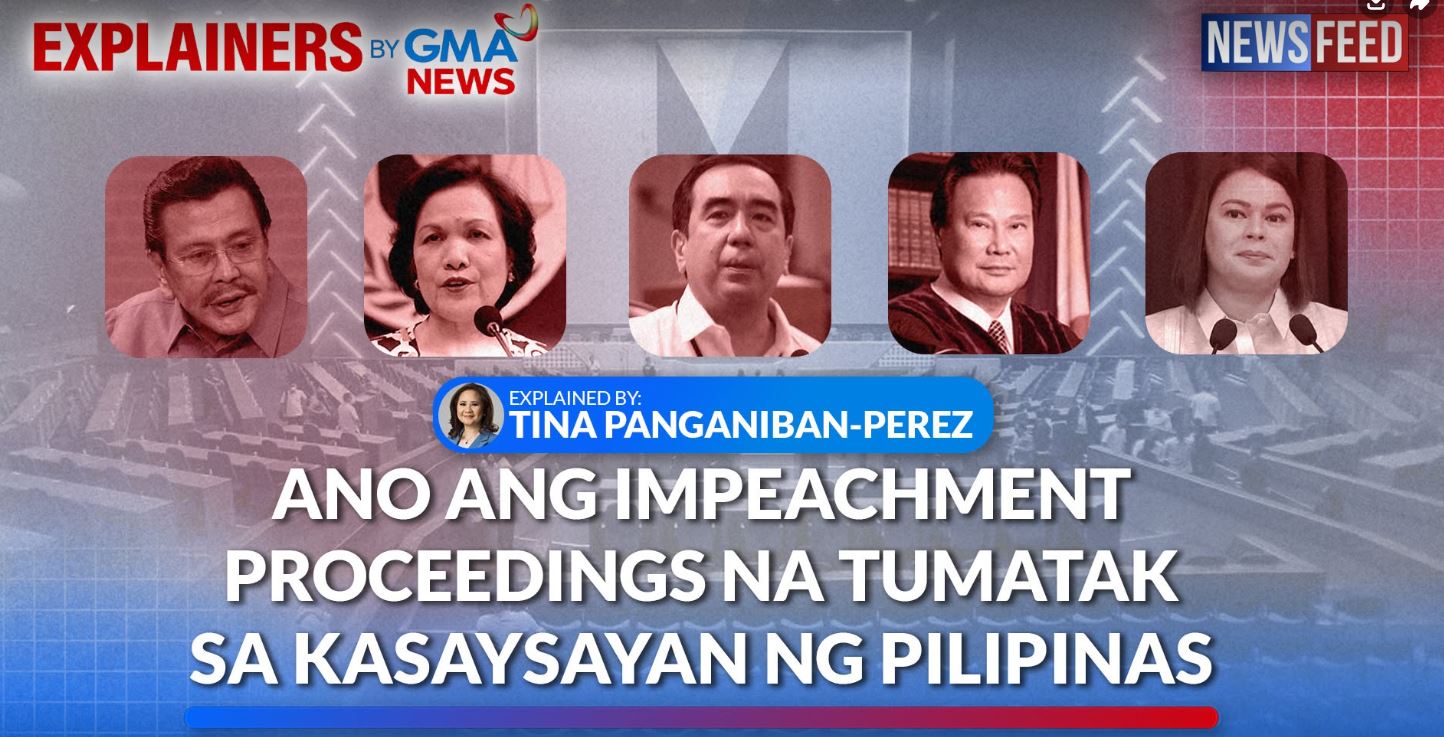
Philippines' Impeachment Cases: A Look Back at Landmark Proceedings
Politics
2026年7月8日
4
GMA News Philippines

Philippines' Impeachment Cases: A Look Back at Landmark Proceedings

AI サマリー

The Philippines' impeachment process sees officials impeached by the House of Representatives tried by the Senate. Historical cases involve former presidents and chief justices, with a Vice President recently impeached. These proceedings highlight power struggles and accountability in Philippine politics.

The House of Representatives has impeached five officials in Philippine history. Under impeachment rules, an official impeached by the House will stand trial before the Senate impeachment court. In the Senate impeachment court, senators serve as judges (senator-judges) to try the case of the impeachable official based on the Articles of Impeachment transmitted by the lower chamber. Vice President Sara Duterte stands as the most recent official impeached by the House, with her trial commencing on July 6, 2026. But before the Vice President’s case, what were the historical impeachment proceedings that went before? Ouster amid trial: Joseph Estrada Former president Joseph Ejercito Estrada was the first Philippine president to be impeached by the House of Representatives for alleged bribery and corruption. “Before the Committee on Justice to the House on the verified complaint of the members for impeachment against His Excellency President Joseph Ejercito Estrada. In case the verified complaint of the members of the House, the same shall constitute the articles of impeachment and trial by the Senate shall forthwith proceed,” former House Speaker Manny Villar declared on November 13, 2000. A wave of conflicting emotions swept through the House plenary during the reading of the Articles of Impeachment against Estrada— drawing celebration from supporters and opposition from his allies. Estrada’s case was later transmitted to the Senate impeachment court. One of the prosecution panel’s critical witnesses was Clarissa Ocampo, then senior vice president of Equitable PCI Bank, who directly linked Estrada to the controversial Jose Velarde secret bank account. Ocampo testified that she personally brought the bank documents to Malacañang on February 4, 1999, for Estrada's signature. She said that she witnessed Estrada sign the documents using the alias "Jose Velarde" to authorize a $10-million investment management agreement funded by the account. During a trial on December 22, 2000, Ocampo was asked who affixed the signature of Jose Velarde on the document in question. She answered, “The President Joseph Ejercito Estrada affixed the signature.” The impeachment proceedings became more heated during the debate on whether the “second envelope”—believed to contain crucial evidence against Estrada—should be opened. Among the senator-judges who engaged in the debate were Senator Loren Legarda and former senator Juan Ponce Enrile. “We talk of discovering the truth. There are people in this chamber who do not know the meaning of truth,” Enrile said. “Our job here is to ferret out the truth. The people deserve nothing less than to know the truth. Payagan po natin, malaman ng taong-bayan ang katotohanan sa pagbukas po ng pangalawang dokumento,” Legarda said. (… Let us allow the Filipino people to know the truth by opening the second document.) With 11 votes against and 10 in favor, the impeachment court ruled that the second envelope should not be opened. This prompted the House prosecutors, as well as several people present in the Senate, to walk out, and catalyzed the people to march once again to EDSA, an event that became known as EDSA Dos. The military also withdrew its support from Estrada and aligned itself with the public's protest. This ultimately led to Estrada stepping down from office. He became the first president of the country to be ousted from power while undergoing an impeachment trial. Pre-Trial Resignations: Ombudsman, Comelec chiefs “Tao rin ako, nasasaktan din ako. Pero sana maging fair naman itong ating mga detractors. Huwag lang naman ‘yung mga negative ang nakikita sa akin. Hindi po ako korap. Iyan po ang maipagmamalaki ko sa inyo.” (I am only human, I get hurt too. But I hope our detractors can be fair. I wish they wouldn’t just look at the negative things about me. I am not corrupt—that is something I can proudly stand by before all of you.) These were the words of then-ombudsman Merceditas Gutierrez, who was accused of alleged betrayal of public trust. Ten days before her Senate impeachment trial started on April 29, 2011, Gutierrez resigned from her post. “As the president himself has ordered his allies in the House of Representatives to impeach me. They are not interested in ferreting out the truth and seeking out real accountability. They are just interested in removing me from the office no matter what,” Gutierrez said. Due to her resignation, her impeachment trial did not proceed as expected and as scheduled. A similar scenario played out in the impeachment case of former Commission on Elections (Comelec) Chairman Andres Bautista, who resigned from his post on the same day that the House approved his impeachment. “Handa po nating harapin ang anumang paratang laban sa akin sa tamang lugar at basta tama po ‘yung proseso at kumbaga sa akin ito rin ay isa ring pagkakataon malinisan ang anumang bahid na ibinato sa akin,” Bautista said on October 11, 2017. (I am ready to face any accusation against me in the proper forum, provided that the process is correct. In a way, I see this as an opportunity to clear my name of any stains thrown at me.) Bautista was accused of betrayal of public trust for allegedly failing to address the hacking of the Comelec website in March 2016 and for allegedly failing to accurately declare his Statement of Assets, Liabilities, and Net Worth (SALN). Convicted: Renato Corona During his impeachment trial in May 2012, then-Supreme Court Chief Justice Renato Corona walked out of the Senate hall after delivering a statement, even though the impeachment court had not yet discharged him. “And now the chief justice of the Republic of the Philippines wishes to be excused,” Corona said at the end of his statement. These words were applauded by his supporters. Then-Senate President Juan Ponce Enrile insisted on his return and was prompted to order the lockdown of the Senate. Shortly after, Corona’s sugar level reportedly dropped while he was still within the Senate premises. Nearly an hour later, he returned to the hall in a wheelchair, having already removed his coat. On that same day, Corona signed a 'conditional' waiver allowing the government and banking institutions to disclose to the public all documents and information regarding his properties, businesses, and even his foreign currency accounts. Voting 20-3, the Senate sitting as the impeachment court convicted Corona for betrayal of public trust and culpable violation of the Philippine Constitution on May 29, 2012. Corona was found guilty for allegedly failing to declare his assets, including real estate properties in his SALN. He was the first official in the country to be convicted through an impeachment trial. Following his impeachment, Corona faced criminal and civil charges related to his alleged ill-gotten wealth and the misdeclaration of assets in his SALN from 2001 to 2011. Information Source: GMA News Philippines

多角的分析

経済的影響

フィリピンにおける弾劾裁判の歴史は、政治的不安定性が経済に与える潜在的な影響を示唆している。特に、大統領や最高裁長官といった要職にある人物が弾劾される事態は、国内外からの投資家心理を冷え込ませ、経済成長の鈍化を招くリスクがある。過去の事例では、弾劾プロセスそのものが経済活動を一時的に停滞させたり、為替レートの変動を引き起こしたりする可能性も指摘されている。現時点での副大統領の弾劾裁判は、今後の経済政策の不確実性を高める要因となりうる。

投資家心理

フィリピンの弾劾裁判の歴史は、投資家にとって政治リスクの重要な指標となる。過去のエストラダ元大統領のケースのように、弾劾プロセスが国民の抗議行動や政権交代に繋がる可能性は、短期的な市場のボラティリティを高める。また、コロナ元最高裁長官の有罪判決は、法の支配と説明責任の重要性を示す一方で、司法の独立性に対する懸念も生じさせうる。投資家は、これらの過去の事例を踏まえ、現副大統領の弾劾裁判の進展を注視し、政治的安定性への影響を評価する必要がある。特に、外国為替や株式市場への影響を慎重に見極める必要がある。

社会的影響

フィリピンにおける弾劾裁判は、単なる政治的プロセスに留まらず、国民の正義感や説明責任への強い要求を反映している。エストラダ元大統領の弾劾を巡る国民的大規模デモ(EDSA Dos)は、市民が政治に直接影響を与える力を持っていることを示した。また、オンブズマンや選挙管理委員会委員長の辞任は、制度疲労や政治的圧力の中で、個々の公務員が直面する困難な状況を示唆している。現副大統領の弾劾裁判は、国民の政治への関心を高め、透明性や公正さに対する社会的な期待を再確認させる機会となるだろう。これは、フィリピン社会における民主主義の成熟度を測る試金石とも言える。

市民の声

弾劾裁判のニュースは、マニラ首都圏に住む市民にとって、政治の不安定さや将来への不安を掻き立てるものです。特に、物価高や失業率の高さといった日々の生活に直結する問題が、政治の混乱によってさらに悪化しないか心配になります。エストラダ元大統領の時のように、国民が街頭に出て声を上げる事態になれば、交通渋滞が悪化したり、経済活動が停滞したりする可能性も考えられます。私たち市民は、政治家が国民のために、より安定した社会と経済を築いてくれることを願っています。

背景・歴史的文脈

フィリピンにおける弾劾制度は、1987年憲法で定められており、大統領、副大統領、最高裁判所長官、憲法裁判所長官、オンブズマンといった高官の不正行為や公務への背信に対する説明責任を確保するための重要なメカニズムである。過去の弾劾事例は、フィリピンの政治史における権力闘争、説明責任の追求、そして国民の意思が政治に与える影響の大きさを示している。特に、エストラダ元大統領の弾劾とその後の国民運動は、市民社会の力と民主主義の回復におけるその役割を浮き彫りにした。これらの歴史的背景は、現副大統領の弾劾裁判が、単なる法的手続き以上の意味を持つことを示唆している。

原文ソース

GMA News Philippines

原文を読む