General articles are free for 24 hours after publish.
Japan's FOIP 3.0: Pragmatism and Resilience for ASEAN Cooperation
Japan has unveiled "FOIP 3.0," an updated vision for its Free and Open Indo-Pacific strategy, prioritizing economic infrastructure and security cooperation with ASEAN. The initiative focuses on AI, data, and economic security to enhance regional resilience.
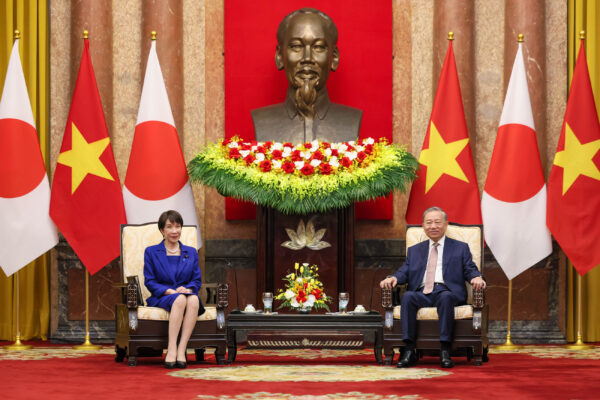
Japan's Prime Minister Takaichi Sanae visited Vietnam in early May this year, presenting an "evolved version" of the Free and Open Indo-Pacific (FOIP), a cornerstone of Japanese foreign policy, now dubbed FOIP 3.0. The "Updated FOIP" specifies priority areas: "Building economic infrastructure for the age of AI and data," "Co-creation of economic growth opportunities through public-private collaboration and rule sharing," and "Enhancing cooperation in the field of security to ensure regional peace and stability," each with concrete cooperation items. The FOIP was first proposed by the late Prime Minister Abe Shinzo in 2016, with "connectivity" as its keyword, amidst a significant power balance shift due to China's rise. International divisions deepened following the Russo-Ukrainian war and the rise of the Global South, making international politics more complex. In response, then-Prime Minister Kishida Fumio proposed the New Plan for a FOIP, or FOIP 2.0, in 2023, with "inclusiveness" as its keyword. Building on this foundation, the keyword for FOIP 3.0 under the Takaichi administration is "resilience." With improved relations with China unlikely in the near future and the U.S. pursuing an unpredictable foreign policy, Japan faces a "double risk." It needs to deepen cooperation with Indo-Pacific countries to mitigate these risks and ensure autonomy and resilience. The new FOIP is thus heavily shaped by the imperative to revitalize the Japanese economy and strengthen economic security through cooperation with the Global South, including ASEAN countries. The strategy of connecting Japanese growth, economic security, and Global South engagement has been clear since the Kishida administration. That administration adopted the "New Policy toward Enhanced Cooperation with Global South Countries" in June 2024 and implemented institutional schemes like the "Global South Future-Oriented Co-Creation Project" and "Official Security Assistance (OSA)," alongside reforming Official Development Assistance (ODA). The "Asia Zero Emission Community (AZEC)" is another scheme launched under that administration. However, while FOIP 2.0 emphasized Japan's ideal international order, FOIP 3.0 does not explicitly define an order; instead, it promotes a pragmatism that more clearly emphasizes economic renewal and the restoration of Japan's vitality. The three priority areas of FOIP 3.0 each list their own spheres for concrete cooperation, identified by the "Council for Japan’s Growth Strategy." These are areas where Japan aims to promote development, with special emphasis on AI and semiconductors, digital server security, information and communications, and quantum technology – fields relevant to digital hegemony. What the times may call for is precisely this kind of pragmatism: an emphasis on revitalizing the Japanese economy and strengthening economic security in the name of "resilience." Resilience has become an equally important theme for ASEAN countries navigating what could be called the "geoeconomic turn." Confronted with potential Trump tariffs, energy supply disruptions, and related pressures, they have become increasingly interested in cooperation to mitigate geoeconomic risks. Key to surviving this uncertainty will be each ASEAN country's ability to connect its national interests and resilience to broader regional cooperation. Through FOIP, Japan aims not only to cooperate with individual ASEAN countries but to support ASEAN’s collective efforts to build resilience, contributing to risk mitigation across the region. Japan can no longer rely on overwhelming economic power and technological advantage as the basis for cooperation with ASEAN countries and other parts of the Global South. There are limits to cooperation built solely on the pragmatism of shared gains. For Japan to earn the trust of ASEAN countries and others in the Global South, it must also clearly demonstrate its commitment to a rules-based international order capable of constraining the arbitrary actions of major powers. Japan is advancing concrete initiatives, but it must also clearly articulate the worldview behind FOIP — the kind of order it is trying to build — in light of today’s upheavals. Information Source: The Diplomat Indonesia
Original source
The Diplomat Indonesia