General articles are free for 24 hours after publish.
Vietnam's National Assembly Convenes Special Session Amid Push to Improve Lawmaking Quality
Vietnam's National Assembly has convened a "non-ordinary" special session from August 3 to August 24, aiming to pass 15 laws and 4 resolutions, and discuss 7 others. Key legislation impacting citizens, such as amendments to the Penal Code and Land Law, are on the agenda. This session signals the government's commitment to rapid, sustainable development under the guidance of the Communist Party.
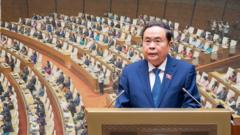
Vietnam's National Assembly is holding a special "non-ordinary" session from August 3 to August 24, a period of 17 days. The session is intended to review and legislate urgent and important matters crucial for the country's rapid and sustainable development, reflecting the government's political resolve and proactiveness. National Assembly Chairman Tran Thanh Man emphasized this commitment during his opening remarks. The agenda includes the consideration and passage of 15 laws and 4 resolutions, with an additional 7 draft laws to undergo their first review. Among the most anticipated legislation are amendments to the Penal Code, Code of Criminal Procedure, Land Law, and Housing Law, all of which have significant implications for citizens. The proposed amendments to the Penal Code include the abolition of the death penalty for six offenses, the addition of cases for excluding criminal liability, new provisions related to personal data, and enhanced regulations to protect the Communist Party of Vietnam. The Land Law amendments come at a time when Hanoi and Ho Chi Minh City are undertaking large-scale land reclamation projects, sparking debates and disagreements over compensation and resettlement. The Central Committee has reiterated its stance against the privatization of land, asserting that the state will regulate, control, and determine land prices, directly impacting the populace. A notable change in the Housing Law amendments is the introduction of a new type of condominium with a limited duration. Beyond legislative matters, the session will also address major construction projects such as the Hanoi Capital Region Ring Road No. 5, the Lao Cai-Hanoi-Hai Phong railway, and the Ninh Thuan nuclear power plant project. The establishment of two new cities, Quang Ninh and Bac Ninh, will also be reviewed. Furthermore, special mechanisms and policies to facilitate projects for the 2027 APEC Summit in Phu Quoc Special Economic Zone and An Giang province will be considered. These agenda items are largely derived from directives issued by the Communist Party. In terms of personnel, the appointment of a new Minister of Home Affairs is expected, though no official candidate has been named. Chairman Man urged the National Assembly to legislate not merely to fulfill a program but to pave the way for development. He called on delegates to enhance the quality and embrace innovative thinking in lawmaking, stressing that policies and laws must be grounded in reality and serve as catalysts for progress. Over the years, Vietnam's National Assembly has shifted from being a body that supervises and critiques government policies to one that prioritizes the rapid legislative institutionalization of the Party's will. Draft laws are typically prepared by ministries, often led by the Ministry of Public Security, and then reviewed and passed by the Assembly. However, the lack of thorough scrutiny and counter-argumentation in the legislative process raises concerns about regulations potentially reflecting the will of administrative bodies more than the protection of citizens' rights. The current National Assembly has no practicing lawyers among its members, raising questions about the capacity for substantive legal debate on policy impacts. Moreover, with over 96% of delegates being Party members, who are bound to follow Party directives, decisions made by the Communist Party tend to be approved by the Assembly, a situation underscored by Chairman Man's call to implement Party policies. Information Source: BBC Vietnamese
Original source
BBC Vietnamese