General articles are free for 24 hours after publish.
Marcos Highlights Anti-Corruption Drive and Economic Stability in SONA
Philippine President Marcos, in his 2026 State of the Nation Address (SONA), underscored the success of his anti-corruption drive and economic stabilization measures amid Middle East tensions. He reported on the crackdown of corruption in infrastructure projects and the freezing and recovery of assets worth approximately P25 billion.
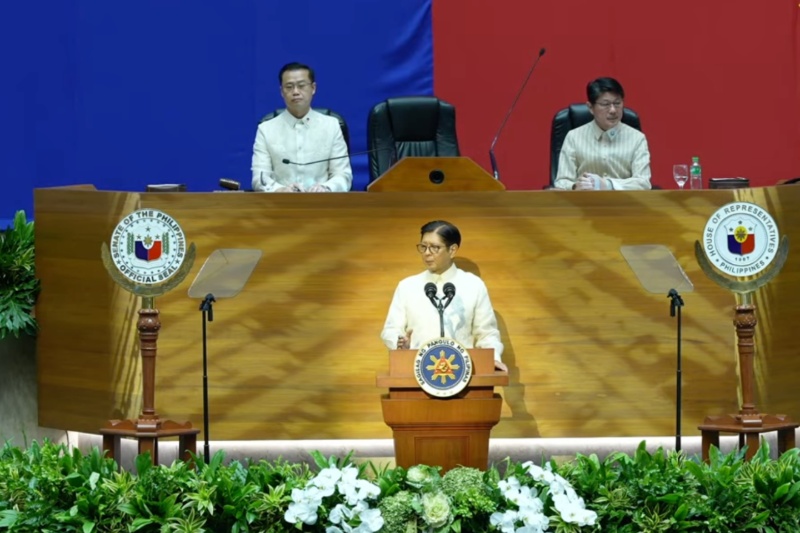
Delivered at the Batasang Pambansa Complex, Quezon City on Monday, July 27, 2026, President Ferdinand Marcos Jr. addressed the nation in his State of the Nation Address (SONA), fulfilling his duty to report on the country's status and the government's actions. One year after his previous address, the President highlighted the intensified campaign against corruption, particularly within flood control projects. He revealed that a comprehensive and meticulous investigation, guided by evidence, has led to the prosecution and imprisonment of contractors, high-ranking officials from the Department of Public Works and Highways (DPWH), and even legislators. Approximately P25 billion in public funds and assets, obtained through corruption, have been recovered, frozen, or preserved, with over P800 million already returned to the Treasury. All recovered funds from those involved in corruption will be returned to the national coffers. The prosecution of these cases has been entrusted to the Ombudsman and the strengthened National Prosecution Service, with confidence placed in the judiciary for fair judgments. The wheels of justice are turning, and citizens can expect fair outcomes. Despite these events, the nation must move forward towards progress. The "Isumbong sa Pangulo" (Report to the President) platform has been instrumental, with public vigilance and participation being key to combating corruption. Reforms within the DPWH have commenced, with new graduates and trustworthy job order and contract of service personnel being integrated. All projects, beyond flood control, have undergone rigorous scrutiny to ensure necessity and proper execution, from planning and pricing to implementation. To prevent overpricing, materials are sourced based on market prices. Transparency is maintained through a Transparency Portal, Integrity Chain, and collaboration with Civil Society Organizations, ensuring close monitoring of every project and its allocated funds. In response to the State of National Energy Emergency declared due to Middle East tensions, the administration's mission is "UPLIFT" – to uplift the citizenry. All agencies were directed to economize and focus on programs crucial for addressing the crisis. Funds are being channeled where they are most needed and will have the greatest impact on citizens' lives. The public funds that were almost pocketed by corrupt officials have been saved and are now being used for the genuine welfare of the people. An additional P58 billion in funds has been allocated to local government units (LGUs) to enhance their capacity for public service delivery, reflecting high confidence in their ability to serve their constituents. This also prepares LGUs for expanded service provision. The immediate priority was assisting those directly affected by the conflict: the repatriation of OFWs caught in the war. This is a critical mission, given that over 2.5 million Filipinos work in the Middle East. Since the conflict began, over 12,000 Filipinos have been safely brought home. More than 140,000 OFWs have received various forms of assistance amidst the Middle East crisis, including food, financial aid, medical care, and shelter. Upon returning to the Philippines, they are supported in restarting their careers through the AKSYON Fund and the OWWA-Kabuhayan program. Others are connected with PESO (Public Employment Service Office) or included in "Bayanihan para sa Balikbayang Manggagawa" job fairs. Some are assisted in finding new employment abroad. Additionally, returning OFW teachers will be deployed to public schools where they are most needed, serving as "Ma'am" and "Sir" in the Philippines. The government continues its engagement with various countries and its support for OFWs' safety, especially as some Filipinos have been reported missing or have perished in the Middle East. Secondly, due to strong diplomatic ties, the Philippines has ensured sufficient oil supply. Despite the closure of the Strait of Hormuz, the country has been able to purchase and import oil from diverse sources like Japan, South Korea, Oman, India, Russia, and even China, securing a supply that can last for nearly two months. Discussions were also held with Iran to ensure the safety of thousands of Filipino seafarers in the Strait of Hormuz. In cooperation with oil companies, the increase in fuel prices was gradual over a week, easing the burden on consumers. The government has mandated a series of significant price rollbacks from oil companies. Furthermore, the imposition of excise taxes on LPG and kerosene was suspended for three months, as mandated by a law passed by Congress. The price increase of imported rice has also been immediately limited. Individuals exploiting the situation during the state of energy emergency have been arrested and charged. Every possible measure has been taken to lower prices and slow down their escalation. Many have been affected or lost their jobs during this period. Consequently, job fairs continue nationwide. On May 1st, Labor Day and amidst high crude oil prices, nearly 100 job fairs were conducted, offering approximately 300,000 jobs to the public. In a single day, over 6,000 Filipinos were hired on the spot. Salaries were also distributed to over 100,000 beneficiaries working under DOLE's DILEEP and TUPAD programs. Immediate action was taken to curb the rapid increase in the prices of goods. Banks and e-wallets were encouraged to reduce or waive their usual transaction fees, leading many to lower or eliminate their online transaction charges. Source: Interaksyon Politics
Original source
Interaksyon Politics