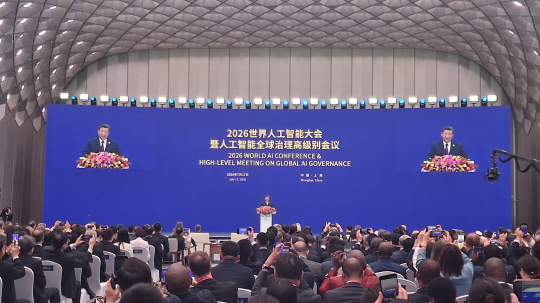
Laos Participates in Shanghai AI Conference, Calls for Stronger Global AI Governance
Technology
2026年7月17日
5
KPL Laos News
Relations
🇱🇦Laos🇻🇳Vietnam🇨🇳China

General articles are free for 24 hours after publish.

Laos Participates in Shanghai AI Conference, Calls for Stronger Global AI Governance

AI サマリー

Laos sent a high-level delegation, including the Deputy Prime Minister and Minister of Foreign Affairs, to the World AI Conference in Shanghai, echoing China's call for stronger global AI governance. The importance of AI development, challenges, and international cooperation was emphasized.

The Lao delegation was led by Mr. Thongsavanh Phomvihane, Deputy Prime Minister and Minister of Foreign Affairs, accompanied by Mr. Santisouk Simmalavong, Minister of Technology and Communications, and Ms. Mukdavanh Sisoulith, Director General of the Department of International Organizations at the Ministry of Foreign Affairs. In his keynote address, Chinese President Xi Jinping described artificial intelligence as a transformative force driving a new wave of scientific and industrial innovation. While AI presents enormous opportunities for economic and social development, he said it also raises important challenges related to governance, ethics, security, and the widening digital divide. To address these challenges, President Xi proposed a four-point framework for global AI governance. He called for expanding open and mutually beneficial cooperation, strengthening AI safety and risk management, promoting cultural diversity and inclusiveness, and reinforcing multilateral cooperation to establish fair and effective international governance mechanisms, with particular attention to supporting developing countries and the Global South. President Xi stressed that AI should serve as a shared public good rather than the exclusive domain of any single country, emphasizing that international cooperation is essential to ensure the technology benefits all humanity. China also announced several new initiatives, including an AI Capacity Building Action Plan, the establishment of international AI cooperation mechanisms, and the provision of 1,000 training and research opportunities for professionals from developing countries over the next three years. Additional plans include creating international AI application cooperation centers and deploying AI-powered weather forecasting technologies in 30 countries. Concluding his address, President Xi reaffirmed China's commitment to greater international openness and practical cooperation, inviting countries worldwide to work together to ensure artificial intelligence contributes to sustainable development, shared prosperity, and the well-being of humanity. The participation of the Lao delegation at the World AI Conference 2026 in Shanghai signifies Laos' active engagement in global discussions on cutting-edge technologies like AI, as it seeks to advance its economic development and international relations under its one-party system. China's proposed initiatives, such as the AI Capacity Building Action Plan and the establishment of international AI cooperation mechanisms, including providing 1,000 training and research opportunities for professionals from developing countries over the next three years, reflect China's emphasis on supporting developing nations. These could potentially help Laos bridge its technological gap and foster economic growth. Laos has historically maintained close ties with Vietnam and has increasingly strengthened its economic and political links with China in recent years. Enhanced cooperation with China in the AI sector could provide Laos with opportunities for technical and financial support in its digitalization efforts, while also potentially increasing China's influence. The conference also saw representatives from 29 countries sign an agreement to establish the World AI Cooperation Organization (WAICO), marking a significant step towards building an international framework for stronger global AI governance. How Laos will navigate its role within this framework and leverage it for its own AI development and societal implementation remains to be seen. Source: KPL Laos News

0

多角的分析

経済的影響

ラオスはAI会議への参加を通じて、中国が主導するAI関連の国際協力や技術支援の機会を探る意向を示唆している。これは、ラオスが抱える経済発展の遅れとデジタル化の必要性を背景に、中国からの直接的な経済支援や技術移転を期待する動きと解釈できる。特に、AI容量構築行動計画や途上国への人材育成支援は、ラオス経済の多角化や産業高度化に寄与する可能性があり、中国経済圏へのさらなる統合を促す要因となりうる。

投資家心理

AI分野における中国主導の国際協力強化の動きは、ラオスへの直接的な投資機会を限定的にする可能性がある。しかし、中国がAI技術を途上国に展開する際に、インフラ整備や関連産業への投資を伴う場合、間接的な投資機会が生まれることも考えられる。ラオス国内の投資家にとっては、AI関連のローカルビジネスへの参入や、中国企業との合弁事業などが新たな選択肢となるかもしれない。

社会的影響

AI技術の急速な発展と普及は、ラオス社会においてもデジタルデバイドの拡大や、雇用構造の変化といった影響をもたらす可能性がある。今回の会議への参加は、ラオス政府がこれらの課題を認識し、国際的な議論に参加することで、AI技術の恩恵を国民全体に広げ、負の影響を最小限に抑えるための道筋を探る姿勢を示している。しかし、一党体制下での情報統制や、国民への技術リテラシー教育の遅れが、AIの恩恵を享受する上での障壁となる可能性も指摘される。

市民の声

AI技術の進化は、ラオス国民の日常生活や雇用機会に間接的な影響を与える可能性がある。特に、AIによる自動化が進む産業分野では、既存の雇用が失われるリスクも考えられる。一方で、AIを活用した教育や医療サービスの向上、農業分野での生産性向上などが期待される。今回の会議への参加は、政府がAI技術の導入を検討する上で、国民生活への影響を考慮するきっかけとなるだろうが、その恩恵が国民全体に行き渡るかは、今後の政府の政策実行にかかっている。

背景・歴史的文脈

ラオスは社会主義一党体制を維持しつつ、経済発展のため対外開放政策を進めている。特に中国とは、インフラ開発や経済協力において近年関係を深めている。ベトナムとは伝統的に緊密な関係を維持しているが、中国の影響力増大に伴い、そのバランスが変化しつつある。AIという最先端技術分野における国際協力は、ラオスがデジタル化を進め、経済発展を加速させる上で重要な要素となる。中国が主導するAIガバナンス強化の動きは、グローバルな技術標準やルール形成において、途上国が自国の立場を確立する機会を提供する一方で、中国の影響力拡大という側面も持ち合わせている。

原文ソース

KPL Laos News

原文を読む