General articles are free for 24 hours after publish.
Gulf Conflicts Expose Vulnerability of Asian Migrant Workers
Escalating conflicts in the Gulf region have turned Asian migrant workers, the backbone of its economies, into forgotten civilian casualties. They face significant economic and physical risks with inadequate protection.
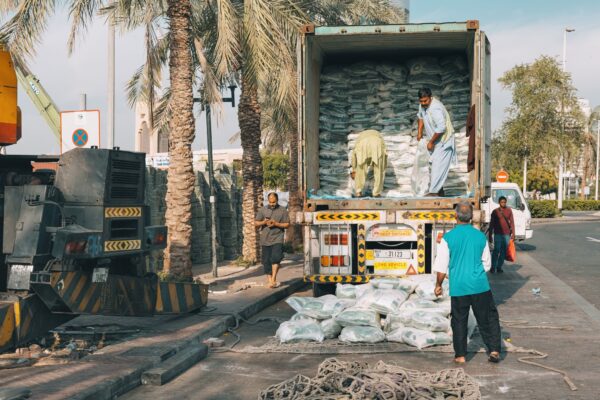
Read The Diplomat, Know The Asia-Pacific The migrants who build, clean, drive, guard, and operate the Gulf’s economies have become the forgotten civilian casualties in its wars. Migrant workers unload a truck in Dubai, UAE, Jan. 10, 2026. Asian migrant workers are indispensable to the Gulf’s economy. Yet, they remain highly vulnerable and unprotected when regional conflict reaches their homes and workplaces. On February 28, after the Iranian attack on the United Arab Emirates, the first deaths included a Bangladeshi, a Pakistani, and a Nepali worker. Human Rights Watch reported at least 11 civilian deaths and 268 injuries across the Gulf by March 16, with migrant workers comprising most of the victims. At least 10 of those killed were foreign nationals. Some died in direct strikes; others were killed by falling debris from air defense interceptions. The known death toll is likely an undercount. There is no public, regionwide casualty registry that consistently records victims’ nationality, occupation, and immigration status. Nor is there a standing regional mechanism that guarantees compensation, evacuation, or income protection for migrants caught in hostilities. The people who build, clean, drive, guard, and operate the Gulf’s economies have become the forgotten civilian casualties in its wars. Migrants make up an overwhelming share of the population in states such as the UAE and Qatar, and South Asians constitute a large part of that workforce. They work at ports, airports, construction sites, logistics hubs, energy facilities, hotels, and industrial zones – precisely the places most likely to be disrupted or targeted in a regional confrontation. During the Iran war, reporting documented workers’ fears about workplace safety, restricted access to shelter, job losses, and employers’ failure to communicate emergency plans. For many workers, leaving the region is difficult financially and logistically. Migration to the Gulf is often financed through loans used to pay recruitment fees and travel costs. A worker who returns home abruptly may lose both income and the means to pay back that debt. The decision to remain during a conflict is therefore not always a choice between safety and work; it can be a choice between physical danger and financial collapse for an entire household. Even for those who wish to leave, it can be difficult to do in practice. Sponsorship-based labor systems, despite reforms in several states, can still leave workers dependent on employers for documents, housing, transport, and information at the very moment mobility matters most. Current labor and compensation systems in the Gulf are designed mainly for routine occupational injuries, not missile attacks, prolonged airspace closures, or emergency evacuation. Some labor-sending countries attempt to provide some safeguards for their citizens. Bangladesh, for example, repatriates the bodies of deceased workers and provides support to their families. Its official migrant-insurance system can provide up to 1 million taka ($8,140) in death compensation to registered workers, alongside the Wage Earners’ Welfare Board’s grants for bereaved families. But those protections depend on registration, documentation, and successful claims processing. Undocumented workers and workers who fall outside formal recruitment channels often receive much less or nothing beyond repatriation assistance. Even where compensation is paid, a one-time benefit cannot replace the lifetime earnings of a person whose household borrowed heavily to send them abroad. When workers are injured, stranded, or laid off during hostilities, in practice, the costs fall on the household as a family loses its main earner while retaining the migration debt that financed the journey. This outcome is not accidental. Origin states measure the success of overseas employment through remittance flows. Recruitment intermediaries’ profit when placement costs are shifted onto workers. Destination-state employers’ benefit from a labor system that supplies workers cheaply and flexibly. None of them – the origin state’s government, the recruiters, or the employers – has a strong financial incentive to address conflict risk. The worker, who has the least bargaining power, absorbs it instead. The region already has the institutions needed to change this. The Colombo Process brings together Asian labor-sending states, while the Abu Dhabi Dialogue includes both origin countries and major destinations in the Gulf and beyond. These forums have rightly focused on ethical recruitment, skills recognition, and reducing remittance costs. But the Iran war shows that a labor migration agenda built for peacetime is no longer sufficient. The first step should be a conflict-contingency protocol attached to bilateral labor agreements. It should require employers and destination governments to provide multilingual emergency information, equal access to shelters, secure access to passports and identity documents, safe transport or evacuation when necessary, and continued wages when work is suspended by conflict. These are not radical demands. They are basic conditions for treating migrant workers as people with rights, not expendable labor inputs. Second, the Abu Dhabi Dialogue should establish a pooled conflict-risk facility. It should be financed by a small employer levy in destination states, rather than by deductions from workers’ earnings or already overstretched origin-country welfare funds. The facility should cover death, serious injury, emergency repatriation, and temporary income support during conflict-related work stoppages. Third, governments should publish clear claims rules before the next crisis. Hostile-fire deaths and injuries should be presumed covered, rather than forcing families to navigate opaque distinctions between an “accident,” a workplace incident, and an act of war. Irregular immigration status must never bar a worker from emergency shelter, medical care, evacuation, or the repatriation of remains. Finally, the region needs a joint, publicly accessible casualty registry. A registry that records nationality, gender, occupation, cause of death or injury, and compensation status would make it harder for workers to disappear into aggregate civilian-casualty figures. All of these measures can be accomplished through existing mechanisms, but it will be easier if Asian origin states bargain collectively rather than separately. India, Bangladesh, Nepal, Pakistan, and Sri Lanka have greater leverage together than they do in parallel bilateral negotiations. A common position on conflict protection would be a practical test of whether the Colombo Process can become more than a forum for discussion. The number of migrant workers killed in this war is small compared with the wider human toll of the conflict. But it is large enough to establish the precedent. South Asia has sent millions of people to sustain the Gulf’s growth, while assuming
Original source
The Diplomat Indonesia