Indonesia Rejects Exclusive Blocs, Foreign Minister States 'Active Freedom' Not Passive or Neutral
Politics
2026年7月10日
5
VOI English
Relations
🇮🇩Indonesia🌐United Nations / ASEAN

Indonesia Rejects Exclusive Blocs, Foreign Minister States 'Active Freedom' Not Passive or Neutral

AI サマリー

Indonesian Foreign Minister Sugiono stated at the Jakarta Geopolitical Forum that Indonesia will not be drawn into exclusive blocs, pursuing a free and active foreign policy. Participation in diverse frameworks like BRICS and ASEAN is aimed at expanding strategic space and strengthening multilateralism.

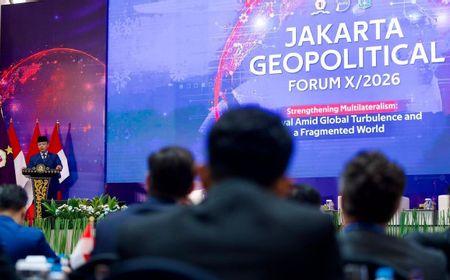
Indonesian Minister of Foreign Affairs Sugiono emphasized that Indonesia will not be dragged into exclusive blocs, with active free foreign policy does not mean passive or neutral, according to Indonesian Foreign Minister Sugiono, highlighting Indonesia's presence in ASEAN to BRICS. Indonesian Minister of Foreign Affairs Sugiono emphasized that Indonesia will continue to strengthen multilateralism so that it is still able to work in the midst of an increasingly fragmented and uncertain world. The message was conveyed by Foreign Minister Sugiono in a keynote speech at the 10th Jakarta Geopolitical Forum (JGF) which was held by the National Resilience Institute (Lemhannas) RI. In his speech, Foreign Minister Sugiono emphasized that free foreign policy is not only relevant, but is increasingly needed in the face of current global geopolitical dynamics. In the midst of an increasingly fragmented world and marked by strategic rivalries, Indonesia is free to actively provide space for Indonesia to determine its own stance, while still actively contributing to world peace, stability, and order. Indonesian Minister of Foreign Affairs Sugiono speaking at the 10th Jakarta Geopolitical Forum. (Source: Indonesian Ministry of Foreign Affairs)"Being free to be active does not mean being passive or neutral. Indonesia will not be dragged into exclusive blocs, but will continue to build bridges and expand its strategic space," explained Foreign Minister Sugiono, launching the Indonesian Ministry of Foreign Affairs, Thursday (9/7). Furthermore, the RI Menu also underlined that the current weakness of the multilateral system should not be an excuse to abandon multilateralism. Instead, the system must be improved to be more representative, inclusive, adaptive, and effective. "The global governance that was built in 1945 needs to continue to be updated so that it remains relevant in the face of the reality of the world in 2045," said Foreign Minister Sugiono. In this context, Indonesia will maintain and improve the multilateralism system, by continuing to encourage global governance reform, including a more transparent, democratic, effective, and accountable UN Security Council. Indonesia will also continue to voice these interests through various forums. "Participation in BRICS, active role in G20, leadership in ASEAN, involvement in D-8 and with the Global South, as well as the accession process to the OECD, are all part of the same principle, namely expanding the strategic space of Indonesian diplomacy," explained Foreign Minister Sugiono. Foreign Minister Sugiono also emphasized that effective diplomacy must be supported by strong national resilience. "Food security is strategic autonomy. Energy security is national security. Human resources are geopolitical capacity. And technology is not only innovation, but also power," said Foreign Minister Sugiono. Closing his speech, Foreign Minister Sugiono conveyed Indonesia's commitment to continue to be present and maintain multilateralism. "Multilateralism can still work, but it can't run on autopilot," he concluded. It is known that JGF is an annual forum held by Lemhannas RI to discuss various global geopolitical issues. This forum brings together participants from government, military, academia, think tanks, international organizations, private sector, and media.

多角的分析

経済的影響

インドネシアは、特定の経済圏への過度な依存を避け、多様な国際経済フォーラム(ASEAN、G20、BRICS、OECD加盟プロセスなど)への参加を通じて、自国の経済的機会を最大化しようとしている。これは、グローバルサプライチェーンの再編や地政学的リスクの高まりの中で、経済的レジリエンスを高めるための戦略と見られる。BRICSへの関与は、新興市場との連携強化を示唆し、OECD加盟プロセスは、国際的な経済・投資基準への適合と、より広範な市場アクセスを目指す動きである。

投資家心理

インドネシアの「自由で能動的な」外交政策は、投資家にとって、特定の地政学的リスクへの過度なエクスポージャーを避ける機会を提供する。多様な国際的枠組みへの参加は、インドネシアがグローバル経済の変動に対してより柔軟に対応できる可能性を示唆する。OECD加盟プロセスは、規制の透明性や予測可能性の向上につながり、外国直接投資(FDI)にとって魅力的な環境を醸成する可能性がある。ただし、地政学的な不確実性は依然としてリスク要因となりうる。

社会的影響

インドネシアの外交政策は、国内の多様な社会経済的利益を調整し、国際社会での発言力を維持・拡大することを目指している。排他的集団への不参加は、国内の様々な社会層や経済セクターが、特定の同盟国からの圧力や制約を受けることなく、グローバルな経済機会や技術革新から恩恵を受けられるようにするための配慮とも解釈できる。また、多国間主義の強化は、国際社会におけるインドネシアのソフトパワーを高め、国内のナショナリズムやアイデンティティの形成にも影響を与える可能性がある。

市民の声

インドネシア国民にとって、この外交方針は、自国が国際社会で孤立することなく、多様な国々との関係を維持・発展させることを意味する。これにより、経済的な機会の拡大や、国際的な問題解決への貢献が期待される。一方で、外交政策の複雑化は、国民が国際情勢を理解し、自国の立ち位置を把握する上での課題となる可能性もある。特に、若年層はSNSなどを通じて国際情勢に関心を持つ一方、情報リテラシーの重要性が増すだろう。

背景・歴史的文脈

インドネシアは建国以来、「自由で能動的な」外交政策を掲げ、冷戦期には非同盟運動の中心的な役割を担った。これは、東西両陣営に偏らず、自国の国益を最大化し、国際社会における独立した発言権を確保するための戦略である。特に、ASEAN(東南アジア諸国連合)における主導的役割は、地域における平和と安定を維持し、インドネシアの影響力を高める上で不可欠な要素となっている。近年、グローバルなパワーバランスが変化し、地政学的な緊張が高まる中で、インドネシアはBRICSのような新興経済圏への関与や、OECD(経済協力開発機構)への加盟プロセスを進めることで、外交的・経済的な選択肢を広げ、戦略的空間をさらに拡大しようとしている。これは、自国が特定の勢力圏に巻き込まれることを避けつつ、国際社会における影響力を維持・強化しようとする、過去からの政策の一貫性と現代的な適応を示している。

原文ソース

VOI English

原文を読む