Philippine Diesel Prices to Rise Again Amidst Middle East Tensions
Economy
2026年7月13日
5
Rappler Business

Philippine Diesel Prices to Rise Again Amidst Middle East Tensions

AI サマリー

Diesel prices in the Philippines are set to increase again starting July 14 due to rising international refined fuel prices, driven by escalating tensions in the Middle East. The government plans to enhance price monitoring to protect consumers.

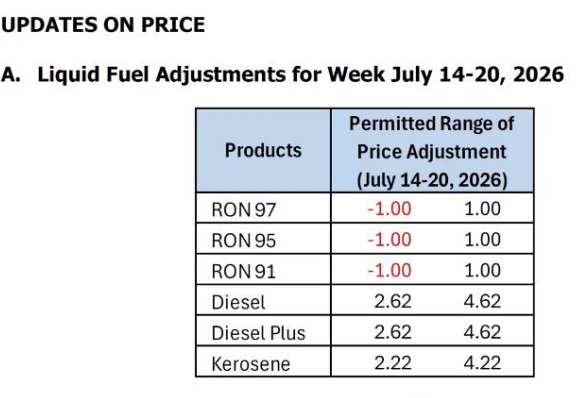
MANILA, Philippines – Diesel prices are set to rise again starting Tuesday, July 14, as renewed volatility in the Middle East keeps pressure on refined fuel prices despite recent easing in crude oil. In a press conference on Monday, July 13, Energy Secretary Sharon Garin announced the following permitted price range adjustments for the week of July 14 to 20: Gasoline – from a decrease of P1 per liter to an increase of up to P1 per liter Diesel – increase of P2.62 to P4.62 per liter Kerosene – increase of P2.22 to P4.22 per liter The adjustments will take effect on Tuesday, July 14. “Last week, kumakalma siya, pero ngayon po (it was already calming down, but now), the recent days, there’s still growing tensions in the region,” Garin said during the press conference. “In particular, threats to navigation through the Strait of Hormuz have underscored the vulnerability of one of the world’s most critical energy trade corridors, placing upward pressure.” “Umaakyat na naman ‘yung pressure on international crude oil prices and consequently, apektado dito po ‘yung domestic pump prices natin. So expect a slight increase in our prices.” (The pressure on international crude oil prices are increasing again, and consequently, our domestic pump prices will be affected. So expect a slight increase in our prices.) Garin also said that if the situation in the Middle East does not improve by next week, price ranges will no longer be used. Instead, the Department of Energy (DOE) will issue only a minimum or maximum rollback or oil price hike. “This is in protection of the consumers. Kailangan ma-monitor natin ng maayos ng mga consumers natin at ng DOE, na lahat po ng mga presyo natin are reflective of what is the adjustment internationally,” Garin added. (This is to protect consumers. We need to properly monitor, both for consumers and the DOE, to make sure that all our prices reflect international adjustments.) For the week of July 7 to 13, the DOE price monitoring showed common retail prices in Metro Manila at P74.60 per liter for gasoline RON95, P67.20 per liter for gasoline RON91, P72.80 per liter for diesel, and P100.40 per liter for kerosene. The latest adjustment follows last week’s implemented price increase, which saw oil firms raise pump prices by P0.20 to P0.25 per liter for gasoline, P3.20 to P3.57 per liter for diesel, and P1.70 to P3.70 per liter for kerosene. (READ: Tax breaks on kerosene, LPG end. How will this affect prices?) Currently, there’s also a divergence in movements of crude and refined fuel benchmarks. The DOE’s oil monitor as of July 7 showed that Dubai crude prices fell by around $2.40 per barrel during the June 29 to July 3 trading period. International gasoline prices also declined by around $3.20 per barrel. But kerosene and diesel prices moved in the opposite direction, increasing by around $3.10 per barrel and $2.50 per barrel, respectively. That matters for Philippine pump prices because the country imports much of its fuel as finished petroleum products, including diesel and gasoline. This means local pump prices are more directly influenced by the Mean of Platts Singapore (MOPS) which tracks regional traded prices of finished fuels, rather than Dubai crude alone. Crude prices had eased earlier on improving Middle East supply flows and the improving flows through the Strait of Hormuz. But the situation remains fragile after renewed exchanges between the United States and Iran again raised concerns over shipping through the key oil route, with Iran declaring that it had closed the strait once more. The Strait of Hormuz, the narrow waterway between Iran and Oman, remains one of the world’s most important oil shipping routes. Any disruption to tanker traffic can quickly affect global crude and refined product prices. Despite recent easing in Dubai crude, local pump prices remain above levels seen before fighting involving Iran and US-Israeli forces erupted on February 28. In the last full week before the conflict, DOE data showed common retail prices in Metro Manila at P56 per liter for gasoline RON95, P54.70 per liter for gasoline RON91, P55 per liter for diesel, and P83.47 per liter for kerosene. The Philippines is a net importer of petroleum products, making local pump prices vulnerable to global oil price swings, foreign exchange movements, regional refined fuel prices, and disruptions in international supply routes. – Rappler.com

多角的分析

経済的影響

フィリピンは石油製品の純輸入国であり、国際的な原油価格の変動に極めて脆弱です。今回のディーゼル価格の上昇は、運輸コストの増加を通じて、国内のインフレ圧力をさらに高める可能性があります。特に、ガソリンやディーゼルはフィリピン経済の基盤となる運輸・物流セクターで広く使用されており、その価格上昇は食品やその他の必需品の価格にも波及し、家計を圧迫することが懸念されます。過去の事例でも、原油価格の上昇はフィリピンの消費者物価指数(CPI)に直接的な影響を与えてきました。

投資家心理

投資家にとって、フィリピンの燃料価格上昇は、コスト増加による企業収益への影響を意味します。運輸・物流、農業、製造業など、燃料を多用するセクターは直接的な打撃を受けます。これらの企業は、価格転嫁やコスト削減策を講じる必要がありますが、消費者の購買力低下も考慮しなければなりません。また、フィリピンペソの為替レートの変動も、輸入燃料のコストに影響を与えるため、投資判断においてはこれらの複合的なリスク要因を慎重に評価する必要があります。

社会的影響

燃料価格の上昇は、特に低所得者層の家計に大きな負担となります。マニラ首都圏では、公共交通機関の運賃上昇や、日々の移動コストの増加が生活必需品の購入能力を低下させます。地方では、農産物の輸送コスト増が食料価格の上昇を招き、地域経済にも影響を及ぼす可能性があります。この状況は、国民の生活水準の維持という点で、公共の課題として強く認識されるべきです。

市民の声

今回の燃料価格の上昇は、日々の生活に直結するため、市民からは不満の声が上がっています。特に、通勤や通学に車やバイクを利用している人々、あるいは公共交通機関を利用している人々は、直接的な影響を受けます。物価全体の上昇につながる可能性もあり、家計のやりくりがより一層厳しくなることが懸念されています。政府による消費者保護策が、どの程度効果を発揮するかが注目されています。

背景・歴史的文脈

フィリピンは、国内の石油生産量が限られているため、エネルギー需要の大部分を輸入に依存しています。特にディーゼルやガソリンといった精製燃料は、シンガポール市場(MOPS)の価格動向に大きく影響されます。中東地域は世界の主要な原油産出地であり、ホルムズ海峡は主要な輸送ルートであるため、この地域の地政学的な不安定化は、フィリピンの燃料価格に直接的かつ即時的な影響を与えます。過去にも、湾岸戦争やイラン・イラク戦争などの影響で、フィリピンの燃料価格は大きく変動してきました。政府は、過去の経験から、燃料価格の安定化のために価格調整メカニズムや、消費者保護策を講じていますが、輸入依存体質という構造的な問題は依然として残っています。

原文ソース

Rappler Business

原文を読む