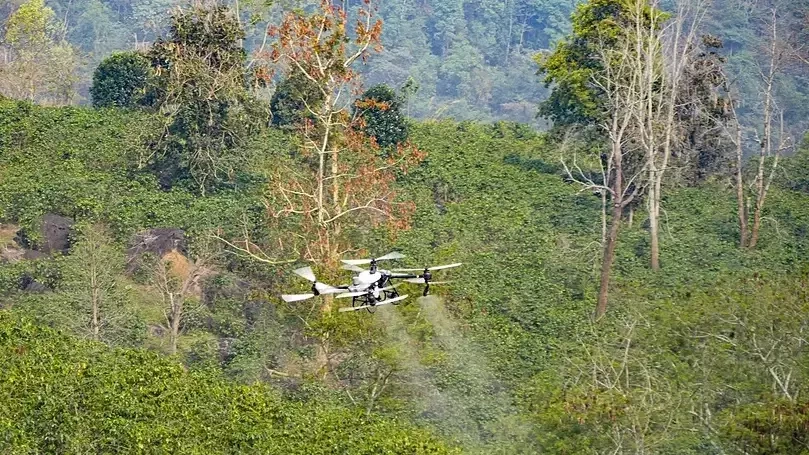
Dien Bien to Test 6,000 Drone Flights for Low-Altitude Economy Development
Politics
2026年8月2日
5
VnExpress
Relations
🇻🇳Vietnam🇨🇳China

General articles are free for 24 hours after publish.

Dien Bien to Test 6,000 Drone Flights for Low-Altitude Economy Development

Share
AI Summary

Dien Bien province in northern Vietnam is launching a sandbox experiment for low-altitude economy development, planning approximately 6,000 drone flights to test UAV application models in agriculture, logistics, and public services, aiming to reduce costs and time by 20-30% compared to traditional methods.

Dien Bien province in northern Vietnam has launched a controlled experiment (sandbox) for the development of the low-altitude economy. This initiative is the result of nearly six months of collaboration between Dien Bien, the Ministry of Science and Technology, the Ministry of National Defense, Vietnam Post, and FPT. Approximately 6,000 test flights using unmanned aerial vehicles (UAVs) will be deployed. The project aims to verify three to five typical UAV application models, with the goal of reducing time or costs by 20-30% compared to traditional methods. At a regular press conference of the Ministry of Science and Technology, Mr. Nguyen Van Thuat, Deputy Director of the Department of Digital Economy and Digital Society, explained the rationale behind choosing Dien Bien. The province is a mountainous region with fragmented terrain, high logistics costs, and many remote areas that are difficult to access for medical services and the transportation of goods and production materials. It also shares a border with Laos and China and has a large forest area, leading to constant needs for resource monitoring, forest fire prevention, rescue operations, and natural disaster response. "These are all problems that low-altitude technology can significantly differentiate from traditional management methods," Mr. Thuat shared. The involved parties have conducted field surveys, assessed terrain, and evaluated socio-economic development needs, while also analyzing requirements for national defense, security, flight safety, and potential risks. Based on the principle of "creating space for innovation while strictly controlling risks," they have identified the experimental area, flight corridors, application fields, and inter-agency coordination mechanisms. The sandbox experiment for low-altitude economy development in Dien Bien targets three main application groups. In agriculture, UAVs will be used for seeding, spraying pesticides, monitoring crops, and transporting materials and post-harvest agricultural products. For logistics, the aircraft will serve to transport medicines, medical supplies, patient samples, and essential goods to remote areas. The remaining group focuses on digital mapping, terrain monitoring, forest and resource management, disaster warning, and public service support. The sandbox in Dien Bien allows for controlled exemption mechanisms, creating conditions for technology enterprises, especially domestic UAV manufacturers, to research and refine their technologies under real-world conditions. Specifically, companies may be exempted from or flexibly apply certain regulations, such as waiving 60 out of 69 testing requirements related to frequency, electromagnetic compatibility, electronic interference prevention, and other quality assessment requirements. Mr. Thuat noted that Dien Bien is the first province to establish a sandbox mechanism for digital technology. The results will serve as a reference basis for completing national policies on low-altitude economy development. He stated that the low-altitude economy is emerging as a new growth driver globally. China identifies it as a strategic economic sector, while the US, Japan, South Korea, and many European countries are also experimenting with new service models based on low-altitude aircraft. These nations are developing not only aircraft but also industrial and service ecosystems. "UAVs are just the means; the economic value lies in the technology ecosystem, data, and associated services," Mr. Thuat said, adding that this is also the approach taken by the Ministry of Science and Technology in researching the development of the low-altitude economy in Vietnam. At the press conference, Deputy Minister of Science and Technology Bui Hoang Phuong assessed that the Dien Bien sandbox demonstrates that legal regulations for testing new models exist, even in complex fields like UAVs. "The mechanism is complete; the remaining issue is implementation," he said. Source: VnExpress

0

Original source

VnExpress

原文を読む