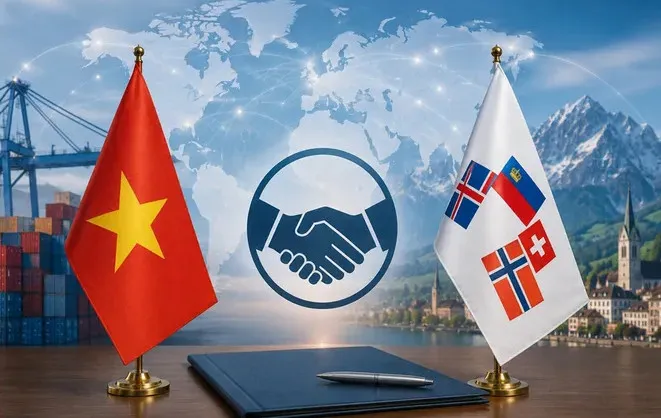
Vietnam and EFTA Conclude FTA Negotiations, Boosting Industrial Ties
Business
2026年7月28日
5
Vietnam Insider
Relations
🇻🇳Vietnam🇹🇭Thailand

General articles are free for 24 hours after publish.

Vietnam and EFTA Conclude FTA Negotiations, Boosting Industrial Ties

Share
AI Summary

Vietnam and the European Free Trade Association (EFTA) have concluded negotiations for a comprehensive Free Trade Agreement (FTA). This is expected to accelerate the establishment of production bases and investments in Vietnam for companies from Switzerland, Norway, Iceland, and Liechtenstein.

The growing economic relationship between Vietnam and the European Free Trade Association, better known as EFTA, marks a new stage in industrial relations between Europe and Southeast Asia. EFTA comprises four countries: On July 2, 2026, Vietnam and the four EFTA member states announced the conclusion of negotiations for a comprehensive free trade agreement. This announcement came after more than twenty rounds of discussions launched in 2012. The agreement must now go through the signing and ratification process before it can enter into force. The announcement was notably published by Vietnam’s Ministry of Industry and Trade. This development is important for Swiss, Norwegian, Icelandic, and Liechtenstein companies. It is expected to gradually facilitate trade, improve regulatory visibility, and strengthen business confidence among companies looking to sell, invest, or organise part of their production in Vietnam. Nearly 10,000 kilometres from Switzerland, on the other side of the world, and barely one week after the announcement, FVSource was appointed to identify and qualify new industrial partners in Vietnam. The client? A Swiss group looking to outsource part of its production and increase its current manufacturing capacity. Its objective was not simply to find a factory offering competitive prices. The priority was to identify manufacturers capable of meeting specific requirements in terms of quality, production capacity, organisation, and reliability. This other case study presents a mission carried out by FVSource as part of a steel structure manufacturing project in Vietnam. For the appointed consultant, the mission therefore involved identifying the most relevant suppliers, verifying their actual capabilities, and visiting their facilities directly to assess their potential as long-term industrial partners. Trade relations between Vietnam and the EFTA countries are not starting from scratch. In 2025, trade in goods between the two sides reached approximately €4.8 billion, excluding gold trade from Swiss statistics. Vietnam recorded a trade surplus of nearly €2.5 billion, compared with around €500 million ten years earlier. The main products exported by EFTA countries to Vietnam include: In the other direction, Vietnam mainly exports the following products to EFTA markets: These trade flows show that the relationship goes beyond the exchange of finished goods. It also includes industrial equipment, components, raw materials, subcontracting, and the organisation of international supply chains. Swiss and Nordic companies are not only looking for lower production costs. Above all, they are seeking to build supply chains that are more diversified, flexible, and less dependent on a single country. For several decades, China has served as the main Asian industrial base for many European companies. It remains essential, but geopolitical risks, trade tensions, rising costs, and logistics disruptions have accelerated the adoption of so-called China Plus One strategies. Under this model, a company retains part of its operations in China while developing a second industrial base in another Asian country. Vietnam is now one of the most closely considered destinations for this type of diversification. The country has an export-oriented manufacturing sector, an extensive network of industrial zones, and preferential access to numerous markets through its various free trade agreements. Vietnam does not necessarily replace China. Instead, it acts as a complementary platform for certain product categories, production volumes, and stages of manufacturing. Switzerland and Liechtenstein have a strong network of SMEs specialising in machinery, industrial equipment, precision instruments, and metal products. In Vietnam, these companies can identify partners for the production of mechanical parts, steel structures, industrial subassemblies, machined components, and equipment manufactured according to technical drawings. The potential is particularly significant for companies that retain design, engineering, and strategic functions in Europe while outsourcing certain manufacturing or assembly operations. Electronics has become one of the main drivers of Vietnam’s industrial growth and exports. The country already hosts major international groups, as well as a growing network of manufacturers producing components, cables, circuits, enclosures, electrical equipment, and assembled products. This sector may be particularly relevant for Swiss and Nordic companies operating in automation, energy, industrial technology, medical equipment, and connected devices. Electronics, computers, and related components already rank among Vietnam’s leading export categories. Manufacturing and processing industries represented more than 85% of Vietnamese exports during the first nine months of 2025. Vietnam is already one of Asia’s major manufacturing centres for garments, technical textiles, and footwear. The opportunities are not limited to large international brands. Vietnamese manufacturers also work with SMEs on more specialised collections, workwear, technical footwear, sports products, and private-label items. For European companies, the main challenges include material traceability, minimum order quantities, product development management, and compliance with social and environmental requirements. Vietnam has a major industry in indoor and outdoor furniture, wood products, interior fit-out items, and certain construction materials. Swiss and Nordic companies can identify manufacturers of residential or commercial furniture, kitchens, shopfitting elements, solid wood products, metal furniture, and solutions for the hospitality sector. The diversity of Vietnam’s industrial base makes it possible to work on both relatively standard products and projects manufactured according to European drawings and specifications. Norway and Iceland naturally maintain strong trade relations with Vietnam’s seafood sector. Cooperation opportunities cover not only trade but also processing, cold-chain logistics, packaging, food-processing equipment, and traceability technologies. More broadly, Vietnam is developing its capabilities in the processing of coffee, fruit, agricultural products, prepared foods, and ingredients intended for export markets. Companies from EFTA countries are also recognised for their expertise in energy efficiency, environmental technologies, the circular economy, and renewable energy. Vietnam’s industrial and urban growth is creating major needs in water treatment, waste management, energy efficiency, storage, electrical equipment, and infrastructure modernisation. In this sector, Vietnam can serve both as a market for European technologies and as a manufacturing base for certain components and equipment. The growth of industrial opportunities does not mean that every Vietnamese factory is suitable for the requirements of EFTA companies. Capabilities can

0

Original source

Vietnam Insider

原文を読む