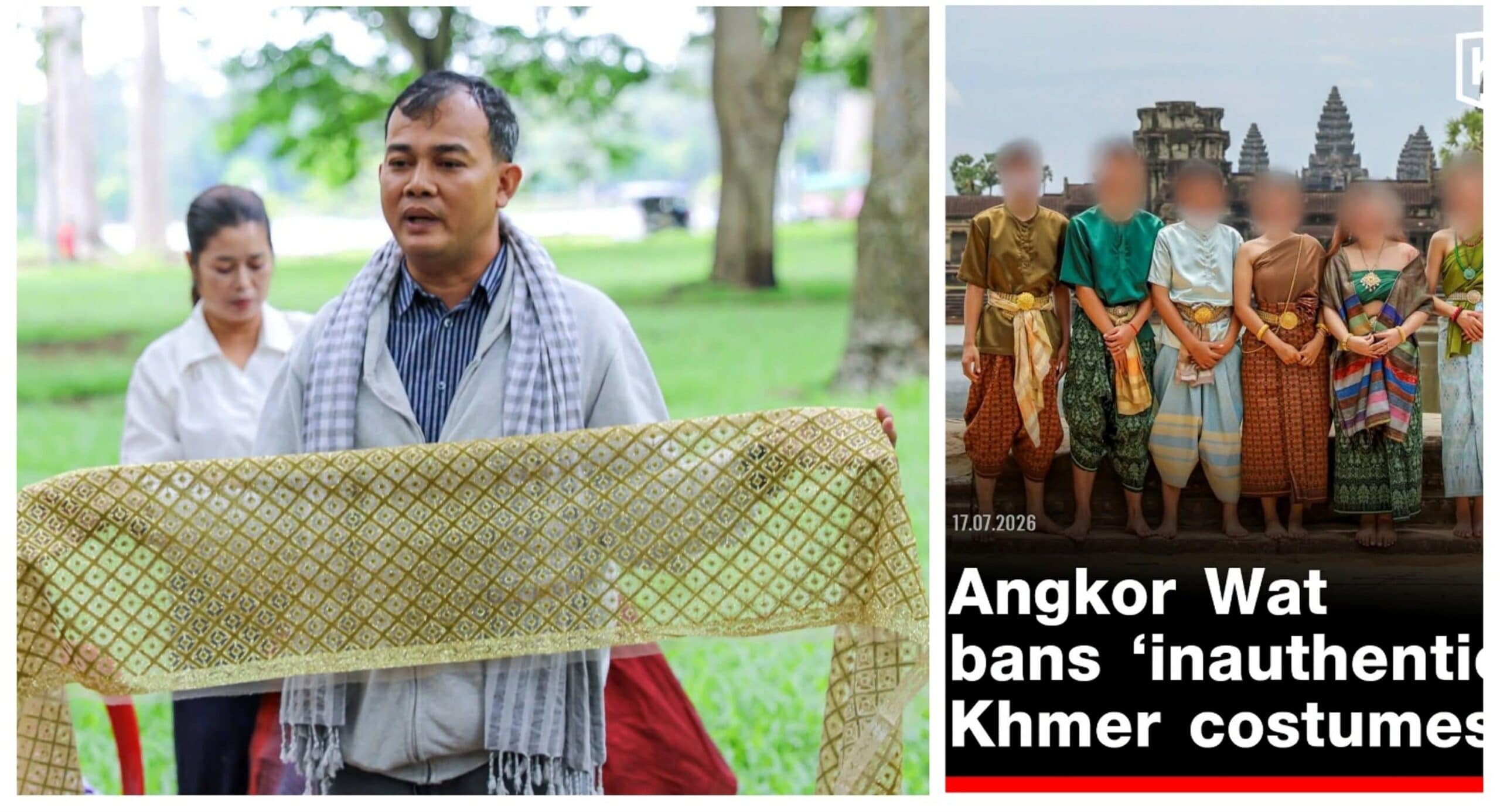
APSARA Rebuts Thai Claims on Angkor Costume Guidance
Culture
2026年7月19日
5
Phnom Penh Post
Relations
🇰🇭Cambodia🇹🇭Thailand

General articles are free for 24 hours after publish.

APSARA Rebuts Thai Claims on Angkor Costume Guidance

Share
AI Summary

Cambodia's APSARA National Authority has refuted Thai media reports misrepresenting its campaign to educate traditional costume rental vendors at Angkor Wat as a ban on 'inauthentic Khmer costumes'. The authority stressed it is an educational effort to preserve Khmer cultural heritage and authenticity.

The APSARA National Authority has refuted claims by Thai media outlet Khaosod English that its recent campaign to educate traditional costume rental vendors at Angkor Wat was a ban on "inauthentic Khmer costumes." The authority stated that the reports misrepresented both the facts and the original purpose of the initiative. In a statement released on July 17, APSARA clarified that the article, headlined "Angkor Wat bans inauthentic Khmer costumes," did not accurately reflect the current outreach program. The program is described as an educational effort aimed at helping vendors better understand authentic Khmer traditional attire and contribute to the preservation of Cambodia’s cultural heritage. "The purpose of the program is to educate tourism vendors, so they correctly use and promote ancient Khmer traditional clothing, which is part of Cambodia’s national identity and an intangible cultural heritage associated with the Angkor World Heritage site," the authority stated. This clarification followed a July 13 meeting involving APSARA officials, the Siem Reap provincial Department of Culture and Fine Arts, local authorities, Heritage Protection Police, and businesses renting traditional Khmer costumes to tourists at the Angkor Archaeological Park. During the meeting, cultural experts raised concerns that many rental costumes had deviated from authentic Khmer designs, with some incorporating imported fabrics and jewelry that did not align with historical Khmer dress traditions. APSARA emphasized that protecting Khmer culture is a "shared and ongoing responsibility" that necessitates cooperation between state institutions, including the police and relevant ministries, as well as the private sector. The authority noted its implementation of the Angkor Code of Conduct in 2016, which provides guidance on appropriate dress within the sacred Angkor complex and promotes visitor safety. It stressed that ancient Khmer costumes possess distinctive characteristics supported by historical research, with reference materials available through the Ministry of Culture and Fine Arts, provincial cultural departments, the National Museum of Cambodia, the Traditional Asian Textile Museum, and the official websites and social media platforms of the ministry and APSARA. The authority stated that its educational campaign on appropriate attire and responsible tourism is intended to preserve the original value of Khmer cultural traditions, strengthen national pride, and encourage respect for Angkor as a sacred heritage site. APSARA also emphasized that costume rental businesses can continue to operate. However, it stated that the Ministry of Culture and the authority have a responsibility to provide guidance to ensure vendors do not offer poor-quality products, charge excessive prices, or rent and sell costumes that inaccurately represent traditional Khmer attire. The authority added that it expects visitors wearing respectful clothing—whether modern or traditional—to demonstrate respect for Cambodia’s ancestors and national heritage. The clarification came after the ANA announced earlier this week that it would strengthen guidance for vendors renting traditional costumes at Angkor, following concerns over the growing use of altered designs and foreign-made costume elements. Officials have stated that the initiative is intended to improve historical accuracy and protect the cultural integrity of one of Cambodia’s most important UNESCO World Heritage sites, rather than restrict tourism or visitors’ choice of clothing.

0

Original source

Phnom Penh Post

原文を読む