General articles are free for 24 hours after publish.
Ho Chi Minh City Gears Up for Urban Development Law Implementation
Ho Chi Minh City is in the final stages of preparing for the implementation of the draft Urban Development Law, currently under review by the National Assembly. The City People's Council is establishing a framework to adopt 154 resolutions simultaneously with the law's effective date.
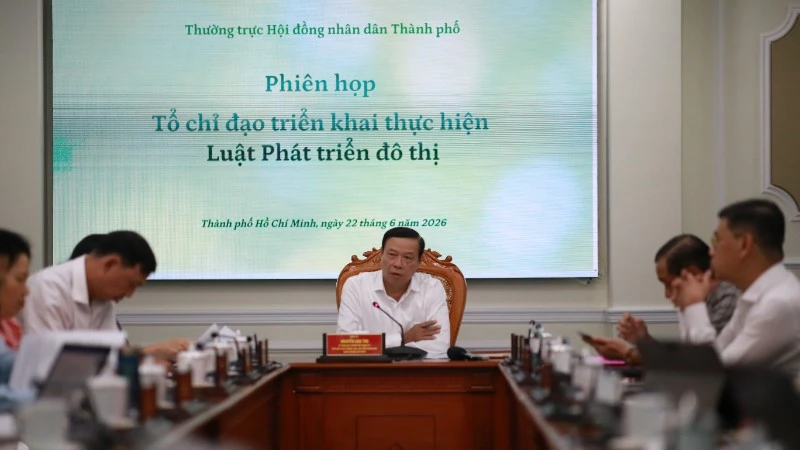
Ho Chi Minh City is in the final stages of preparation for the "Urban Development Law," currently under review by the Vietnamese National Assembly. On July 22, the Steering Committee for the Implementation of the Urban Development Law held a meeting to assess progress, discuss solutions for obstacles, and agree on key points for implementation after the draft law is passed. This Urban Development Law is considered a particularly important legal document, creating a premise for Ho Chi Minh City to strongly exploit its potential, optimize its role in institutional building, enhance development quality and governance standards, and promote a new growth model based on science, technology, innovation, digital transformation, labor productivity, and competitiveness. This will solidify its position as a key growth pole for the entire country. To effectively perform its function as a local state power agency, the Standing Committee of the City People's Council has developed a plan for the implementation of the Urban Development Law. This plan aims to proactively review contents within its authority and be ready to issue resolutions for implementation immediately upon the law's effectiveness, ensuring uniformity, synchronization, and feasibility. In recent times, the committees of the City People's Council have actively organized field surveys and proactively studied and learned from the practical experience of Hanoi Capital in the process of building and implementing the Capital Law. At the meeting, representatives from the City People's Council committees frankly pointed out some "bottlenecks" and difficulties regarding coordination mechanisms and the division of authority during supervision and resolution drafting. According to the City People's Council's Legal Committee (the Standing Body of the Steering Committee), through review and synthesis, it is projected that 154 resolutions (including 131 normative legal resolutions and 23 individual resolutions) will need to be issued by the City People's Council to concretize the law's provisions. These cover the fields of economy-budget, urban affairs, culture-society, and legal affairs. At the meeting, a representative from the Ho Chi Minh City Department of Justice stated that the department is maximizing the working efficiency of leading expert groups and scientists to contribute high-quality opinions to the draft law and its guiding documents. Concluding the meeting, Mr. Nguyen Van Tho, Member of the Standing Committee of the City Party Committee and Permanent Vice Chairman of the City People's Council, acknowledged the efforts of agencies and units in completing the draft law. He noted that 37 out of 117 work items are still in progress and requested the entire system to tighten discipline and accelerate the pace to complete the draft law soon. Mr. Tho requested agencies and units to continue focusing on reviewing all content to complete the draft law as soon as possible, especially by accelerating the preparation and construction of subordinate legal documents to be ready for immediate application once the Urban Development Law is passed and takes effect. He also urged proactive coordination and consensus on handling methods for overlapping issues or unclear functions and responsibilities between committees and departments/sectors. He emphasized the importance of ensuring the law's completion according to the plan to stabilize the legal framework, maximize the city's development potential, and meet the expectations of the business community and the people. Furthermore, he stressed the need to concretize task assignments based on the "6 Clars" principle (clear person, clear task, clear progress, clear responsibility, clear product, clear effectiveness) to enhance the responsibility of heads and the efficiency of public service execution. He also highlighted the necessity of effective coordination with central ministries and sectors to promptly seek guidance and resolve difficulties, and to closely coordinate and leverage the leadership and direction of Party committees, the City People's Committee, and the Party committees of agencies and units to complete tasks on schedule.
Original source
Nhan Dan