General articles are free for 24 hours after publish.
Kyrgyz President Japarov Complains About Sanctions, Praises Trump's NGO Funding Halt at UNGA
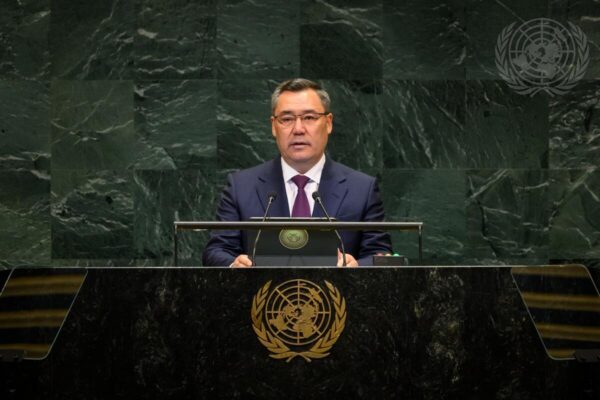
Kyrgyz President Sadyr Japarov, addressing the UN General Assembly, criticized sanctions as tools for interference in sovereign states and praised former U.S. President Donald Trump for halting NGO funding. He questioned the basis of sanctions attributed to NGOs and called for UN Security Council decisions on sanctions.
Kyrgyz President Sadyr Japarov, addressing the United Nations General Assembly this week, reiterated his complaints about sanctions, stating they are used as an instrument of interference in the internal affairs of sovereign states. He expressed concern that the negative consequences of unjustified unilateral sanctions also affect small countries like Kyrgyzstan, which are in the stage of formation and development, a sentiment shared by other small states. Japarov further alleged that some major powers, in pursuit of their own interests, pressure smaller countries like Kyrgyzstan, attempting to force them into bargaining or issuing ultimatums, though he did not specify which countries or to what end. In a notable pivot during his address, Japarov took the opportunity to praise former U.S. President Donald Trump for his decision to halt funding of non-governmental organizations (NGOs) after taking office. Japarov stated that this move has "practically ceased" interference by NGOs in the internal affairs and policies of developing states. This aligns with his previous assertion at the UNGA last year that sanctions imposed on Kyrgyzstan were based on false information spread by certain NGOs and "malicious citizens." Bakai Bank of Kyrgyzstan recently won a case in a Belgian commercial court against the Open Dialogue Foundation (ODF) for its reports alleging the bank's involvement in circumventing sanctions against Russia. The court classified ODF as a "commercial enterprise," opening it to liability. Meanwhile, in April 2026, the EU targeted Kyrgyzstan with its "anti-circumvention tool." Kyrgyz authorities have claimed to be taking action, such as state-owned banks ending partnerships with clients due to sanctions risks, but have not specified which companies were affected, making it difficult to verify if actual sanctions risks have been addressed. As of June 2026, 31 companies from Kyrgyzstan, including five banks, were reportedly under Western sanctions. Japarov argued that decisions to impose sanctions should be taken in accordance with the UN Charter and exclusively within the mandate of the Security Council. Kyrgyzstan secured a non-permanent seat on the UN Security Council this year. He further suggested that if a state fails to implement UN decisions, other countries should cease cooperation, thereby increasing the effectiveness of sanctions. However, the current Security Council is largely paralyzed by divisions among permanent members, making a call to centralize all sanctions decisions within the UNSC effectively a call for no sanctions at all.
Original source
The Diplomat Indonesia