General articles are free for 24 hours after publish.
Impeachment Trial: Absent Senators' Vote Sparks Debate on Conviction Threshold
A heated debate has erupted in the Philippines' impeachment trial over the number of votes required for a conviction against the Vice President. The House prosecution panel argues against including absent senators in the tally, while the defense maintains the established threshold of 16 votes.
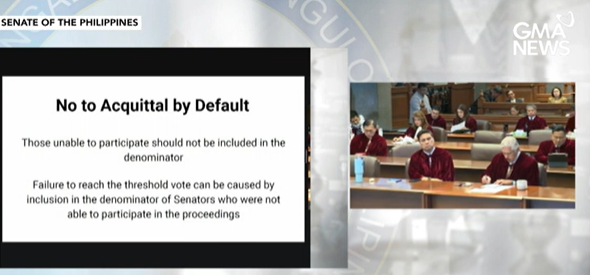
A heated debate has ensued in the Philippines' impeachment trial regarding the threshold for a conviction against the Vice President, specifically concerning the voting rights of absent senators. The House prosecution panel is arguing against their inclusion, while the defense team insists on maintaining the previously set number. House prosecutor and Akbayan Representative Chel Diokno argued that if senators are unable to take their oath for any reason or are illegally prevented from performing their duties, including them in the base number of 24 senators for voting could lead to an acquittal by default. He emphasized that this would reduce the number of votes needed for both conviction and acquittal, making it easier to acquit and potentially undermining the constitutional requirement of a two-thirds concurrence of all senators. The 1987 Constitution, Article 11, Section 3, states that "no impeachable person shall be convicted without the concurrence of two-thirds of all the Members of the Senate." He further elaborated, "A situation where a senator fails to take oath as a senator-judge or is illegally prevented from performing his job… a situation when senators are all detained, suspended, due to lawful orders. It would be absurd to include them." He added, "Yes, the Constitution deliberately makes conviction harder by imposing the two-thirds requirement. But making it harder is not the same as making it depend on senators who are not judges or who are incapable of acting as judges. That would be tantamount to an acquittal by default, a failure to arrive at the threshold number caused not by the judgment of the incapacitated senators, but by their mere inclusion in the denominator." Conversely, defense counsel Michael Poa asserted that the Senate impeachment court's July 6 ruling, which set the required voting threshold for conviction at 16, is non-appealable. He argued that there are no supervening events that warrant a change to this ruling and that altering the threshold would violate the Vice President's right to due process. "Last July 6, 2026, on the very first day of trial, the presiding officer ruled that a voting threshold to convict is 16. At that time, no senator-judge objected. No senator-judge sought reconsideration. No senator-judge appealed. Your Honors, that was over two months ago. There is no supervening event [to change the threshold]. Our point is, nothing changed between July 6 and today," Poa said. He continued, "Your Honors, reading the rules on impeachment, under Rule number six, there is no timeframe within which a motion for reconsideration can be considered. Naturally, because that should have been brought up at the earliest opportunity. But that did not happen." Among the senators, Jinggoy Estrada and Rodante Marcoleta are currently detained on plunder and related charges. Senator Ronald dela Rosa is reportedly evading an arrest warrant issued by the International Criminal Court due to his alleged involvement in drug war deaths. Senator Loren Legarda is on an extended medical leave abroad due to a lung ailment. Last week, the impeachment court invited former Supreme Court Chief Justices Artemio Panganiban, Reynato Puno, and Hilario Davide Jr., along with Associate Justice Adolfo Azcuna, as amici curiae or friends of the court. Panganiban, Puno, and Davide suggested that the voting threshold should be based on the number of senator-judges who actively participated in the impeachment trial. They noted that the Constitution specifies a fraction, not a fixed number, for conviction. Likewise, the three said that allowing those absent to vote will be unfair, if not an injustice, to the Filipino people since an impartial judge needs to evaluate the evidence for them to be able to make a sound judgment. However, Azcuna, one of the framers of the 1987 Constitution, offered a different view that the two-thirds concurrence requirement should relate to the entire membership of the Senate; hence, a conviction by 16 senator-judges is needed. While Azcuna was the lone dissenter in changing the threshold, all the amici curiae agreed that the Senate impeachment court has the authority to determine the voting threshold needed for conviction because the Constitution provides that the Senate has the sole power to try and decide impeachment cases. This dispute highlights the critical impact of procedural technicalities on the outcome of impeachment proceedings and underscores the ongoing tension between constitutional interpretations and practical realities in Philippine governance. The case will likely set a significant precedent for future impeachment trials. Source: GMA News Philippines
Original source
GMA News Philippines