New Zealand's Trade Agreement With India Reflects a Foreign Policy Shift
New Zealand has signed a Free Trade Agreement (FTA) with India, signaling a shift in foreign policy to reduce economic reliance on China and balance economic and security relationships. Despite some domestic opposition, the move aims to expand access to India's growing market.
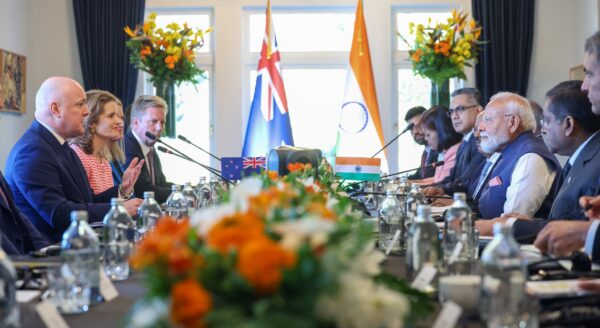
Read The Diplomat, Know The Asia-Pacific The nation is looking to expand and balance its economic and security relationships – and India is at the top of the list. Indian Prime Minister Narendra Modi attends a summit meeting with New Zealand Prime Minister Christopher Luxon in Auckland, New Zealand, July 11, 2026. For the past several decades New Zealand has looked to China and Australia, and to a lesser extent the United States, United Kingdom, and European Union, as its major economic partners, while relying on Australia and other Western states as its major security partners. The July 11 visit by Indian Prime Minister Narendra Modi to New Zealand on the heels of the bilateral Free Trade Agreement (FTA) signed in April suggests a new effort by New Zealand to expand and balance its economic and security relationships to resist growing militarization and politicization in the Pacific. Modi’s one-day trip was the first visit by an Indian prime minister since Rajiv Gandhi visited New Zealand in 1986. The visit celebrated the signing of the New Zealand-India Free Trade Agreement and signified the deepening relationship between the two states. Currently two-way annual trade between the countries is approximately $3.1 billion, with New Zealand exports (primarily in wool, logs, and apples) making up about $718 million of that total. The Indian government has said that the FTA is a “forward-looking partnership” that promises to give its labor-intensive sectors, such as textiles and leather, additional economic opportunities. The New Zealand government stated that the FTA provides new and expanded business opportunities. Trade Minister Todd McClay stated that the new agreement would eliminate or reduce tariffs on 95 percent of exports, such as kiwifruit, apples, meat, wool, coal, and forestry. “It puts New Zealand exporters on an equal or better footing to our competitors across a range of sectors and opens the door to India’s rapidly expanding middle class,” McClay said. While the trade legislation supporting the deal passed its first reading in Parliament at the end of June (with Labor Party support), it has not been without controversy. Foreign Minister Winston Peters, leader of the Nationals’ coalition partner, New Zealand First, objected to the FTA. He argued that the agreement adversely impacted national migration policy, did not provide enough access for dairy products, and included unrealistic investment obligations for New Zealand business. Peters told Radio New Zealand that “the deal was neither free, nor fair.” He added, “I’ve seen deals where the objective was for political purposes rather than economic advantage for New Zealand. This is one of those.” A major point of debate has been whether the FTA “commits” New Zealand to invest $20 billion over the next 15 years or merely requires New Zealand to “promote” investment in India. Critics have noted it is unlikely for New Zealand to reach this investment amount, and failing so could lead India to claw back market access. The Māori Party (Te Pati Māori) has also rejected the agreement for failing to uphold Te Tiriti o Waitangi/the Treaty of Waitangi or protect Māori interests. Other aspects of the deal have attracted particularly vituperative rhetoric. Shane Jones, deputy leader of New Zealand First, warned that the deal would bring a “butter chicken tsunami” coming to New Zealand. Conservative Destiny Church leader Brian Tamaki urged New Zealand to “purge” Hindus, Sikhs and Muslims in response to what he claimed was the persecution of Christians in India under Modi, leading to widespread condemnation across the political spectrum. Despite the controversy, the government’s rationale for pursuing the FTA with India is clear. Trade in goods and services comprises about 50 percent of the New Zealand economy. With such an open economy, New Zealand has recently entered into a number of free trade agreements with both developed and developing states including the U.K., the EU, and the Comprehensive and Progressive Agreement for Trans-Pacific Partnership spanning both sides of the Pacific. The new FTA is a recognition that India can become an important and growing international market that provides significant opportunities for New Zealand services and products. India has overtaken Japan as the world’s fourth largest economy and its economy is expected to grow over 6 percent in the next few years. To date there has been limited interest and opportunities for New Zealand businesses on the subcontinent; the FTA is an effort to change that. It is also an attempt to diversify import and export supply chains from dependence on China. This is coupled with an appreciation of the vulnerabilities that such dependence can engender, as well as an awareness that China might decide to leverage its trading and political relationship to achieve other political objectives. At the same time, the FTA links security issues more closely to trade and economic relations than has been usual. As is becoming the norm in many trade agreements, there are political and security components that parallel and augment the trading relationship. These broader elements, laid out as part of the India-New Zealand “Roadmap to 2030,” include commitments to improve bilateral ties in investment, technology, maritime security, education, tourism, sport, agriculture, and people-to-people links, as well as trade. In the security area, it was announced that the New Zealand-India relationship has been elevated into a “strategic partnership” during Modi’s visit. The new partnership involves the establishment of a joint working group on counterterrorism to strengthen cooperation in combating violent extremism. Other priorities include engaging on cybersecurity, institutionalizing intelligence exchanges, and deepening maritime defense ties. The Roadmap to 2030 also extends the March 2025 Defense Cooperation Arrangement that established regular bilateral defense engagement and dialogue between the two countries. Since the end of its U.K.-dominated trade relationship in the 1970s, New Zealand has not closely tied its trade to security objectives. As a small trade-dependent state, New Zealand rather has worked hard to lower trade and investment barriers as an important aspect of deepening its economic relations with Asia generally; security issues were less of a concern. However, New Zealand’s liberal view of free trade and economic relationships – and a more benign view of the international environment – has shifted with the increased strategic competition and Chinese attempts to gain influence in the region. As noted by Prime Minister Christopher Luxon, “We live in the Indo-Pacific region, it is a big focus for us where our national interests actually sit… our national interests are both security and economic and those two issues are increasingly interdependent.” Whether these new India-New Zealand security arrangements will amount to more than rhetorical s
多角的分析
ニュージーランドとインドのFTAは、ニュージーランド経済の約50%を占める貿易への依存度を考慮すると、経済的機会の拡大を目指す動きである。特に、インドの労働集約型産業(繊維、皮革)への経済的機会提供は、インド側にとってのメリットとなる。ニュージーランド側は、関税撤廃・削減により、農産物や一次産品(キウイ、リンゴ、肉、羊毛など)の輸出競争力を高めることを期待している。しかし、乳製品分野でのアクセス不足や、投資義務に関する論争は、国内産業への影響を巡る懸念を示しており、経済的利益の分配と国内産業保護のバランスが今後の課題となる。
このFTAは、ニュージーランド企業にとってインドの巨大な消費市場へのアクセスを改善する機会を提供する。特に、FTAに含まれる「ロードマップ2030」は、投資、技術、農業など多岐にわたる分野での協力強化を約束しており、新規事業やサプライチェーンの多様化を目指す投資家にとって魅力的である。しかし、投資義務に関する曖昧さや、国内での政治的反対意見は、投資リスクを増大させる要因となりうる。インドの経済成長率と人口動態を考慮すると、長期的な投資ポテンシャルは高いが、政治的・規制的リスクの評価が重要となる。
FTA締結に伴う「バターチキン津波」といった過激な発言や、宗教的偏見に基づく非難は、ニュージーランド社会における移民や多様性に対する根深い懸念を浮き彫りにしている。特に、マオリ党がマオリの権利保護を訴えている点は、先住民の権利と国際貿易協定との関係性という、ニュージーランドが抱える社会的な課題を示唆している。また、インドからの移民増加が、国内の雇用や社会インフラに与える影響に対する懸念も、一部で表明されている。これらの社会的な摩擦は、FTAの国内での受容度に影響を与える可能性がある。
ニュージーランド国民にとって、このFTAは生活必需品や農産物の価格に影響を与える可能性がある。関税撤廃・削減は、一部の輸入品の価格低下に繋がるかもしれないが、国内の主要産業(特に農業)がインドからの競争にさらされることで、雇用の安定性や地域経済に影響が出る可能性も否定できない。また、移民政策への懸念は、社会サービスやインフラへの負担増大、文化的な摩擦といった形で、市民生活に直接的な影響を与える可能性がある。特に、地方都市に住む人々は、これらの変化をより敏感に感じ取るだろう。
背景・歴史的文脈
ニュージーランドは、1970年代に英国中心の貿易関係から脱却して以来、アジア諸国との経済関係深化に努めてきた。特に近年、中国の経済的影響力増大と太平洋地域での軍事的・政治的活動の活発化は、ニュージーランドの安全保障観に変化をもたらした。こうした背景から、ニュージーランドは、経済的利益と安全保障上の懸念のバランスを取るため、従来の主要パートナー(中国、オーストラリア、米国)に加え、インドのような新たなパートナーシップを模索するようになった。今回のインドとのFTA締結は、こうした戦略的再配置の一環と見ることができる。
原文ソース
The Diplomat Indonesia