General articles are free for 24 hours after publish.
Philippine Sailor Injured in China Coast Guard Confrontation in South China Sea
A Philippine Navy sailor was injured by China Coast Guard (CCG) personnel near Second Thomas Shoal in the South China Sea. The Philippine military condemned the CCG's "unlawful, coercive, and aggressive actions." Meanwhile, a Chinese state-run media AI video depicting Filipinos as monkeys has further strained bilateral ties.
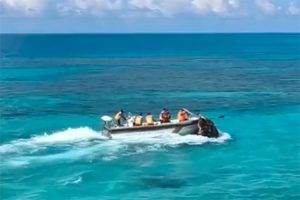
The Armed Forces of the Philippines (AFP) on Monday said a Philippine Navy serviceman was injured after members of the China Coast Guard (CCG) struck him with a wooden baton during an encounter near Second Thomas Shoal in the South China Sea (SCS). In a statement, the AFP said the incident occurred after a CCG rigid hull inflatable boat carrying eight personnel from CCG vessel 21560 unlawfully approached within close range of BRP Sierra Madre, the grounded Philippine Navy vessel stationed at the shoal, which the Philippines calls Ayungin. The military said the Chinese boat circled BRP Sierra Madre while taking photographs and videos, prompting two AFP rubber boats to “calmly and nonconfrontationally” drive it away. The Chinese personnel “reacted violently and aggressively” by striking a Philippine Navy serviceman on the head with a wooden baton, causing injuries and damaging one of the Navy’s rubber boats operating in the area, according to the AFP. The AFP said the incident demonstrated a “blatant disregard for safety,” endangered the lives of Philippine personnel and escalated tensions in the South China Sea. “The AFP remains steadfast in protecting the country’s sovereign rights and jurisdiction,” it said. “Our lawful presence and sustainment operations in Ayungin Shoal will continue.” “No act of coercion or aggression will deter us from carrying out our constitutional mandate or exercising the Philippines’ lawful rights in the West Philippine Sea,” it added. The Chinese Embassy in Manila did not immediately reply to a Viber message seeking comment. The military also called on the People’s Liberation Army, the CCG and China’s maritime militia to stop what it described as “illegal, coercive, aggressive and deceptive actions” in the South China Sea and to comply with the 2016 arbitral award affirming the Philippines’ maritime rights under international law. ‘VICIOUS GRAY-ZONE TACTICS’ Chester B. Cabalza, president and founder of International Development and Security Cooperation, said the latest incident reflects China’s continuing efforts to assert its claims in the South China Sea. “The heightened tensions began after China failed to advance its claims over Batanes,” he told BusinessWorld via Facebook Messenger. “Beijing has returned its focus to the West Philippine Sea by creating tension around Ayungin Shoal to reinforce its military posture.” He said China is likely to continue employing gray-zone tactics despite the 2016 arbitral award. “The vicious gray-zone tactics in our waters will continue as long as China does not get what it wants,” he said. “Ten years after the arbitral award, we should not be surprised by these incidents. This will remain an intergenerational issue that will continue to resurface.” Mr. Cabalza said the Philippines should remain vigilant in protecting its maritime features and military outposts in the South China Sea. Separately, the Department of National Defense condemned what it described as the CCG’s latest act of violence and harassment, saying it forms part of a “clear pattern of provocative and hostile behavior” that further erodes Beijing’s trust and credibility. In a separate statement, the agency said the incident came against the backdrop of China’s continued disregard for the United Nations Convention on the Law of the Sea and the final and binding 2016 arbitral tribunal ruling on the South China Sea. The department said the latest incident further reinforces its policy of disengagement from China, saying it “simply cannot trust this belligerent neighbor.” “As we continue to monitor and prepare measures to meet this aggression, the Department of National Defense salutes the defenders of BRP Sierra Madre and our western frontier,” it said. “We will not back down.” Also on Monday, the Philippine government condemned an artificial intelligence (AI)-generated video published by Chinese state-run media outlet China Daily depicting Filipinos as monkeys, calling it a racist affront that further strains relations between Manila and Beijing. Malacañang said President Ferdinand R. Marcos, Jr. had seen the video and supported the response of government officials, including Foreign Affairs Secretary Ma. Theresa P. Lazaro and Defense Secretary Gilberto C. Teodoro, Jr. “No Filipino would react positively to such a depiction,” Palace Press Officer Clarissa A. Castro told a news briefing in Filipino. “Portraying Filipinos as monkeys is simply unacceptable.” The Department of Foreign Affairs earlier demanded that the video be removed, saying disagreements over legal and political issues did not justify material that demeaned Filipinos. Mr. Teodoro likewise denounced the video as racist propaganda, saying it sought to undermine the Philippines’ position on the South China Sea through ridicule rather than reason. Asked whether Mr. Marcos would summon Chinese Ambassador Huang Xilian, following Senator Ana Theresia “Risa” N. Hontiveros-Baraquel’s call for such action, Ms. Castro said the Palace would leave the matter to the Department of Foreign Affairs. The controversy stems from an AI-generated video posted by China Daily on social media featuring a monkey character dressed in Filipino attire in connection with the South China Sea dispute and the 2016 arbitral ruling that voided China’s expansive maritime claims. The Federation of Filipino Chinese Chambers of Commerce and Industry, Inc. also urged that the video be removed, saying territorial disputes should not become attacks on the dignity of an entire nation. The group expressed its “profound disappointment.” “No matter how sincere or deeply held the differences between governments on maritime or territorial issues, there can be no justification for depictions that demean the dignity of an entire nation,” Federation President Victor T. Lim said in a statement. He said disputes should be addressed through diplomacy and dialogue rather than material that could inflame public sentiment. “Our bilateral relationship is far broader and far more enduring than any single political or territorial disagreement,” Mr. Lim said. “Such issues are best addressed through diplomacy, mutual respect and constructive dialogue — not through imagery that risks inflaming public sentiment or undermining goodwill between our peoples.” The video was released around the 10th anniversary of the 2016 arbitral ruling, which Beijing continues to reject, adding to tensions over competing claims in the South China Sea. — Pexcel John Bacon and Erika Mae P. Sinaking
Original source
BusinessWorld Nation