General articles are free for 24 hours after publish.
Indonesia's Growing China Dependencies Cast Shadow on 'Free and Active' Foreign Policy
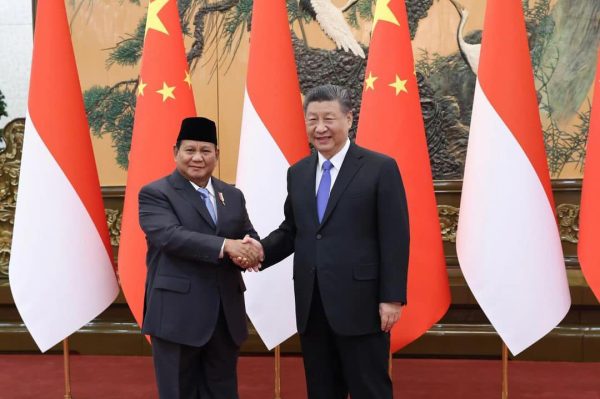
Following President-elect Prabowo's visit to Beijing, China's economic influence in Indonesia is surpassing that of the US and Japan, eroding the foundation of Jakarta's 'free and active' foreign policy. Dependencies are deepening, particularly in the EV sector and mineral processing, where Chinese firms are dominating entire supply chains.
Indonesia's foreign policy, traditionally anchored in the principle of being "free and active" (bebas aktif), is facing a significant challenge as China's economic influence grows, increasingly overshadowing that of the United States and key partners like Japan and South Korea. As the sole G20 member in ASEAN and a critical node in global mineral supply chains, Indonesia's strategic orientation holds substantial weight in the Indo-Pacific and the Global South. The shift is particularly pronounced in the economic sphere, with inbound investment flows decisively tilting in Beijing's favor. This economic entanglement is raising questions about the material basis for Indonesia's strategic autonomy. China is now decisively out-investing Seoul and Tokyo, Indonesia's traditional economic partners. The EV sector exemplifies a growing "full-stack dependency" on China. Chinese entities are increasingly shaping the entire value chain, from setting technological standards and providing hardware and software to financing. Indonesia's Presidential Regulation No. 79 of 2023, designed to accelerate EV adoption and incentivize domestic production, has been leveraged by Chinese automotive manufacturers as a strategic entry point. This has allowed Chinese brands to offer competitively priced EVs, rapidly capturing market share. BYD, for instance, is projected to take nearly 50 percent of Indonesian EV wholesales for 2025, even as EV sales surge to over 10 percent of the automotive market. This marks a significant displacement of Japanese brands, which historically dominated the Indonesian automotive landscape. Beyond downstream sales, China's influence extends to upstream and midstream sectors, particularly in the processing of nickel, a critical component for EV batteries. Chinese capital and firms like Tsingshan have heavily invested in nickel ore extraction and processing, employing advanced technologies like high-pressure acid leaching (HPAL) to establish dominance. When South Korea's LG Energy Solution withdrew from a major EV battery project, China's Huayou stepped in as the replacement investor. In telecommunications, Chinese firms like Huawei and ZTE are crucial for Indonesia's 5G networks. This reliance is creating a digital nervous system optimized for and maintained by Chinese technological standards and personnel, potentially making substitution prohibitively expensive and technically complex. This deepening economic interdependence with China, while offering opportunities for development, poses a challenge to Indonesia's ability to maintain a truly "free and active" foreign policy, with potential profound regional consequences.
Original source
The Diplomat Indonesia