General articles are free for 24 hours after publish.
Ho Chi Minh City Real Estate Display Mistaken for 'Giant Library,' Exposing Social Media Information Asymmetry
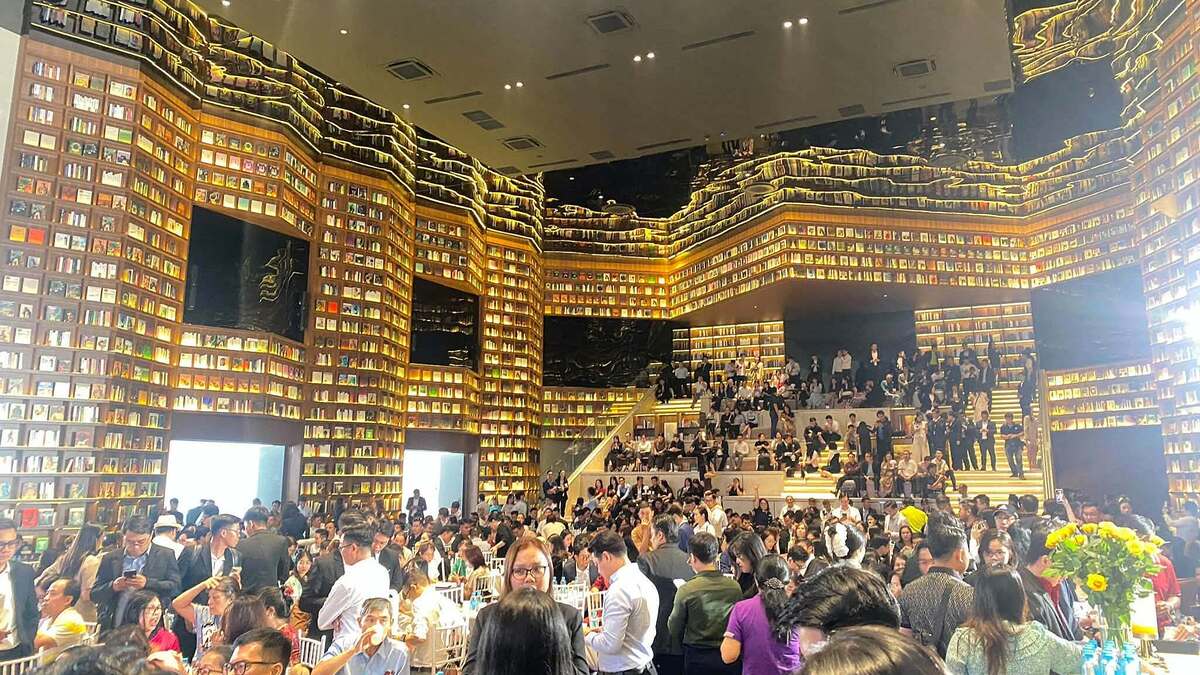
A real estate project display in the suburbs of Ho Chi Minh City was mistakenly promoted on social media as a 'giant library,' leading to many visitors being disappointed upon arrival. This incident highlights information asymmetry and raises questions about consumer information literacy and social media marketing practices.
A real estate project introduction space in Nha Be district, Ho Chi Minh City, has been widely circulated on social media as a 'giant library,' causing many people to visit only to discover the truth and feel disappointed. "After watching a series of videos about a space presented as a library in Ho Chi Minh City, I thought it was a library-themed cafe. I traveled over 15 km to the location and only then realized the books on display were models," said Nam Anh, a resident of Ho Chi Minh City, on September 21. Since September 19, a series of videos and images showcasing a location in Nha Be district with multi-story bookshelves and a spacious lobby have appeared on social media, attracting tens of thousands of interactions with titles like 'giant library' and 'Korean library in Ho Chi Minh City,' leading many to believe it was a library or a book cafe. Some initially debated its design similarities to Korea's Starfield Library before the actual function became clear. "The issue isn't the design but the information conveyed. If the posts had clearly stated from the beginning that this is a real estate exhibition space, viewers wouldn't have misunderstood or felt disappointed upon arrival," Nam Anh stated. A sales employee at the project mentioned that the venue, which opened on September 19, is a real estate experience space featuring project models, model apartments, and a customer consultation area. The number of visitors has exceeded expectations, with over 50% coming out of curiosity about the library-like ambiance. However, a majority of those checking in are not potential real estate buyers. This situation makes it "difficult for the sales team to approach target customers at certain times," she said. Dr. Pham Phu Tuan, a lecturer in Digital Communication at Gia Dinh University, believes the attraction stems from exploiting people's curiosity and the herd effect on social media, particularly through "ambiguous" information about the actual function. "One shouldn't just look at images or a few videos and assume the function of a place. It requires skills to receive and verify information on social media," he advised. From a tourism perspective, Mr. Nguyen Chau A, General Director of Oxalis Adventure, calls this an expression of 'superficial tourism' – a type of tourism where visitors prioritize collecting photos and marking their presence on social media over deep exploration of a destination. This is evident in the 'check-in and leave' behavior, favoring 'hot' spots and good photo opportunities over genuine discovery. The case of the Nha Be exhibition space demonstrates how social media can quickly turn a commercial space into an unexpected check-in point. However, when images are spread without complete information, the gap between expectation and reality can easily become a source of contention. Source: VnExpress
Original source
VnExpress