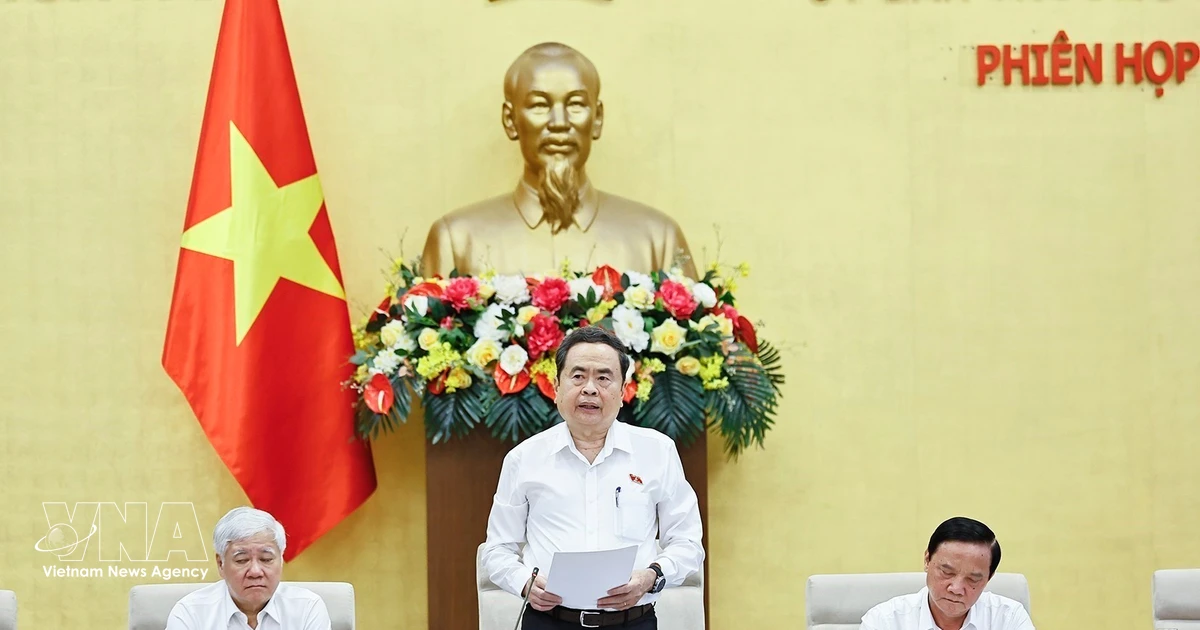
NA Standing Committee Convenes Fourth Session, Focusing on Economic Growth and Legal Framework
The National Assembly Standing Committee held its fourth session, confirming support for economic growth promotion measures. The committee also reviewed amendments to an ordinance on administrative sanctions procedures and adopted resolutions to refine the legal framework for People's Courts.
The National Assembly Standing Committee convened its fourth session, confirming voters' support for the continued implementation of measures aimed at promoting economic growth, stabilising the macroeconomy, controlling inflation, and safeguarding major economic balances, alongside ensuring economic, energy, monetary, and food security, as well as social order and safety. During the session, the NA Standing Committee will provide opinions on a draft ordinance amending and supplementing a number of articles of the ordinance on the procedures for considering and deciding on the application of administrative sanctions at the People's Courts. The committee will also review and adopt one ordinance and one resolution to further fine-tune the legal framework governing the People's Courts under the newly restructured organisational system. Dr. Le Thi Chien, Deputy Director of the Department of Science Management under the Ho Chi Minh National Academy of Politics, stated that streamlining the apparatus is neither a "subjective wish" of the Party nor an "imposed" policy or a tool for "factional purges" as claimed by hostile, reactionary, and politically opportunistic forces. In response to the country’s development requirements in the new era, the campaign against "internal enemies" remains resolute, with no forbidden zones and no exceptions. However, its objective has evolved beyond addressing misconduct to building a national governance system founded on integrity, transparency, and modernity. Nguyen Kim Son, Deputy Head of the Communist Party of Vietnam (CPV) Central Committee’s Commission for Policies and Strategies, briefed the French side on Vietnam's development process, its socialist-oriented market economy, and the Commission’s role in advising the Party leadership on major socio-economic policies, institutional reform, and national development strategies. A resolution setting out a vision of enabling Vietnam's "heartbeat to resonate with that of the world, breathe in step with the spirit of the times, contribute to peace shaping, foster prosperity, and build a stronger and higher international standing for the country and nation” was also mentioned. Among news highlights on the evening of July 7 were the first exchange program between young officers of the Vietnam Coast Guard and the Philippine Coast Guard, Hanoi welcoming its 5 millionth international visitor in 2026, and nearly 400 km of new expressways put into operation in the first half of 2026. Through these exchange activities, young officers are expected to strengthen solidarity and build confidence, thereby contributing to the maintenance of peace, security, order, and safety, as well as respect for international law in the adjacent waters of the two countries. The program also underscores the positive role played by maritime law enforcement forces in promoting regional stability and cooperation. In a review of disciplinary proposals involving Party members in the Party organisations of Quang Ninh, Lao Cai, Ca Mau, and Dong Thap provinces, as well as ACV, the commission concluded that several officials had shown political, moral, and lifestyle degradation and committed violations of Party regulations and State laws. NA Chairman Tran Thanh Man noted that the main challenge now lies not in policymaking but in implementation. Coordination among some agencies remains uneven, while digital transformation and data application have yet to fully meet new requirements. Copyright, VietnamPlus, Vietnam News Agency (VNA) Editor-in-chief, Mr. Tran Tien Duan.
多角的分析
ベトナム国会常務委員会の会合は、同国が直面する経済的課題への継続的な取り組みを示唆している。特に、マクロ経済の安定化、インフレ抑制、経済安全保障の確保は、持続的な成長の基盤を築く上で不可欠である。過去数年間、ベトナム経済はパンデミックからの回復力を見せてきたが、世界的なインフレ圧力や地政学的な不確実性は、引き続き注意深い政策運営を要求している。法整備の強化は、投資環境の改善と予測可能性の向上に寄与し、外国直接投資(FDI)の誘致と国内産業の育成を後押しするだろう。
今回の国会常務委員会の会合は、ベトナムの政策立案者が経済の安定と成長に引き続き注力していることを示しており、投資家にとって安心材料となる。特に、行政手続きの透明性向上や法制度の精緻化は、ビジネス環境の改善に繋がる可能性がある。しかし、法執行の実際における一貫性や、デジタル変革の進捗は、投資判断において引き続き注視すべき点である。ベトナムは依然として、製造業やサプライチェーンの多様化を目指す企業にとって魅力的な投資先であり、これらの法整備や安定化策は、その魅力をさらに高める可能性がある。
行政機構の合理化や「内なる敵」とのキャンペーンは、ベトナム社会における誠実さ、透明性、近代性に基づいた国家統治システムの構築を目指す動きとして捉えられる。これは、国民の信頼を得て、社会秩序と安全を維持するための取り組みの一環である。一方で、幹部の規律違反や道徳的退廃の指摘は、社会の公正さに対する懸念を示唆している。法整備の強化と並行して、これらの問題への実効的な対処が、社会全体の安定と発展に不可欠である。また、ベトナム沿岸警備隊とフィリピン沿岸警備隊の交流は、地域安全保障における市民レベルの協力関係の重要性を示している。
国民は経済成長とマクロ経済の安定化策に支持を示しており、これは生活水準の向上や雇用機会の安定に対する期待の表れである。しかし、法整備や政策実行の現場における課題、例えば一部機関間の連携不足やデジタルトランスフォーメーションの遅れは、国民生活に直接的な影響を与える可能性がある。行政手続きの簡素化や透明性の向上は、市民の利便性を高める一方で、幹部の規律違反の指摘は、社会の公正さに対する市民の関心を反映している。ベトナムの国際的地位向上を目指すビジョンは、国民全体に希望を与えるものであるが、その実現には国内の課題解決が不可欠である。
背景・歴史的文脈
ベトナムの一党体制下では、共産党が国家運営のあらゆる側面を主導している。経済成長は、1986年のドイモイ(刷新)政策以降、市場経済原理の導入と外国からの投資誘致に成功し、目覚ましい成果を上げてきた。しかし、その一方で、政治的自由の制限や、権力集中による腐敗のリスクも指摘されている。近年、ベトナムは中国との経済関係を深めつつも、南シナ海問題などを巡り、安全保障面ではバランスの取れた外交を展開している。今回の国会常務委員会の会合は、経済成長を維持しつつ、国内の統治能力を高め、社会の安定を図ろうとするベトナム政府の姿勢を反映している。
原文ソース
VietnamPlus English