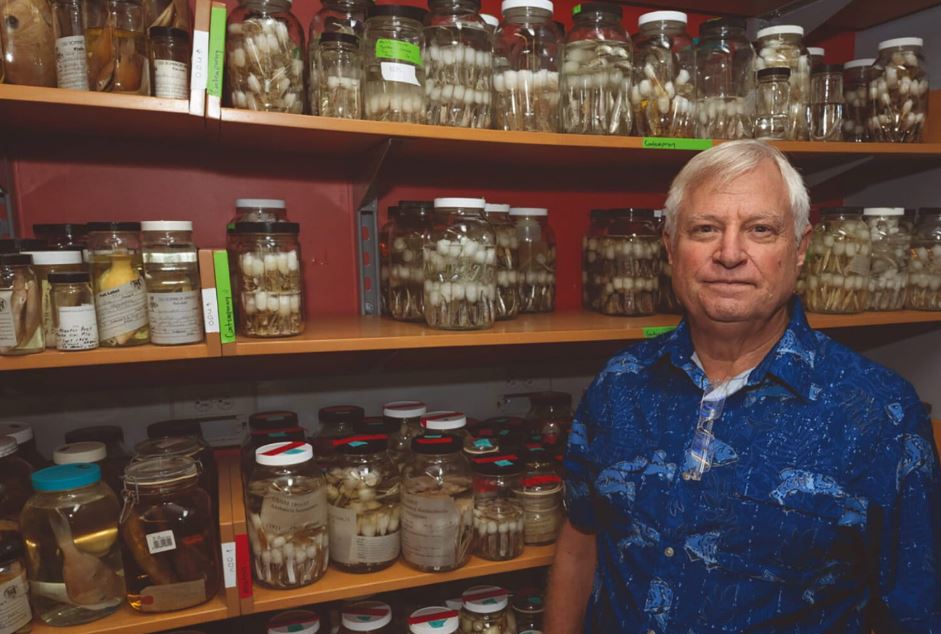
Kent Carpenter, Authority on Philippine Marine Biology, Contributed to South China Sea Ruling
Culture
2026年7月15日
4
GMA News Philippines

Kent Carpenter, Authority on Philippine Marine Biology, Contributed to South China Sea Ruling

AI サマリー

Internationally renowned American marine biologist Kent Carpenter, who dedicated his life to studying the Philippines' marine biodiversity, has been fatally shot. His research significantly supported the Philippines' case in the 2016 South China Sea arbitral ruling.

Internationally renowned American marine biologist Kent Carpenter, who dedicated decades to studying the Philippines' rich marine biodiversity, has been fatally shot. His pioneering research not only advanced coral reef science but also significantly supported the Philippines' case in the 2016 South China Sea arbitral ruling. Who is Kent Carpenter? The Old Dominion University (ODU) in Norfolk, Virginia, lists Carpenter as a professor and eminent scholar in Biological Sciences. Carpenter earned a Bachelor of Science in Biology from the Florida Institute of Technology in 1975 and a Ph.D. in Zoology from the University of Hawaiʻi at Mānoa in 1985. Carpenter arrived in the Philippines at 22 after the Peace Corps assigned him to the Bureau of Fisheries and Aquatic Resources and put him in charge of coral reef research, according to Mongabay.com, an environmental science news and information service. He later called it “the best job there ever was or ever will be in the Peace Corps," as it gave him access to reefs across the archipelago and set the direction of his career. 'Center of the center' His best-known finding began with distribution records for 2,983 marine species. Working with Victor Springer, he mapped their ranges across the Indo-Malay-Philippine region. The highest concentration appeared in the central Philippines, especially around the Verde Island Passage, which lies between Batangas and the island of Mindoro. "He called the region the 'Center of the Center' of marine shore-fish biodiversity. Conservationists adopted the phrase to explain the importance of the narrow passage between Luzon and Mindoro, where shipping, coastal development, and fishing pressed against an exceptional concentration of marine life," according to Mongabay. The University of the Philippines Marine Science Institute said was through Carpenter's work that the Philippines earned the acclaim of being the "center of the center of marine shore fish biodiversity." He also advocated for the designation of an important part of this "center", the Verde Island Passage, as a National Protected Area and a UNESCO World Heritage Site. Groundbreaking contributions Carpenter worked with Siliman University (SU) in Dumaguete City for nearly five decades. In 1976, he worked alongside the late National Scientist Dr. Angel C. Alcala and fellow marine scientists in pioneering studies on the rich marine ecosystems of the Philippines. Their partnership helped establish SU as an internationally respected center for marine and coastal research and contributed significantly to the scientific understanding of coral reef biodiversity, reef fish ecology, fisheries sustainability, and marine conservation. "Throughout the years, Dr. Carpenter worked closely with faculty, researchers, and students of the Biology Department, the Institute of Environmental and Marine Sciences, and the SU Angelo King Center for Research and Environmental Management, bringing to Silliman his expertise in ichthyology, marine biodiversity, systematics, conservation biology, and evolutionary research," the university said in a social media post. "Through the Partnerships for International Research and Education program, he opened opportunities for Filipino graduate students and researchers to collaborate with leading international institutions, strengthening the University’s international research network and attracting global scientific partnerships," it added. According to SU, among his most significant recent contributions was his leadership of the Albatross Re-Collection Project, a landmark evolutionary genomics research initiative that revisits the historic collections of the U.S. Fish Commission Steamer Albatross, which surveyed Philippine waters more than a century ago. He also worked closely with Silliman researchers on studies tackling pressing environmental issues, including coral reef conservation, fisheries management, and marine pollution. Among these were investigations into the ecology and fisheries of rabbitfish (Siganus fuscescens) and the effects of microplastics on marine organisms in Negros Oriental—research that reflected his commitment to producing science that supports conservation and the sustainable management of marine resources. Expert witness in 2016 Arbitral Award Carpenter served as an expert witness for the Philippines in the landmark 2016 arbitral ruling on the South China Sea case brought against China. He submitted expert evidence detailing the environmental damage caused by China's large-scale land reclamation and destructive fishing practices in the West Philippine Sea, and delivered oral testimony during the tribunal's merits hearing in 2015. Going to great lengths during his testimony, he provided reports, testimonials, video conference and satellite imagery on the state of coral reefs in the area. Carpenter also contributed his expertise to the Tubbataha Reefs Natural Park, participating in fish surveys and publishing research on the UNESCO World Heritage Site since 2018. Through his collaborations with Philippine and international institutions in tropical marine ecology, he helped build the expertise of Filipino scientists and mentored generations of students. Distinctions Carpenter authored numerous publications, including research in the Philippines, which saw print in science journals, books, and presentations. He was the recipient of various honors and awards, including the 2017 Faculty Research Award from ODU, the Fulbright Senior Scholar Award in 2011, a Fellow at the California Academy of Sciences in 2011, the Visiting Scientist Award, Food and Agriculture Organization of the U.N. in 1998, and the Visiting Scientist Award, Smithsonian National Museum of Natural History in 1998. Students remained at the heart of Carpenter’s career. Accepting Virginia’s Outstanding Faculty Award in 2020, he said his greatest inspiration came from students who shared his passion for the marine environment. Even during his fellowship in Vietnam, he held weekly meetings with his students and continued teaching across time zones. Carpenter spoke Tagalog, although he admitted Vietnamese was more challenging to learn. He often joked that years of playing bass guitar in rock bands had damaged his hearing, making it harder to distinguish the tonal nuances of the language.—LDF, GMA News

多角的分析

経済的影響

ケント・カーペンター氏の研究は、フィリピンの海洋資源の経済的価値、特に漁業や観光業への影響を科学的に裏付けるものでした。彼の「中心の中枢」という概念は、ヴェルデ島海峡の生物多様性が、周辺地域の持続可能な漁業と生態系サービスに不可欠であることを示唆しています。これは、フィリピン経済における海洋資源の重要性を強調し、これらの資源を保護・管理するための政策決定に科学的根拠を提供するものです。彼の研究が、仲裁裁判におけるフィリピンの主張を補強したことは、海洋資源の主権と経済的利益を守る上での科学的知見の価値を示しています。

投資家心理

カーペンター氏の研究は、フィリピンの海洋生態系の脆弱性と、それがもたらす経済的リスクを浮き彫りにしました。南シナ海における中国の活動による環境破壊は、漁業資源の枯渇や観光業への悪影響を通じて、フィリピン経済に直接的な損害を与える可能性があります。投資家にとって、これは、海洋資源への依存度が高い産業への投資リスクを評価する上で、地政学的な緊張だけでなく、環境リスクも考慮する必要があることを意味します。彼の研究は、持続可能な開発への投資の必要性を強調するものです。

社会的影響

ケント・カーペンター氏の死は、フィリピンの海洋科学コミュニティ、特にシレマン大学とその卒業生に深い悲しみをもたらしました。彼は単なる研究者ではなく、多くのフィリピン人学生に影響を与え、指導したメンターでした。彼の研究は、ヴェルデ島海峡のような重要な海洋生態系を保護することの社会的意義を浮き彫りにし、沿岸コミュニティの生計や文化遺産を守るための科学的根拠を提供しました。彼の死は、海洋環境保護活動家や科学者たちの間で、正義を求める声と、彼の遺志を継ぐことへの決意を呼び起こしています。

市民の声

ケント・カーペンター氏の研究は、フィリピン国民、特に沿岸地域に住む人々の生活に密接に関わるものでした。彼の「中心の中枢」という発見は、ヴェルデ島海峡の豊かな海洋生物が、彼らの食料源や収入源としていかに重要であるかを示しています。南シナ海での環境破壊に関する彼の証言は、国民が自国の領海とその資源を守ることの重要性を理解する助けとなりました。彼の突然の死は、多くの国民に衝撃を与え、彼の功績を称え、彼の研究が守ろうとした海洋環境の保護を継続することの必要性を再認識させています。

背景・歴史的文脈

ケント・カーペンター氏の研究は、フィリピンの海洋生物多様性の中心地としてのヴェルデ島海峡の重要性を科学的に確立しました。この地域は、インド・太平洋地域における海洋生物の進化と分布の「中心の中枢」とされ、2,983種もの海洋生物の生息地となっています。彼の研究成果は、2016年の南シナ海仲裁裁判において、中国の埋め立てや破壊的な漁業慣行がこの貴重な生態系に与えた損害を立証する上で、フィリピンの主張の強力な証拠となりました。この裁判は、フィリピンが中国の海洋進出に対して国際法に基づき提起したもので、フィリピンの排他的経済水域(EEZ)における権利を支持するものでした。

原文ソース

GMA News Philippines

原文を読む