General articles are free for 24 hours after publish.
Marcos summons China envoy as PH-China tensions escalate over South China Sea incident
Philippine President Ferdinand Marcos Jr. summoned the Chinese Ambassador to Manila following a violent confrontation in the West Philippine Sea where a Filipino soldier was injured. The incident escalates existing tensions between the two nations.
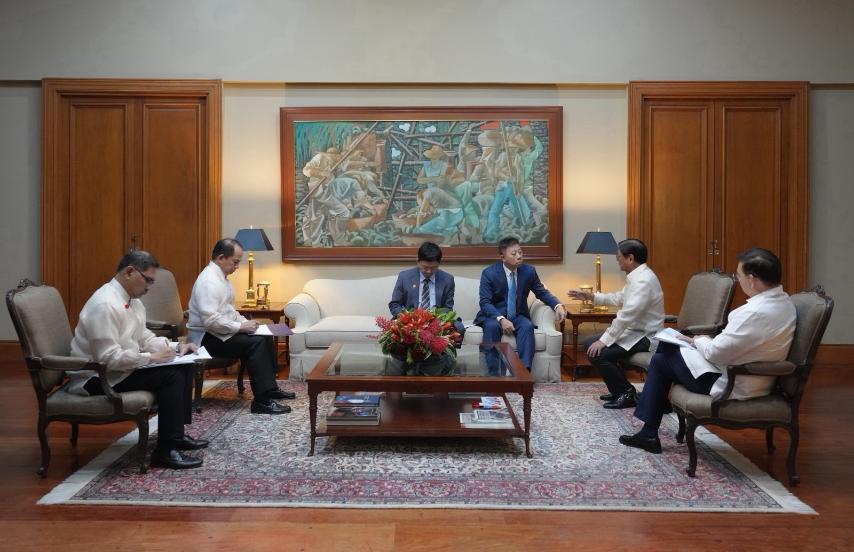
MANILA, Philippines — President Ferdinand Marcos Jr. has summoned Chinese Ambassador to Manila Jing Quan late Tuesday, July 21, a day after a Filipino soldier was injured in a violent confrontation with China Coast Guard (CCG) personnel in Ayungin (Second Thomas) Shoal in the West Philippine Sea. The July 21 meeting would be the first time for Marcos to summon Jing, who arrived in Manila in December 2025. Marcos had summoned Jing’s predecessor, Huang Xilian, twice: over the CCG’s use of lasers on the Philippine Coast Guard in 2023, and after Beijing announced sanctions on former senator Francis Tolentino, who is now Marcos’ labor chief. A year after Tolentino was sanctioned, Beijing then sanctioned Defense Secretary Gilberto Teodoro Jr. That means two of Marcos’ Cabinet members are sanctioned by Beijing. The development comes as tensions between the Philippines and China — in both political and maritime spaces — turn extra tense, and as Chinese Foreign Minister Wang Yi visits Manila for the first time since July 2022 or the early months of the Marcos presidency. Wang is here for high-level Association of Southeast Asian Nations (ASEAN) meetings. A racist video released by state-owned China Daily depicts the Philippines as a monkey to undermine the landmark 2016 Arbitral Award has sparked outrage among Filipinos. On Monday, July 20, a Filipino soldier stationed at the BRP Sierra Madre in Ayungin Shoal sustained a gash after the CCG hit him on the head with a “wooden baton” during a melee between the two sides. The CCG vessel, which anchored close to the BRP Sierra Madre, deployed a rigid hull inflatable boat with eight of its personnel on board the morning of the 20th. According to the Armed Forces of the Philippines (AFP), the CCG boat then went around the Sierra Madre while taking photos and videos. The Philippines deployed two rubber boats with two and five soldiers on board to shoo away the CCG. Chaos broke out when the CCG refused to leave. Beijing has accused Manila of instigating the confrontation and “deliberate provocation” during what it said was a “routine patrol” in Ayungin Shoal, which China calls Ren’ai Jiao. Reset in China ties? The BRP Sierra Madre is a World War II vessel that was ran ground in Ayungin Shoal in 1999, in response to China’s building activities in Mischief Reef, a feature close by. Beijing had claimed back in 1995 that the structure was merely a fisherman’s shelter. It is now a militarized artificial island. Beijing claims Ayungin Shoal as their territory, even if it’s a low-tide elevation that generates no territorial claim or territorial waters. It is just over 100 nautical miles from Palawan, which means Ayungin is right within the Philippines’ exclusive economic zone, an area affirmed by the landmark 2016 Arbitral Award which China does not recognize. Marcos, in early 2026, signaled a desire to reset ties with China after years of tense ties, mostly over maritime issues. China claims almost all of the South China Sea, including parts that are claimed by the Philippines and part of its exclusive economic zone (EEZ). China’s insistence on its supposed historical claims have meant, for Filipinos, the danger of harassment out at sea. Chinese maritime units, typically its CCG, have used dangerous maneuvers, ramming, and water cannons to drive away Philippine vessels during their missions to the West Philippine Sea. Harassment can extend to Filipino fisherfolk with much smaller wooden vessels. Ayungin had become relatively peaceful since Manila and Beijing agreed on a provisional arrangement covering resupply missions to the BRP Sierra Madre. It’s unclear if the arrangement still stands after the latest clash. US, Australia condemn Chinese actions In a statement early Tuesday, July 21 (July 20 in Washington DC), the United States State Department condemned China’s “dangerous and aggressive actions” in the shoal and called on Beijing to “immediately cease its destabilizing conduct. “China’s troubling pattern of provocation against lawful Philippine maritime operations undermines regional peace and stability and directly contradicts China’s repeated commitments to resolve disputes peacefully,” said State Department Deputy Spokesperson Tommy Pigott. “We reaffirm the July 2016 Arbitral Tribunal ruling, which found that China’s expansive maritime claims in the South China Sea have no basis in international law. That decision is final and legally binding on both China and the Philippines. We will continue to stand with our Allies and partners in defense of a free and open Indo-Pacific,” said Pigott. UN State Secretary Marcos Rubio arrived in Manila early Tuesday for the high-level ASEAN meetings. The US is the Philippines’ only treaty-ally. The two countries are bound by the Mutual Defense Treaty, which covers areas in the South China Sea. Australian Ambassador to Manila Marc Innes-Brown, meanwhile, said in a post on social media that Canberra “remains concerned about destabilising and dangerous conduct in the South China Sea, including actions by Chinese vessels toward Philippine vessels yesterday.” “We continue to call for adherence to UNCLOS,” said Innes-Brown. The Philippines and Australia are strategic partners and have a Status of the Visiting Forces Agreement in place, allowing training between its militaries. In social media posts, Japanese Ambassador to the Philippines Endo Kazuya said Tokyo was “seriously concerned about the aggressive actions in Second Thomas Shoal which resulted in injury to PH personnel and damage to the [Philippine] boat.” He added: “We stand with countries in maintaining and enhancing the free and open international order based on the rule of law. The Philippines and Japan are Comprehensive Strategic Partners and have a Reciprocal Access Agreement in place akin to the SOVFA.” – Rappler.com
Original source
Rappler Philippines