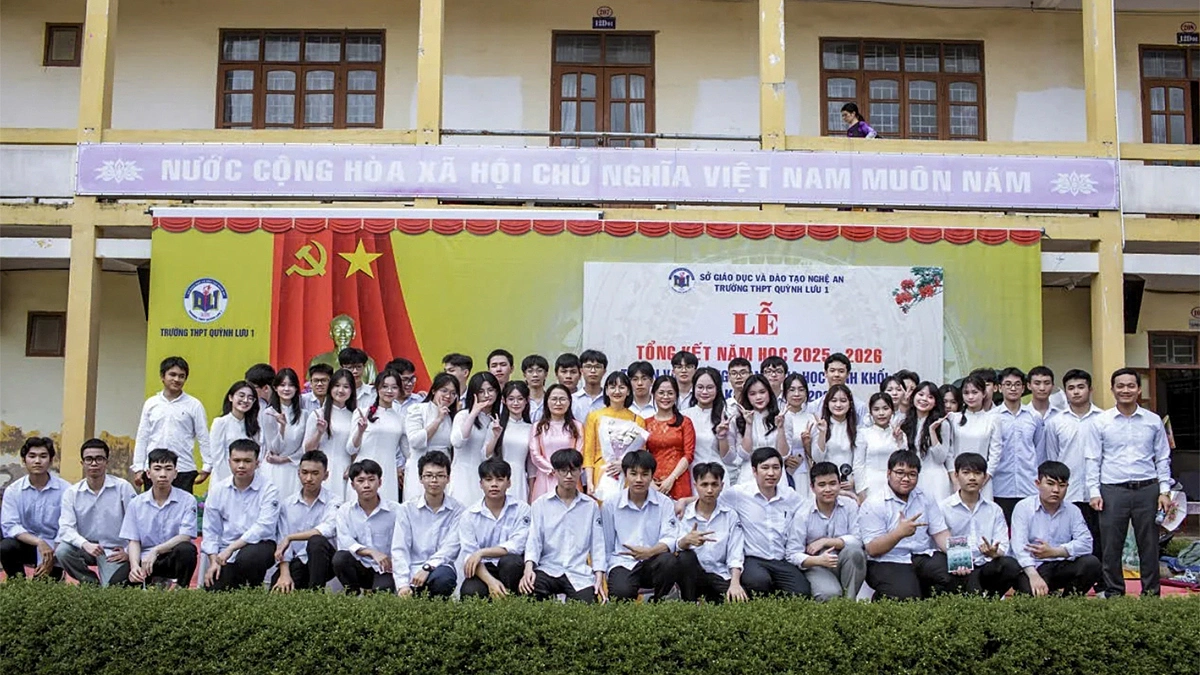
Rural Students in Central Vietnam Achieve Top National Ranks
High school students from rural backgrounds in Vietnam's central Nghe An province have achieved top national academic results through classroom learning and self-study, without attending private tutoring. Notably, 18 students scored perfect marks in mathematics, producing the province's top and second-highest scorers.
The 12A1 class at Quynh Luu 1 High School in Nghe An province, central Vietnam, composed primarily of students from rural backgrounds, has achieved an exceptional average score of 9.25 in Mathematics for the 2026 High School Graduation Exam (THPT), without relying on external tutoring. This class has produced the province's top scorer (thủ khoa) in the A00 block (Mathematics, Physics, Chemistry) with 29.75 points, Le Minh Hieu, and the second-highest scorer (á khoa) in the same block, Phan Trung Long, with 29.5 points. Out of the 51 students in the class, 18 achieved a perfect score of 10 in Mathematics, an unprecedented achievement for the school. Many students come from farming or civil servant families in rural areas, facing economic constraints that make private tutoring inaccessible. Their learning relies heavily on in-class instruction and home study. Mr. Ho Sy Nam Thang, the school principal, stated that 12A1 is the school's "spearhead" class, selected from the 10th grade. Last year, 29 students from this class won provincial-level awards in academic competitions, and they consistently ranked within the top 5 and top 3 in three mock exams conducted by the provincial Department of Education and Training. Beyond Mathematics, students also demonstrated strong performance in other key subjects, with average scores in Physics of 8.11, Chemistry of 8.77, and Literature of 7.93. Principal Thang emphasized that these results are the product of continuous effort, not a sudden breakthrough. Ms. Nguyen Thi Tam, the homeroom teacher, expressed no surprise at the students' achievements, citing their solid foundation, diligence, and eagerness to learn. Many students aspire to enroll in military, police, technical, economic, and pedagogical universities. Quynh Luu 1 High School, established in 1961, had 634 candidates in the recent graduation exam, with 44 students scoring a perfect 10 in Mathematics. Having been outside the top 20 provincial rankings for many years, the school has now climbed to 4th place in Nghe An province this year. This case highlights the improving quality of education in Vietnam's rural areas and the significant results being achieved in some regions, potentially spurred by investments in education against the backdrop of economic growth.
多角的分析
このニュースは、ベトナムの地方部における教育投資の効果と、それが経済成長に与える長期的影響を示唆している。農村出身の生徒が塾なしで高い学業成績を収めたことは、質の高い公教育が提供されれば、経済的背景に関わらず優秀な人材が育成可能であることを示している。これは、ベトナム政府が推進する教育分野への投資、特に地方部の教育インフラ整備や教員研修の成果と捉えることができる。このような人材育成は、将来的にベトナムの産業競争力強化、特に高度技術産業やサービス業における人材不足の解消に貢献する可能性がある。また、地方からの優秀な人材の都市部への流出だけでなく、地方経済の活性化にも繋がる可能性を秘めている。
このニュースは、ベトナムの人的資本の質の高さを裏付けるものであり、長期的な視点を持つ投資家にとってポジティブなシグナルとなる。特に、教育、テクノロジー、製造業などの分野への投資を検討している投資家は、国内で育成される優秀な人材プールに注目すべきである。農村部から優秀な人材が輩出されることは、地方での産業育成や、地方を拠点とした企業の成長の可能性を示唆している。これは、サプライチェーンの分散化や、新たな市場開拓を目指す投資家にとって、ベトナムの地方部が有望な投資先となり得ることを示唆している。ただし、地方部への投資にはインフラ整備や物流網の確立といった課題も伴うため、慎重なデューデリジェンスが必要である。
ゲアン省の農村部から輩出された優秀な生徒たちの事例は、ベトナム社会における教育への強い希求と、努力による階級移動の可能性を示している。多くの生徒が経済的に困難な家庭環境にあるにもかかわらず、学業で成功を収めている事実は、ベトナム社会における教育が、依然として個人の将来を左右する重要な要素であることを浮き彫りにする。しかし、この成功が一部の地域や学校に限定されないか、また、都市部と地方部の教育格差が依然として存在するかどうかは、さらなる検証が必要である。地方の生徒たちが、都市部の生徒と同等の教育機会を得られるよう、教育資源のより公平な配分が求められる。また、このような成功事例は、地方に住む若者たちに希望を与え、地域社会の活性化にも繋がる可能性がある。
このニュースは、ベトナム国民、特に地方に住む親たちにとって、大きな希望となるだろう。追加の塾代などを負担できなくても、子供たちが学校の勉強をしっかり頑張れば、全国トップクラスの成績を収め、良い大学に進学できる可能性があることを示している。ゲアン省の農村部で、多くの生徒が数学で満点を取れたことは、公立学校の教育の質が向上している証拠であり、親たちは我が子にも同様の機会があると感じるだろう。一方で、都市部との教育環境の差を懸念する声もあるかもしれない。しかし、このような成功事例が積み重なることで、地方の教育への信頼が高まり、より多くの若者が自身の能力を最大限に発揮できる社会が実現することを期待する。
背景・歴史的文脈
ベトナムは、1986年のドイモイ(刷新)政策以降、市場経済化を進め、急速な経済成長を遂げてきた。この過程で、教育への投資も増加し、特にSTEM分野(科学、技術、工学、数学)における人材育成が重視されてきた。しかし、経済成長の恩恵は都市部に集中しがちであり、地方部との格差が課題となっている。ベトナム共産党は、教育の均等化と質の向上を目指し、地方部の学校への支援を強化している。今回の事例は、そうした政策の一端が、特定の地域や学校において、地域住民の努力と結びついて、具体的な成果として表れた可能性を示唆している。農村部出身の生徒が経済的制約の中で優秀な成績を収めることは、ベトナム社会において教育が依然として重要な社会的流動化の手段であることを示している。
原文ソース
VnExpress