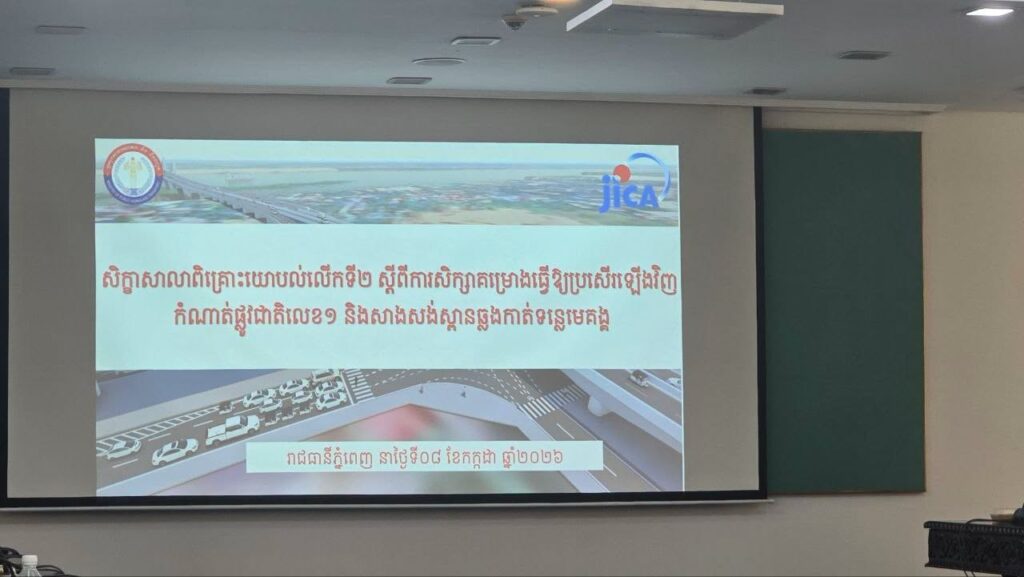
New Mekong River Bridge Planned with Japanese Support, Coastal Development Expected
A model for a Mekong River bridge project, supported by the Japanese government, has been unveiled in Cambodia. The project is integrated with infrastructure improvements along National Road No. 1, and is expected to promote coastal development. Prime Minister Hun Manet emphasized the long-standing cooperation with Japan and requested continued infrastructure support.
A new bridge project spanning the Mekong River is taking shape as part of Cambodia's infrastructure development. On July 8, technical officials from the Ministry of Public Works and Transport, Phnom Penh city authorities, and a technical team from Japan's Japan International Cooperation Agency (JICA) held a workshop on the National Road No. 1 improvement and Mekong River bridge project. The workshop shared findings from the project's feasibility assessment, preliminary design and cost estimation, Environmental Impact Assessment (IESIA), and Resettlement Action Plan (RAP). Notably, a model of the Mekong River bridge, planned for construction with financial support from the Japanese government, was unveiled. Prime Minister Hun Manet had previously requested the Japanese government to consider supporting the construction of a Mekong River bridge connecting Kdey Takoy and Arykksat during the groundbreaking ceremony for the first phase of the deep-sea container terminal at Sihanoukville Autonomous Port on December 22, 2023. Addressing a Japanese Vice-Minister of Land, Infrastructure, Transport and Tourism visiting Cambodia at the time, the Prime Minister lauded Japan as "an important friend who has contributed to Cambodia's development in the past, present, and future," and requested continued support for infrastructure development, including the expansion and improvement of National Road No. 1 and the Mekong River bridge. This new bridge project, coordinated with the improvements to National Road No. 1, holds the potential to revitalize the regional economy, particularly by promoting development in the Mekong River coastal areas. Japan's long-standing Official Development Assistance (ODA) to Cambodia has played an indispensable role in the nation's infrastructure development, and this project is positioned as part of that ongoing effort. Further reading: Six major river bridges are in the study phase and will proceed to construction successively. At the groundbreaking ceremony for the first phase of the deep-sea container terminal at Sihanoukville Autonomous Port on December 22, 2023, Cambodian Prime Minister Hun Manet requested the Japanese government to consider supporting the construction of a Mekong River bridge from Kdey Takoy to Arykksat. Through the Japanese Vice-Minister of Land, Infrastructure, Transport and Tourism, who visited Cambodia, Prime Minister Hun Manet stated that Japan is an important friend who has contributed to Cambodia's development from the past, present, and into the future. Within the framework of developing the public works and transport sector, the Prime Minister requested the Japanese government to continue supporting the development of Cambodia's road and bridge infrastructure, such as the project to expand and upgrade National Road No. 1 to the Neak Loeung Bridge and the bridge crossing the Mekong River from Kdey Takoy to Arykksat.
多角的分析
メコン川架橋プロジェクトは、カンボジアの物流コスト削減と地域経済活性化に大きく貢献すると考えられる。特に国道1号線沿いのインフラ整備と一体となることで、陸上輸送の効率化が進み、沿岸部の開発ポテンシャルを最大限に引き出す可能性がある。日本からの資金援助は、カンボジア政府の財政負担を軽減し、プロジェクトの迅速な実現を後押しするだろう。過去の日本からのインフラ支援がカンボジア経済に与えたプラスの影響を鑑みると、この架橋も同様の効果をもたらすことが期待される。
この架橋プロジェクトは、カンボジアへの投資環境改善のシグナルとなり得る。物流インフラの強化は、製造業やサービス業の立地コストを低下させ、国内外からの投資を呼び込む要因となる。特に、メコン川沿岸部の開発が進めば、新たな不動産開発や商業施設の設立が見込まれ、投資機会が拡大するだろう。ただし、プロジェクトの進捗状況や、周辺開発計画との連携が投資判断の鍵となる。
メコン川新架橋は、プノンペン近郊の地域住民の生活に大きな変化をもたらす可能性がある。交通アクセスの向上により、都市部への通勤・通学が容易になり、経済活動の機会が増加するだろう。一方で、再定住行動計画(RAP)の策定が進められていることから、土地収用や移転を余儀なくされる住民への十分な配慮と補償が不可欠となる。環境影響評価(IESIA)も実施されており、生態系への影響を最小限に抑えるための対策が求められる。
新しい橋は、プノンペンと対岸地域を結ぶ交通を劇的に改善する。これまでフェリーに頼っていた移動が、より迅速かつ容易になることで、人々の生活圏が広がり、経済活動の機会が増えるだろう。特に、農産物の市場への輸送や、都市部での雇用機会へのアクセスが改善されることは、農村部の住民にとって大きな恩恵となる。しかし、建設に伴う騒音や交通渋滞、そして土地の利用に関する懸念も無視できない。
背景・歴史的文脈
カンボジアにおけるメコン川架橋計画は、同国の経済発展と地域間連携強化の重要性を示すものである。過去、カンボジアのインフラ開発は、主に中国からの大規模な融資や援助に依存してきたが、近年、日本もODAを通じて、国道1号線拡幅事業(2015年完了)など、重要なインフラプロジェクトに貢献してきた。今回のメコン川架橋計画は、こうした日・カンボジア間の協力関係の継続と深化を示すものであり、フン・マネト政権が掲げる経済成長戦略の一環として位置づけられる。特に、国道1号線沿いの開発は、プノンペンとベトナム国境を結ぶ主要ルートの利便性を高め、経済回廊としての機能を強化する狙いがある。
原文ソース
Kampuchea Thmey Local