General articles are free for 24 hours after publish.
West Kalimantan Wildfires: Civil Society Groups Sue Indonesian Government
Civil society groups in West Kalimantan have filed a class-action lawsuit against the Indonesian government, accusing President Prabowo Subianto and other officials of negligence in preventing and handling ongoing wildfires. The blazes have caused widespread health issues and environmental damage.
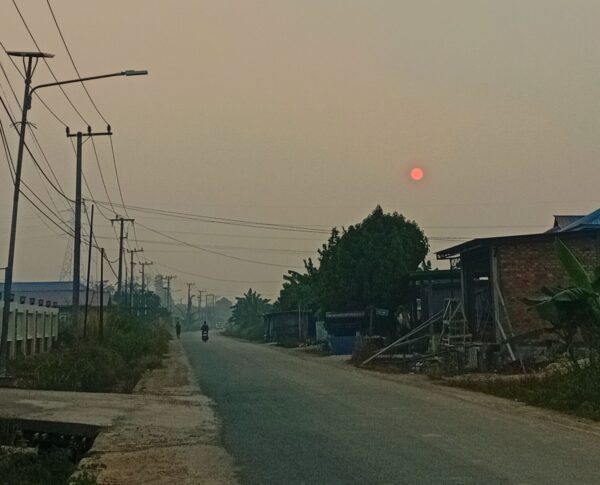
A group of indigenous and civil society organizations in Indonesia’s West Kalimantan province has filed a class-action lawsuit against the country’s government, accusing it of failing to prevent and properly handle the wildfires currently raging across the region. The class action lawsuit was filed on September 17 at the Pontianak District Court by a coalition of civil groups known as Nafas Kalimantan Barat, which translates as “the breath of West Kalimantan,” Tempo reported. The plaintiffs include the West Kalimantan chapter of the Indigenous Peoples Alliance of the Archipelago, the environmental group Laman Puyung Indonesia, and the leadership of the West Kalimantan Catholic Youth, as well as the citizen-activist Sisilius Rami. The lawsuit names President Prabowo Subianto, Vice President Gibran Rakabuming Raka, the national police chief, and the head of the National Disaster Management Agency (BNPB), as well as the governor and police chief of West Kalimantan, and the ministries of health, forestry, and environment. It accuses them of deliberate negligence for failing to prevent and properly handle the ongoing wildfires, arguing that the disaster has overwhelmed provincial capacity. It also seeks a court order that would force the government to declare a national disaster, which would enable greater financial assistance for affected areas. For months, Kalimantan has been battling its most intense wildfires since 2015. According to a report in The Guardian, “photos from Kalimantan have shown a thick, sepia-toned haze shrouding streets and obscuring cities, schoolchildren wearing masks at their desks, and even rescuers giving oxygen to smoke-affected orangutans.” Fires are also raging in Sumatra and in parts of Papua. Since January, nearly 900,000 hectares have been burned across Indonesia, according to data from Nusantara Atlas, which tracks fires and deforestation in Asia. This falls short of the 2.6 million hectares that were destroyed in 2015, and the 1.65 million hectares that were consumed by wildfires in 2019, but Nusantara Atlas stated that burning usually accelerates in August and peaks during September and October, and that as of July 20, cumulative hotspot activity in 2026 “was above every previous year at the same point in the season.” “Indonesia has not yet entered the period when fire activity has historically accelerated most sharply,” it stated. “The current hotspots signal is therefore an early warning, not yet the peak.” Indonesian Forestry Minister Raja Juli Antoni has warned that with a particularly extreme El Niño climate pattern only now starting to peak, September could be “when the real battle begins.” Glorio Sanen, the lawyer representing the plaintiffs, told the Jakarta Post that the spillover effects of peatland and forest fires in West Kalimantan – particularly the choking air pollution – continue to threaten public health and damage the environment. “Meanwhile, our assessment concludes that there has been no sufficient coordination between the central government, ministries and even local administrations to prevent and respond to the disaster in West Kalimantan,” Glorio said. The haze from the fires in Indonesia has now spread far beyond the country’s borders, including to the Malaysian states of Borneo, peninsular Malaysia, Brunei, Singapore, and the Philippines, affecting the health of millions. As of September 9, more than 113,000 people were reported to have suffered from wildfire-related respiratory illnesses. Even if this year has been particularly bad for wildfires, the issue is an annual occurrence in Indonesia. As in other parts of Southeast Asia, the blazes are often deliberately lit in order to clear land for oil palm plantations and then spread raging infernos. Indonesia’s environment ministry says that it is investigating 19 companies that it believes may be linked to the wildfires, and has promised to punish any wrongdoers. The fires have overwhelmed the Indonesian government’s capacity, in part due to the complexity of battling peatland fires. David Gaveau, a landscape ecologist who runs Nusantara Atlas, told The Guardian that fires on dried-out peatland are very difficult to extinguish, because they can burn for weeks underground. He described these fires as “the legacy of 50 years of forest degradation [and] deforestation” in Indonesia. The initial hearing in the lawsuit is set for October 7.
Original source
The Diplomat Indonesia