General articles are free for 24 hours after publish.
India-China Relations: Stuck in 'Temporary Truce' Diplomacy?
India and China's relationship shows temporary de-escalation around multilateral summits, but fundamental structural tensions remain unresolved. While both nations ease some economic restrictions, mutual distrust persists over border issues, preventing a true reset.
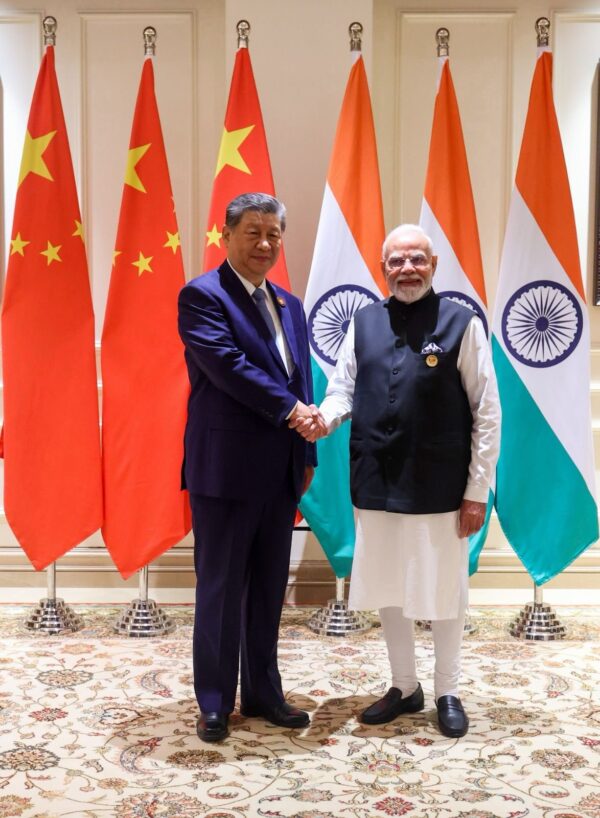
Read The Diplomat, Know The Asia-Pacific Agreements are reached to facilitate meetings between leaders ahead of multilateral summits, but often don’t move much beyond that. Chinese President Xi Jinping and Indian Prime Minister Narendra Modi shake hands ahead of their meeting on the sidelines of the 18th BRICS Summit at New Delhi, India, Sept 12, 2026. Chinese President Xi Jinping met Indian Prime Minister Narendra Modi in New Delhi on September 12, on the sidelines of the 18th BRICS Summit hosted by India. This was Xi’s first visit to India in nearly seven years and his third meeting with Modi in under two years – all on the sidelines of multilateral meetings, including at Kazan in Russia and Tianjin in China. Both the Indian and Chinese readouts from the New Delhi meeting sought to convey that relations, which had plunged to a low after the 2020 Galwan border clashes, were on an upswing. According to the Chinese readout, President Xi said that the progress made had not “come easily and needs to be cherished.” The Indian readout also “welcomed the steady progress” in bilateral ties since the leaders last met in Tianjin last year. Indeed, over the past two years, relations have moved forward. The two countries have gradually advanced talks on boundary delimitations and paved the way for greater people-to-people exchanges, including through the resumption of direct flights. On the economic front, New Delhi has eased restrictions on the purchase of select Chinese equipment imports, while Beijing has agreed to ease restrictions on supplying fertilizers, rare earth minerals, etc., to India. Notably, these breakthroughs in bilateral ties – especially on contentious border-related questions – came just before multilateral summits. On September 8, 2022, after a prolonged military stalemate along the Line of Actual Control in eastern Ladakh, India and China agreed to disengage from the Gogra-Hot Springs area. Significantly, this breakthrough came just a week before the Shanghai Cooperation Organization (SCO) Summit in Samarkand that both Xi and Modi were scheduled to attend. Again, on October 21, 2024, India and China reached a landmark agreement on patrolling arrangements at two friction points, Depsang and Demchok, in eastern Ladakh. This came just two days before the 16th BRICS Summit at Kazan, where Modi and Xi held their first formal bilateral meeting on the margins of the summit. More recently, just days before the 2026 SCO summit at Bishkek, Kyrgyzstan, where Modi and Xi were present, India’s National Security Adviser Ajit Doval and Chinese Foreign Minister Wang Yi met in Beijing for the 25th round of talks between the Special Representatives of India and China on the Boundary Question. The two sides released an eight-point outcome reaffirming commitment to peace and tranquility in the border areas and announced new institutional arrangements to manage border frictions, including plans to establish two new border hotlines and two new points for meetings between army commanders. However, when the smiles, handshakes, and photo-ops are done, bilateral ties settle back into their familiar pattern of mutual mistrust. Despite repeatedly committing to de-escalation, the heavy deployment of Indian and Chinese troops continues along the frontier, even as both sides step up infrastructure building along and near disputed sites. According to a report by Al Jazeera, China has repeatedly denied the Indian army access to key patrolling points and encroached on land in the Indian border state of Arunachal Pradesh. At Tianjin, both Modi and Xi agreed that India and China are “development partners, not rivals” and decided to strengthen cooperation as “important economies of the world” to stabilize world trade. Yet, New Delhi’s regulatory hurdles are pushing Chinese investment out of the country. New Delhi rejected Alipay+, a China-based digital payment platform, for cross-border transactions due to national security concerns. Indeed, according to a Reuters report, proposed investments in India by Chinese companies “are facing more scrutiny from Beijing itself, including in sectors where sophisticated manufacturing and high-end technology,” as are business visa approvals for Indian companies, causing operational challenges. These examples suggest that orchestrated pre-summit diplomatic thaws and episodic summitry are what Indian analyst Jabin T. Jacob calls a “marking-time reset” – a pragmatic, temporary freeze in hostilities that fails to address fundamental structural tensions. For Beijing, platforms such as SCO and BRICS are crucial for challenging Western dominance and provide cohesive, non-Western alternatives for the Global South, while for New Delhi, participation in these forums is crucial to maintain its “multi-aligned” position. For both sides, preserving the optics of a unified front in a multilateral setting is essential. They exploit high-level summit attendance as a bargaining chip to secure short-term concessions. Sections of the Indian media have drawn attention to the “long warm handshake” between Modi and Xi in New Delhi and interpreted their recent meeting as signaling a reset in bilateral relations. But such positive assessments are not only premature, but risk overstating the magnitude of the current thaw. While external factors such as India’s strained ties with the United States due to President Donald Trump’s tariffs and transactional diplomacy can accelerate the thaw in India-China ties, the prospects for sustained stability appear limited. As former Foreign Secretary and Ambassador to China and the United States Nirupama Menon Rao pointed out, India and China must move towards a “steady and sustained process of stabilization” on the military and economic front, rather than focusing on the optics of success of multilateral side-meetings. Until then, a meaningful reset in ties will remain elusive. Subscribe today and join thousands of diplomats, analysts, policy professionals and business readers who rely on The Diplomat for expert Asia-Pacific coverage. Get unlimited access to in-depth analysis you won't find anywhere else, from South China Sea tensions to ASEAN diplomacy to India-Pakistan relations. More than 5,000 articles a year. Already have an account? Log in. Rushali Saha is a New Delhi based independent researcher and foreign affairs columnist. She is currently working as a security risk analyst with Horizon Intelligence, a Belgium-based threat intelligence firm. Get briefed on the story of the week, and developing stories to watch across the Asia-Pacific.
Original source
The Diplomat Indonesia