General articles are free for 24 hours after publish.
Thai Military's Occupation of Cambodian Territory Under Scrutiny After ASEAN Observer Visit
Cambodia has strongly criticized a visit by ASEAN observers and media to the illegally occupied O'Smach area by Thai forces, alleging it was a 'staged scenario.' An observer noted discrepancies with prior information, prompting Cambodia to demand independent verification.
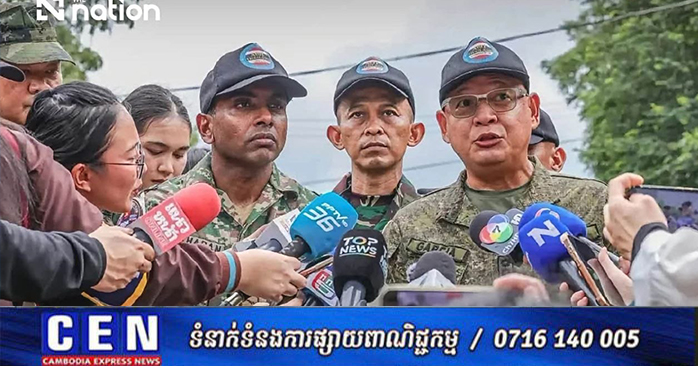
Cambodia has strongly criticized a visit by ASEAN observers and media to the O'Smach area, which it claims is illegally occupied by Thai forces, labeling it a "staged scenario" prepared by Thailand. Following the visit on September 7, 2026, Cambodian Minister of Information, Net Pheaktra, stated that the Royal Government of Cambodia had strongly protested Thailand's actions, which violate Cambodia's sovereignty and territorial integrity, via diplomatic notes on September 8. He questioned whether what the observers saw was the full truth or a curated image by the Thai side illegally controlling the location. This question gained further weight when Lieutenant Colonel Roderick T. Garcia of the ASEAN observers in Thailand remarked after the visit that "what I saw was significantly different from the information I received before arriving" and that "I am not yet able to draw conclusions from the evidence or explanations of any party." He emphasized that the information requires further evaluation and verification. This clearly means, Cambodia asserts, that "what Thailand presented does not mean AOT (Airports of Thailand) recognizes it as the truth." The core issue, Cambodia argues, is that the location is under illegal control by Thai military forces. Therefore, it raises questions: Who controlled the site before AOT and the journalists arrived? Who selected what to show? Who controlled entry and exit? And who can guarantee that what was presented that day was the original situation, not a pre-arranged scenario? When one party controls the location, access, what is presented, and the interpretation of what has been shown, such a presentation cannot be considered an independent verification, Cambodia stated. Consequently, Cambodia insists that any attempt to use images of buildings, fake police stations, hospitals, or other materials to create a narrative that slanders Cambodia must first undergo independent verification. The organization of a visit does not equate to confirming the truth. Before asking "What is inside that building?" Cambodia posits, one must first ask, "Whose territory is that building on?" Violations must be resolved by law. Border issues must be resolved according to legal border documents and agreed-upon mechanisms. Accusations of scams cannot be a pretext for forceful territorial occupation, Cambodia maintained. A notable point, according to reports, is that Lt. Col. Garcia mentioned the Thai explanation that they had no intention of occupying and were prepared to withdraw once border issues were resolved. This leads to a simple question: If it's not an occupation, why mention "prepared to withdraw"? And if it's merely a temporary presence, why wait for JBC negotiations to withdraw? The JBC meetings, Cambodia noted, are repeatedly postponed by the Thai side using various pretexts. Therefore, Cambodia concludes, what is happening in O'Smach should not be judged solely by the images the organizers of the visit want the world to see. It is crucial to verify who controls the site, who prepared what was to be shown, and what was present before the site came under the control of Thai forces. "You can control the location. You can arrange the visit. You can choose what you want to show. You can prepare a scenario. But you cannot arrange the truth to follow the scenario." Forceful occupation cannot create sovereignty, and a visit arranged by illegal occupiers cannot transform claims into reality; it is merely an arrangement to deceive observers and journalists, Cambodia stated, adding, "But as the Khmer saying goes, 'Too many lies, you lose to yourself.'" Source: CEN Cambodia
Original source
CEN Cambodia