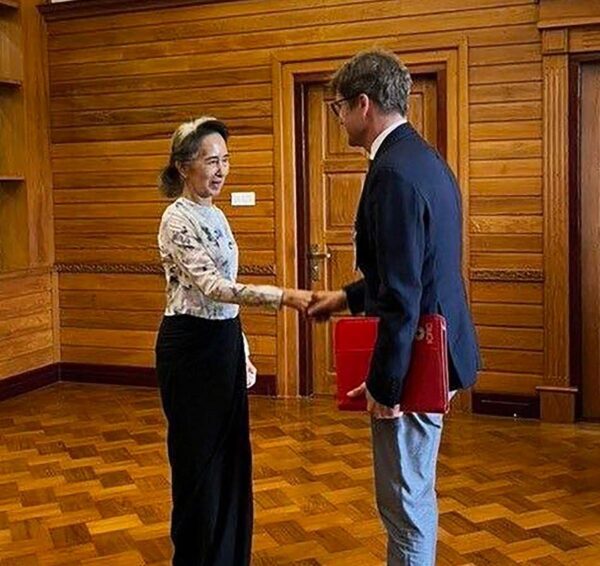
Aung San Suu Kyi Meets Red Cross Official Amid Junta's ASEAN Outreach
Diplomacy
2026年8月4日
5
The Diplomat Indonesia
Relations
🇮🇩Indonesia🇲🇲Myanmar🌐United Nations / ASEAN

General articles are free for 24 hours after publish.

Aung San Suu Kyi Meets Red Cross Official Amid Junta's ASEAN Outreach

Share
AI Summary

Myanmar's detained former leader Aung San Suu Kyi met with a representative from the International Committee of the Red Cross (ICRC). This move by the military junta is seen as an outreach to ASEAN for sanctions relief, but international skepticism remains.

Read The Diplomat, Know The Asia-Pacific The move is intended to weaken ASEAN’s determination to hold Myanmar to the Five-Point Consensus and widen the divisions between the bloc’s member states. Myanmar’s detained former leader Aung San Suu Kyi shakes hands with Arnaud de Baecque, resident representative of the International Committee of the Red Cross (ICRC) to Myanmar, in Naypyidaw, Aug. 3, 2026. Myanmar’s detained former leader Aung San Suu Kyi met yesterday with a representative of the International Committee of the Red Cross (ICRC), as coup leader-turned-president Min Aung Hlaing prepares to visit Thailand. The military-backed government yesterday released four photos of the 81-year-old meeting with an ICRC official, whom a government spokesperson identified as Arnaud de Baecque, the ICRC’s resident representative in Myanmar. The ICRC confirmed the meeting, stating that the visit was carried out in accordance with the organization’s standards and procedures for visiting people deprived of liberty. This “included the opportunity to speak with Daw Aung San Suu Kyi in private,” it stated. “In line with the ICRC’s working methods, detention visits provide people deprived of liberty with the opportunity to exchange news with their families,” it added. The ICRC did not reveal any details of what was discussed, but said that “observations and recommendations related to the visit are shared exclusively and confidentially with the detaining authorities.” In one of the photographs, Suu Kyi is seen shaking hands with de Baecque and sitting with him in a bare wood-paneled room with parquet floors, containing only two chairs and a coffee table. Another shows the deposed leader in another room cutting a birthday cake inscribed with the message “Happy Birthday Aunty Suu 19.6.2026.” These images are among just a handful that the military has released of Suu Kyi since she was removed from power in a military coup on February 1, 2021, just hours before she was due to be sworn in for a second term as Myanmar’s de facto leader. Since then, she has been in the military’s custody and is currently serving a lengthy prison term on a range of far-fetched charges, including incitement, corruption, election fraud, and violation of Myanmar’s Official Secrets Act. Suu Kyi’s meeting with the ICRC representative comes amid a push by the new military-backed government to normalize its relations with ASEAN and other important partners. In May, the authorities announced her relocation from prison to house arrest, alongside a broader amnesty of political prisoners. However, despite the release of one photo of Suu Kyi at the time, and assurances from Naypyidaw that she was in good health, many were skeptical. Suu Kyi’s son Kim Aris launched a “proof of life” campaign, demanding more substantial evidence of her health and physical condition, and there was growing international pressure, including from ASEAN, for access to the detained leader. Aris said in a statement that he welcomed the ICRC visit, which he described as “the first positive development” concerning his mother for more than five years. Although it was an important first step, he said, “it must not be the last.” “I hope this leads to further humanitarian progress, including direct contact with my mother, access for our family, credible and independently verified information about her wellbeing, and ultimately her immediate and unconditional release, together with all political prisoners,” he said. The Assistance Association for Political Prisoners likewise described the meeting as a “partial victory driven by collective pressure from domestic and international organizations,” including ASEAN, but said that Suu Kyi should be released immediately. “The military’s decision to permit access solely to the ICRC makes it very clear that she remains a prisoner,” it stated. (A Myanmar propaganda account on X made this point clear yesterday.) The timing and nature of the meeting are clearly intentional. Since assuming the office of president in April, Min Aung Hlaing has pushed hard for Myanmar’s reintegration into ASEAN. The 11-nation bloc has barred Myanmar from its summits since late 2021, over its failure to implement its Five-Point Consensus plan for resolving the country’s post-coup conflict, which involved pledges to cease violence, allow humanitarian access, and engage in political dialogue involving “all parties” to the country’s conflict. Min Aung Hlaing is set to visit Thailand this week, where he will no doubt seek to advance efforts at normalization. Over the past two years, Thailand has been a strong advocate of bringing Myanmar back into the “ASEAN family,” and helped broker an informal meeting between ASEAN’s foreign ministers and Myanmar Foreign Minister Tin Maung Swe in Bangkok on July 12. Sure enough, Thai Foreign Minister Sihasak Phuangketkeow said in a statement yesterday that he welcomed reports of the meeting and expressed “hope that the Government of Myanmar will undertake further positive steps towards lasting peace and stability in Myanmar.” In comments to the Straits Times, he added that the authorities in Myanmar “seem to be listening to our repeated urging that we need more positive developments on the Lady,” as Suu Kyi is known to many within Myanmar. He added, “It’s their way of responding to our concerns.” At the same time, however, Min Aung Hlaing has shown few signs that he is willing to make concessions. In a speech to parliament last week, he rejected ASEAN’s Five-Point Consensus, which the military-proxy parliament last month denounced as an unwarranted interference in Myanmar’s internal affairs. In early July, Myanmar’s government rejected a request by the current ASEAN special envoy, Philippine Foreign Secretary Ma. Theresa Lazaro, for “brief access” to Suu Kyi. In this context, providing limited access to the detained leader, albeit in a form that underlines her status as a prisoner, is a cost-free move intended to weaken ASEAN’s resolve to hold Myanmar to the Five-Point Consensus and widen the divisions between the bloc’s member states. The Myanmar military has long been aware of the potent symbolic power of Aung San Suu Kyi, and the ability to leverage this to its own advantage. In 2017, I argued that while the totemic Nobel laureate “was effective in rallying international opposition to Myanmar’s ruling generals, it also gave the latter an easy route back to legitimacy.” This small step will do nothing to shift the positions of the Western governments that have been most critical of Myanmar’s military since the coup. It is also unlikely to be enough to gain readmission to ASEAN, at least for now. Lazaro said last month that Myanmar’s full reintegration was “still far off” due to its lack of compliance with the Five-Point Consensus, and the bloc will clearly need to take a significant step in this direction if Myanmar is to fill its seat at the bloc’s next summit in November. But it

0

Original source

The Diplomat Indonesia

原文を読む