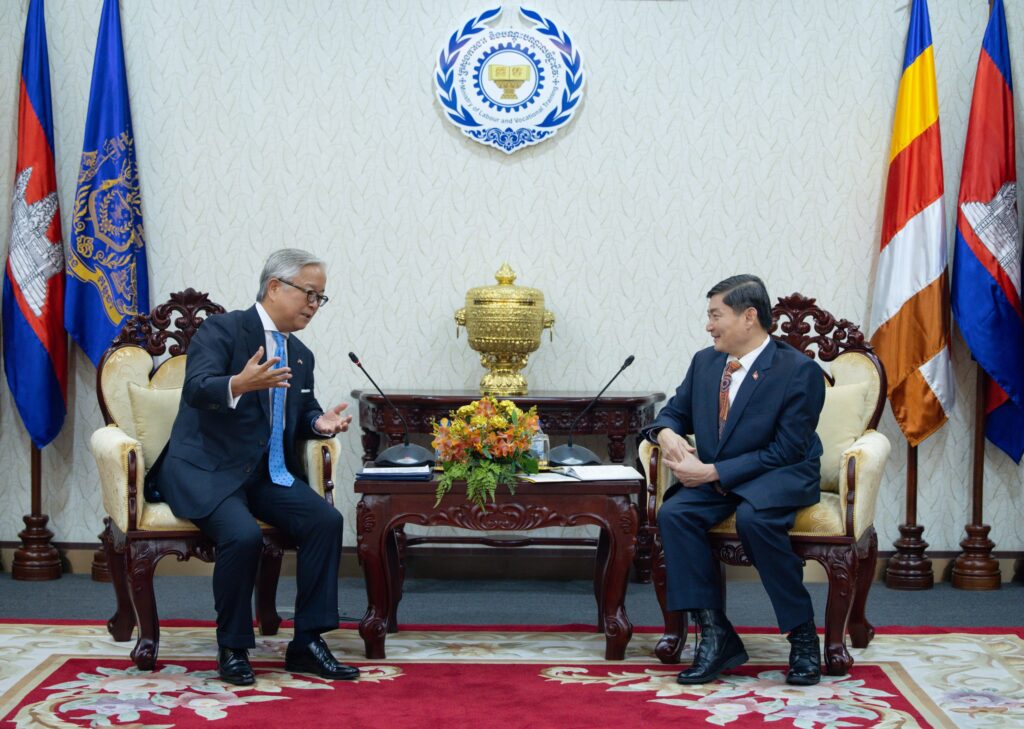
Cambodia Affirms Stronger Cooperation with Japan in Labor and TVET Sectors
Cambodian Minister of Labour and Vocational Training, Heng Sour, met with the Japanese Ambassador to Cambodia, expressing high appreciation for Japan's contributions in labor, social security, and Technical and Vocational Education and Training (TVET). Both nations affirmed their commitment to further strengthen cooperation under their comprehensive strategic partnership.
Phnom Penh – Mr. Heng Sour, Minister of Labour and Vocational Training, on the afternoon of July 14, 2026, received Mr. Ueno Atsushi, the outgoing Ambassador Extraordinary and Plenipotentiary of Japan to Cambodia, for a farewell meeting at the Ministry. Minister Heng Sour expressed his warm welcome and deep gratitude, highly valuing the numerous achievements realized during the Ambassador's tenure. He noted that these contributions have been instrumental in strengthening the long-standing friendship and cooperation between the two countries, particularly in the fields of labour, social security, and Technical and Vocational Education and Training (TVET). The Minister highlighted the significant role of the Japanese Embassy as a trusted bridge connecting the Ministry with the Japanese government, authorities, development agencies, employers, business associations, and other relevant institutions. He emphasized that the Ambassador's commitment to people-centered development has transformed the comprehensive strategic partnership into tangible benefits for students, trainees, and vulnerable communities in Cambodia. These individuals not only gain income from working in Japan but also have opportunities to enhance their knowledge for human resource development. Mr. Heng Sour pointed to key support from the Japanese government, including creating employment opportunities for Cambodian workers, developing the social security system, modernizing the TVET system, and providing assistance to former workers affected by the Cambodia-Thailand border crisis. He also acknowledged the provision of training equipment for electricity and engineering to several institutes. Furthermore, he recognized the collaboration with Japanese companies such as Toyota (Cambodia), the Japan-Cambodia Association, and the Japan Business Association in Cambodia (JBAC) for providing training, equipment, internships, and job opportunities to Cambodian youth. In response, Mr. Ueno Atsushi expressed his profound gratitude to the Royal Government of Cambodia, the Ministry of Labour and Vocational Training, and Minister Heng Sour personally for their full support and cooperation in all related endeavors during his mission in Cambodia since January 2023, which has yielded commendable achievements. Mr. Ueno also recalled the elevation of the relationship between the two countries to a Comprehensive Strategic Partnership, noting that cooperation under this framework is making significant progress across various sectors. While thanking the Minister for his attention and support to Japan and the Japanese community in Cambodia, Mr. Ueno requested that Minister Heng Sour continue to provide cooperation and support to the new Japanese Ambassador. This, he stated, is aimed at maintaining and further strengthening the excellent relations between the two countries. Concurrently, the Minister reaffirmed the Ministry's commitment to further enhancing close cooperation with the new Japanese Ambassador, focusing on mutual benefits. He also wished Mr. Ueno good health, happiness, and success in his future duties. Source: Kampuchea Thmey Local
多角的分析
日本はカンボジアのTVET分野への継続的な投資を通じて、現地労働者のスキル向上と雇用機会の創出を支援している。これは、カンボジアの人的資本開発と経済成長の促進に寄与する。特に、製造業やサービス業で求められる専門スキルの育成は、カンボジアの産業構造の高度化と、より付加価値の高い産業への移行を後押しする可能性がある。
日本からの技術・職業訓練(TVET)分野への支援は、カンボジアの労働力プールの質向上に繋がり、日本企業を含む外国からの直接投資(FDI)にとって魅力的な投資環境を醸成する。質の高い労働力は、生産性向上とコスト削減に直結するため、特に製造業や高度技術産業への投資を促進する要因となるだろう。
日本によるTVET分野への支援は、カンボジアの若者や脆弱なコミュニティに対し、具体的なスキル習得と雇用機会を提供する。これにより、貧困削減や社会経済的格差の是正に貢献する可能性がある。また、日本での就労機会は、カンボジア国内の労働市場への還流や、国際的な視野を持った人材育成にも繋がる。
カンボジア市民、特に若年層にとって、日本からのTVET支援は、より良い雇用機会と収入向上に直結する。日本での就労経験や習得したスキルは、帰国後のキャリア形成や国内経済への貢献に繋がる可能性がある。一方で、支援が特定の職業訓練に偏る場合、全ての市民が恩恵を受けられるとは限らないという課題も考えられる。
背景・歴史的文脈
カンボジアと日本の関係は、第二次世界大戦後、日本の経済復興と共に緊密化し、特に1990年代以降、ODA(政府開発援助)を通じたインフラ整備や人材育成支援が活発化した。カンボジアは、長年にわたり日本からの経済支援を重要な柱の一つとしており、特にインフラ、農業、そして近年では人的資本開発、特に技術・職業訓練(TVET)分野での協力が深化している。これは、カンボジアが経済発展を進める上で、国内の労働力強化が不可欠であるとの認識に基づいている。また、日本はカンボジアの主要な貿易相手国でもあり、両国は包括的な戦略的パートナーシップを締結している。
原文ソース
Kampuchea Thmey Local