General articles are free for 24 hours after publish.
Indonesia's Perspective: Pakistan's Lunar Ambitions and Their Implications
Pakistan's plan to send its lunar rover, Jinnah 1, to the lunar South Pole in 2029 signals its space ambitions, increased cooperation with China, and a new rivalry with India in space. This move could offer insights for Indonesia's own space development strategies and regional cooperation.
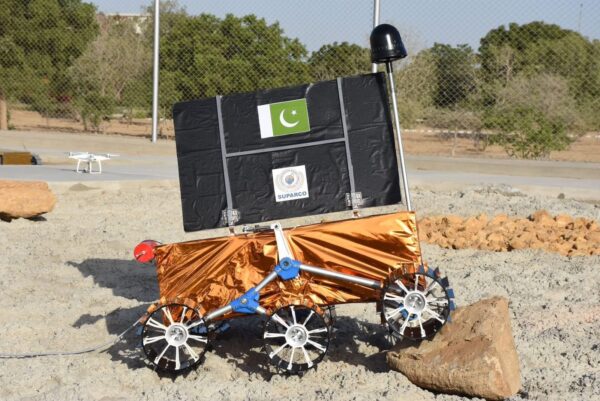
Read The Diplomat, Know The Asia-Pacific The Jinnah 1 mission signals increased cooperation with China and takes Pakistan’s rivalry with India to new heights – literally. An early prototype of the track system for Pakistan’s first lunar rover, dubbed the Jinnah 1. The lunar South Pole has emerged as a major focus of international space exploration due to its scientific potential. In view of this, Pakistan has also decided to send its own scientific mission there. The country’s first indigenous lunar rover, Jinnah 1, will head to the Moon’s South Pole in 2029 aboard China’s Chang’e 8 mission. Pakistan’s decision to undertake a lunar mission reflects three key perspectives. First, the gesture is symbolic as Islamabad also wants to be among the group of elite member countries conducting scientific research on the Moon, indicating its growing interest in the space sector. Second, the mission signals the revival of an old rivalry on the Moon, as India reached the lunar South Pole with Chandrayaan 3 in 2023. Lastly, Jinnah 1 illustrates increasing cooperation between Pakistan and China in the space domain. Jinnah 1 aims to explore and study the geological characteristics of the lunar surface and conduct key experiments for future lunar research. The rover is likely to weigh around 35 kg and have an expected price tag of approximately 400 million rupees ($1.4 million). It will have a panoramic camera, ground-penetrating radar, and a device to analyze minerals in lunar soil using infrared spectroscopy. It will also be equipped with a device for taking soil samples, analyzing and separating the noble gases contained therein, and storing them. Before analyzing why Pakistan decided to send its own lunar mission, it is equally important to understand why different states are sending their own expeditions to the Moon’s South Pole. The region is believed to be suitable for long-term human habitation due to its vast, untapped ice reserves. If the surface contains large quantities of ice, it can be used not only to produce hydrogen fuel for deep-space propulsion but also to provide drinking water for humans residing there. This will exponentially reduce costs for future lunar and interplanetary explorations. Moreover, it is also an area with elevated ridges, making it an ideal site for generating solar power and for constructing permanent structures that support human presence on the Moon. Jinnah 1 reveals Pakistan’s renewed interest in the space sector and the country’s desire to become part of the leading states carrying out activities on the Moon for peaceful purposes. The country is taking this seriously as Pakistan seeks to broaden its space cooperation, using science, research and technology partnerships to build a knowledge-based economy and develop a new generation of engineers, scientists and innovators. For instance, Pakistan’s senior government minister, while meeting with aerospace companies during a visit to Houston in July 2026, aimed to deepen the country’s collaboration with the U.S. space agency, NASA. He said that Pakistan aims to launch its first national mission to the Moon by 2035 as part of a broader drive to advance the country’s space program. The landing of Chandrayaan 3 near the lunar South Pole in August 2023 made India the fourth country to achieve a soft landing on the Moon and the first to land near the South Pole. The achievement generated domestic and international recognition. Jinnah 1’s targeting of the same lunar South Pole is not coincidental. The rivalry between India and Pakistan – which has been fought on land, in the air, over water, and in the domain of nuclear deterrence – has now acquired a new frontier. The rover’s name, invoking the founder of Pakistan, is deliberately juxtaposed with an Indian achievement named after Vikram Sarabhai (India’s Vikram lander). The announcement of Jinnah 1 also confirms that cooperation between China and Pakistan extends beyond the military domain, as evidenced by deepening bilateral ties in space exploration. This is not the first space collaboration between the two “iron brothers.” China has launched various Pakistani satellites into space, including the country’s inaugural lunar satellite, ICUBE-Q and the indigenous electro-optical satellites E0-1, E0-2, E0-3, and PRSS-1 – all in the last two years. Besides, earlier this year, two Pakistani astronauts completed advanced assessments in China for a human spaceflight mission. One of them is expected to travel to Tiangong, China’s space station, later this year. Pakistan was also the first country to deploy and benefit from the Chinese navigation system Beidou. China-Pakistan space cooperation, in short, is a manifestation of the peaceful use of space technologies. Space cooperation between Beijing and Islamabad is likely to increase in an unprecedented manner given the trajectory of their current joint endeavors. For Pakistan, the sector offers more than pure scientific exploration. Space-based assets can provide assistance and solutions to Islamabad’s environmental challenges as the country faces severe impacts from climate change despite contributing less than 1 percent of global emissions. Jinnah 1’s journey to the lunar South Pole in 2029 reiterates Pakistan’s official stance of exploring celestial bodies for peaceful purposes and refraining from any action that could lead to the militarization of space. The mission signals that Islamabad’s ambitions in space are anchored in scientific contribution rather than in staking a geopolitical claim over the untapped resources present on the Moon. Subscribe today and join thousands of diplomats, analysts, policy professionals and business readers who rely on The Diplomat for expert Asia-Pacific coverage. Get unlimited access to in-depth analysis you won't find anywhere else, from South China Sea tensions to ASEAN diplomacy to India-Pakistan relations. More than 5,000 articles a year. Already have an account? Log in. Usman Haider has an MPhil degree in Strategic Studies from the National Defense University, Islamabad, Pakistan. His articles have been published in The Diplomat, Australian Institute of Affairs, South Asian Voices, South China Morning Post, Real Clear Defense, and many others. Abdul Moiz Khan works as a research officer at Center for International Strategic Studies, Islamabad. Get briefed on the story of the week, and developing stories to watch across the Asia-Pacific.
Original source
The Diplomat Indonesia