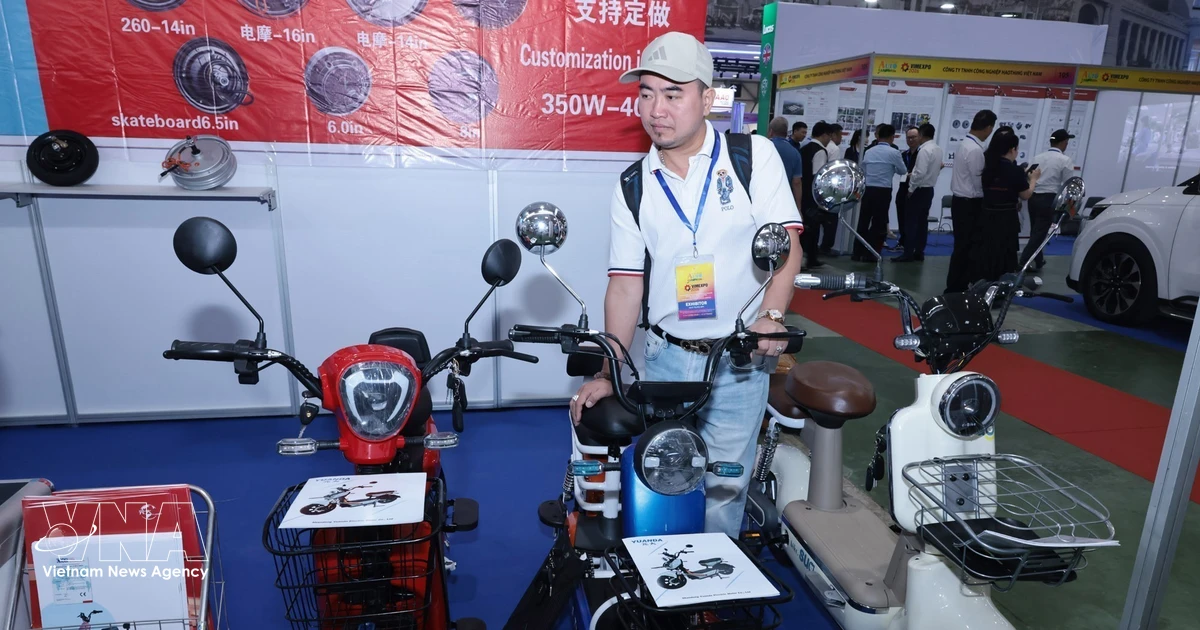
Vietnam's Motorcycle Market Shifts to Multi-Technology Competition
Vietnam's motorcycle market is transitioning from traditional gasoline models to electrification, entering an era of diverse technological competition. VinFast is expanding its electric motorcycle production, supporting the shift towards cleaner transportation. While overall motorcycle sales show a slight decline, automobile sales are on an upward trend.
The one-millionth vehicle, a red Feliz II, rolled off the production line at VinFast’s electric automobile and motorcycle manufacturing complex in the northern port city of Hai Phong. The company said the broader footprint would improve access to electric vehicles and support the country's transition toward cleaner transport. According to the firm, total motorcycle sales reached 169,976 units in May, down 3.9% year-on-year. Meanwhile, automobile sales rose 26% from the same period last year to 1,870 units. Despite headwinds from Middle East tensions that have pushed up freight and logistics costs, exports of wood and wood products were estimated at 1.53 billion USD in June, lifting first-half export turnover to 8.54 billion USD, up 4.4% from a year earlier, according to the Ministry of Agriculture and Environment (MAE). Despite the encouraging performance, Vietnam's exports remain heavily dependent on a limited number of major markets and product groups, while the domestic value added of many export products remains relatively low because of their reliance on imported raw materials and components. Speaking at the at the city's regular socio-economic press briefing on July 9, Deputy Head of the Ho Chi Minh City Export Processing and Industrial Zones Authority (HEPZA) Tran Viet Ha said that foreign direct investment (FDI) accounted for nearly 1.6 billion USD of the total, including 65 newly licensed projects worth more than 867 million USD and 83 existing projects that added over 707 million USD in registered capital. With the current trading band of +/- 5%, the ceiling rate applicable for commercial banks during the day is 26,475 VND/USD, and the floor rate 23,953 VND/USD. The initiative marks a shift from traditional investment promotion toward a digital ecosystem that standardises information and provides transparent connections with investors worldwide. Textile and seafood exporters are struggling to retain enough workers to meet recovering export demand, underscoring a shift in constraints from demand to workforce capacity. National flag carrier Vietnam Airlines will increase frequencies on several routes to Japan, the Republic of Korea (RoK) and Taiwan (China) to meet rising demand for tourism, business and family visits between Vietnam and Northeast Asia. Israeli businesses and experts introduced a wide range of technologies and solutions for sustainable agricultural development, including smart irrigation systems, greenhouse technologies, crop varieties, microbial technologies, post-harvest solutions, aquaculture technologies, and digital transformation in agriculture. The maximum retail price of E5RON92 was set at 19,191 VND (0.73 USD) per litre, down 539 VND from the previous ceiling and 812 VND lower than E10RON95-III. The latter was capped at 20,003 VND per litre, a decrease of 412 VND. The recognition marks a significant milestone for Vietnam’s maritime industry as it advances the development of smart, green ports and sustainable logistics. Singapore-based United Overseas Bank (UOB) has sharply raised its forecast for Vietnam's 2026 GDP growth to 8.5%, more than reversing the previous downgrade to 7%, citing stronger-than-expected first-half economic performance driven by manufacturing, investment and foreign direct investment (FDI). PM Le Minh Hung said the fulfilment of the capital disbursement target should become a key criterion in evaluating the performance of ministries, sectors and local authorities. Da Nang is pursuing a next-generation IFC focused on innovation, fintech and sustainable finance, concentrating on high-value segments rather than a traditional fully integrated financial-centre model. Instead of concentrating mainly on attracting foreign capital, Resolution No. 10-NQ/TW emphasises building a foreign-invested sector that is closely integrated with the domestic sector to create new growth drivers for the country. Vietnam is projected to remain the fastest-growing economy in Southeast Asia, with the Asian Development Bank (ADB) maintaining its growth forecasts of 7.2% for 2026 and 7.0% for 2027 in its Asian Development Outlook (ADO) July 2026 released on July 8. Vietnam currently has about 17,400 OCOP products rated three stars or above. The figure is set to increase to around 25,000 by 2030, with greater emphasis on improving quality, adding value and enhancing competitiveness rather than simply expanding the number of products. Vietnam currently has 130,571 rental housing units under construction. A review of national rental housing demand will be completed before the construction ministry assigns specific targets to provincial governments. India remained the largest supplier, with the value reaching 63.2 million USD, representing around 52% of Vietnam's total diamond imports. Speaking at the opening ceremony at Staybridge Suites London-Vauxhall in Lambeth, Vietnamese Ambassador to the UK Do Minh Hung said bilateral ties have developed strongly in recent years, culminating in the establishment of a Comprehensive Strategic Partnership during Party General Secretary To Lam’s official visit to the UK in October last year. The meetings with AFD and EDF were seen as an important step in deepening ties between Quang Ngai and French partners as the province enters a new phase of development. Through broader international cooperation, Quang Ngai aims to attract more capital, technology, management expertise and training resources to advance green industry, clean energy and sustainable infrastructure, strengthen competitiveness and move toward becoming a major industrial, energy and logistics hub in central Vietnam and the country. Copyright, VietnamPlus, Vietnam News Agency (VNA) Editor-in-chief, Mr. Tran Tien Duan.
多角的分析
ベトナムの二輪車市場における電動化へのシフトは、単なる技術革新に留まらず、エネルギー転換政策との連動、および国内のインフラ整備状況と密接に関連している。VinFastのような国内メーカーの積極的な投資は、サプライチェーンの国内化と高付加価値化を促す可能性を秘めているが、同時に、充電インフラの普及度や電力供給能力、そして消費者の価格受容性といった課題も浮き彫りにする。過去の事例では、新興国における自動車市場の電動化は、政府の補助金政策や国際的な環境規制の強化によって後押しされてきたが、ベトナムにおいては、これらの外部要因に加え、国内の所得水準と購買力という内部要因が、移行のペースを決定づける重要な要素となるだろう。
ベトナムの二輪車市場における電動化への移行は、投資家にとって新たな機会とリスクの両方をもたらす。VinFastのような先行企業への投資は、成長ポテンシャルが高い一方で、技術開発競争の激化、サプライチェーンの不安定性、そして政府の政策変更リスクに直面する可能性がある。また、既存のガソリン二輪車メーカーや部品サプライヤーは、事業転換を迫られるため、投資ポートフォリオの見直しが必要となる。過去の事例では、新興国市場における技術シフトは、初期段階での先行投資が大きなリターンを生む一方で、失敗した場合の損失も大きい傾向にある。投資家は、市場の成熟度、技術の普及速度、そして政府の支援策を慎重に見極める必要がある。
二輪車市場の電動化は、ベトナムの都市部における大気汚染の軽減や、静かでクリーンな交通環境の実現に貢献する可能性がある。しかし、電動二輪車の普及には、初期費用の高さ、充電インフラの整備、そしてバッテリー交換・充電インフラの地域格差といった課題が伴う。特に地方部や低所得者層にとっては、ガソリン車に比べて初期投資が大きく、利用可能な充電ステーションが限られていることが、普及の障壁となる可能性がある。また、電動二輪車のメンテナンスや修理に関する技術者の育成も、社会的な課題として挙げられる。過去には、都市部での交通渋滞緩和や環境改善を目的とした政策が、住民の生活様式に大きな変化をもたらした事例もあり、今回の電動化シフトも同様の影響を与えると考えられる。
二輪車市場の電動化は、ホーチミン市やハノイ市のような大都市の住民にとって、よりクリーンで静かな通勤環境をもたらす可能性がある。VinFastのFeliz IIのような電動スクーターの生産拡大は、環境意識の高い層や新しい技術に関心のある層にとって魅力的だろう。しかし、多くのベトナム市民、特に地方部や低所得層にとっては、電動二輪車の初期費用や充電インフラの不足が、購入の大きな障壁となる。ガソリン価格の変動に左右されないというメリットはあるものの、自宅や職場での充電環境の整備、バッテリーの寿命や交換コストなども、市民が購入を検討する上で重要な要素となる。過去には、都市部での公共交通機関の整備が、市民の移動手段に変化をもたらしたように、電動二輪車の普及は、都市部と地方部での生活実感に格差を生む可能性も指摘されている。
背景・歴史的文脈
ベトナムにおける二輪車は、長年にわたり主要な交通手段であり、国民生活に不可欠な存在であった。特に都市部では、交通渋滞の主要因ともされてきた。近年、ベトナム政府は、環境問題への意識の高まりと国際的な潮流を受け、クリーンエネルギーへの移行を国家戦略として推進している。2022年には、2050年までのカーボンニュートラル達成目標を掲げ、再生可能エネルギーの導入拡大や、自動車・二輪車の電動化を奨励する政策を打ち出してきた。VinFastのような国内企業による電動二輪車・自動車への大規模投資は、こうした政府の政策的後押しと、国内外からの投資を呼び込むための競争力強化策の一環として位置づけられる。この動きは、従来のガソリンエンジン技術への依存から脱却し、新たな産業構造を構築しようとするベトナムの意欲を示している。
原文ソース
VietnamPlus English